
Sync licensing fees typically range from a few dollars for small social or indie video placements to tens or even hundreds of thousands for a national ad campaign. The final number always hinges on term, territory, exclusivity, and prominence, and there is no fixed rate card because fees are negotiated case by case. The biggest trap for independents: a deal isn't real until both the composition and the recording are cleared, which means two licenses, not one.
TL;DR:
- Sync licensing fees vary greatly depending on the scope, with national campaigns exceeding $100,000 and social media use often under $1,000.
- The final fee is primarily influenced by terms, territory, exclusivity, and prominence, with exclusive licenses and wider territories commanding higher prices.
- Independent artists owning both rights can issue a single license, simplifying negotiations and potentially increasing earnings.
- Both a sync license for the composition and a master use license for the recording are required to legally clear a music placement.
- Building relationships, ensuring rights clarity, and understanding market rates are essential for successful and profitable sync licensing.
Table of Contents
- What Do Sync Licensing Fees Actually Look Like?
- What Contract Terms Actually Move the Price?
- Why Do You Need Two Separate Licenses?
- How Much Should You Charge by Media Type?
- How Should Independent Artists Price Their Songs?
- Who Finds the Deal, and Who Actually Pays?
- What Happens to Royalties After the Sync Fee Is Paid?
- A Pre-Licensing Checklist Before You Pitch
- What Contract Clauses Change Your Sync Fee?
- Does Genre or Artist Profile Change the Fee?
- Major Label vs. Independent: How Do Fee Structures Differ?
- How Do Duration and Format Affect the Price?
- What Legal Risks Come With Sync Deals?
- How Are Streaming and New Media Changing Sync Rates?
- Priorities for Independents Chasing Sync Deals
- Where Independent Artists Can Find Real Sync Opportunities
- Sources
What Do Sync Licensing Fees Actually Look Like?
A sync fee is the price a music supervisor, brand, or filmmaker pays to pair a song with visual media. It sits alongside a separate payment called a master use fee, which covers the specific recording. Together they form the full clearance package, and skipping either one is the fastest way to get a placement pulled after it airs.
Fee bands cluster by media type and audience size, but they overlap more than most guides admit. A scrappy YouTube channel with 40,000 subscribers might pay the same for a track as a well funded indie film, while a regional TV spot can cost less than a viral social ad if the brand has a small budget. What matters more than the platform is the deal's scope: how long the music runs, where it can air, and whether the buyer wants the door closed to everyone else.
Here's a working reference for common use cases, compiled from published industry rate guides:
| Use Case | Typical Fee Range | What Drives the Top End |
|---|---|---|
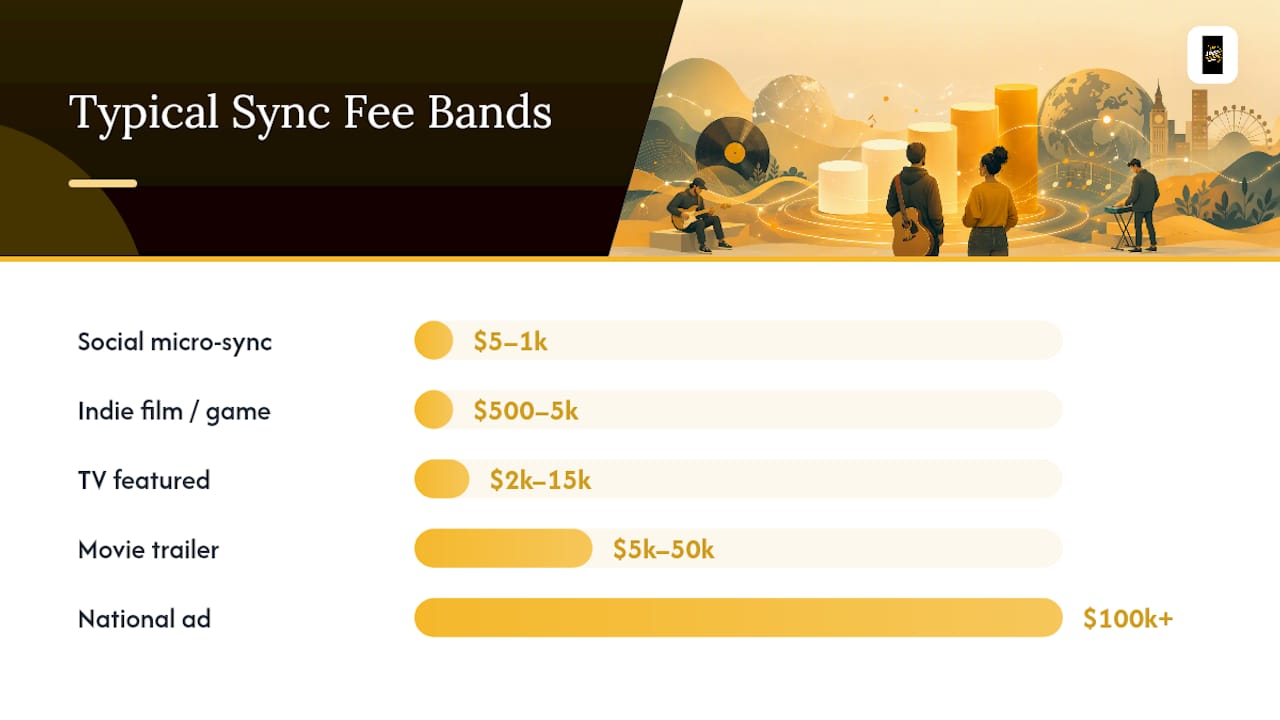
| Social media / micro-sync | $5–$1,000 | Follower count, brand deal size |
| Indie film or video game | $500–$5,000 | Festival run, game budget, exclusivity |
| TV background placement | $1,000–$5,000 | Show reach, network tier |
| TV featured placement | $2,000–$15,000+ | Screen time, dialogue-free scenes |
| Streaming series | ~$3,000–$50,000 | Platform size, episode prominence |
| Regional ad campaign | $2,000–$20,000 | Airtime length, market size |
| National ad campaign | $100,000+ | Brand budget, exclusivity term |
| Movie trailer | $5,000–$50,000+ | Studio size, theatrical vs. streaming |
These bands come from rate-card style industry guides that track how supervisors and libraries actually price deals, not theoretical ceilings. A "featured" placement (the song plays audibly, often with a scene built around it) commands more than "background" use (music under dialogue, barely noticeable) because the audience actually hears and remembers it. Trailers pay well because they run everywhere at once, often across broadcast, streaming, and social simultaneously, which multiplies the value of every second of music used.
Pro Tip: Screenshot or bookmark this table before your first negotiation. Supervisors respect artists who know the market rate walking in, and it stops you from underpricing a featured TV placement because you assumed all TV pays the same.
What Contract Terms Actually Move the Price?
Four levers push a sync fee up or down more than anything else: term, territory, exclusivity, and prominence. Understanding each one turns a vague "what should I charge" question into a specific number.
- Term is how long the license lasts. A one-year license costs less than a perpetual one, because the buyer is renting the song rather than owning the right to use it forever.
- Territory defines where the placement can run. A license limited to the UK costs a fraction of a worldwide license, since a global buyer is paying for reach across every market at once.
- Exclusivity blocks you from licensing the same song to a competing brand or category during the term. Exclusive deals routinely command two to five times the fee of a non-exclusive one, because the buyer is also purchasing your silence toward their rivals.
- Prominence measures how audible and central the music is. Featured use in a hero moment pays more than the same track buried under dialogue in a background scene.
A buyout, where the client pays one lump sum for unlimited perpetual use with no future payments to you, always costs more upfront than a limited-term deal, because you're giving up all future negotiating leverage in exchange for certainty now. The four levers most guides agree matter most are term, territory, exclusivity, and prominence, and negotiating any one of them independently can shift a quote significantly.
Pro Tip: If you wrote the song and recorded it yourself, you control both the composition and the master. That means you can quote one combined fee instead of forcing a buyer to chase two separate rights holders, which makes your song easier to license than a track split across a label and a publisher who don't return emails.
Why Do You Need Two Separate Licenses?
Every sync deal actually requires two distinct permissions, and missing either one leaves the placement legally exposed. A sync license clears the composition, meaning the underlying melody and lyrics, and is issued by whoever owns the publishing (often the songwriter or their publisher). A master use license clears the specific recording, and is issued by whoever owns that recording (often the artist or their label). Gov confirms that both clearances are typically required before a piece of music can be lawfully synced to visual media.
For an independent artist who wrote, performed, and self-released a track, this is good news: you likely hold both rights and can issue one combined license. For anyone who used a co-writer, a session musician, or a distributor with a publishing arm, it gets more complicated fast.
To clear a song properly, gather this before you quote a price:
- The exact usage: where the video or ad will run, for how long, and starting when.
- The territory the client needs covered, since a worldwide license costs more than a single-country one.
- The client's name and the production or brand behind the request, so you can check their budget tier.
- Confirmation of who else holds a piece of the composition or master, especially co-writers or sampled material.
Watch for a few red flags before you sign anything. Split ownership among multiple writers means you need sign-off from everyone, not just yourself. Uncleared samples in your track can void the whole license after the fact. And if a session player performed on the recording without a signed work-for-hire agreement, they may retain a claim on the master that surfaces only after a supervisor asks for proof of clearance. A guide to the clearance process walks through exactly what documentation to have ready before you pitch.
How Much Should You Charge by Media Type?
The fee bands above give you a starting range, but real deals cluster around specific numbers once you know the format. A short-form social clip for a small creator brand often lands between $5 and $1,000, and most of that variance comes down to whether the creator has 5,000 followers or 500,000. An indie film with a modest festival budget typically pays $500 to $5,000 per song, with the higher end reserved for a needle-drop moment that anchors a key scene.
Television splits sharply by prominence. Background use, the kind that plays under a montage or a transition, tends to sit in the $1,000 to $5,000 range. A featured placement, where a character mentions the song or it plays over a pivotal moment, can run $2,000 to $15,000 or more depending on the network's audience size. Streaming series placements vary the most, from roughly $3,000 up to $50,000, because platform reach differs wildly between a niche documentary and a flagship drama.
Advertising pays the best and the most unpredictably. A regional campaign for a local business might offer $2,000 to $20,000, while a national campaign for a recognized brand often opens the conversation in the five figures and can exceed $100,000 once exclusivity and worldwide territory get added to the term. Movie trailers behave similarly. They run everywhere, often for months, so studios routinely pay $5,000 to $50,000 or more for the right track.
A few patterns push any of these numbers well past the stated range:
- A brand campaign that demands category exclusivity, meaning no competitor can use your song, adds a substantial premium.
- Worldwide territory instead of a single country roughly doubles or triples the quote in most negotiations.
- A song that becomes the campaign's signature track, appearing across TV, digital, and social simultaneously, can justify pricing well above a single-platform placement.
There is genuinely no statutory ceiling on sync fees; global campaigns for major brands have paid six and seven figures for the right song at the right emotional moment.
How Should Independent Artists Price Their Songs?
Pricing a sync deal without a framework is guesswork. Work through these steps in order every time a request comes in:
- Identify the prominence. Is your song the emotional centerpiece of the scene, or quiet background texture? This alone can double or halve a fair asking price.
- Confirm the territory. Ask directly whether the client needs one country or worldwide rights. Never quote a global fee for what turns out to be a single-market ad.
- Nail down the term. A three-month digital campaign and a five-year broadcast license are not the same product, even if everything else matches.
- Ask about exclusivity. If the client wants to lock out competitors in your genre or category, that's worth two to five times a non-exclusive quote.
- Size the budget proxy. A local coffee shop and a national retailer are not shopping in the same range, and it's fair to ask about the production's overall budget before quoting.
For independents just starting to license music, a reasonable starter range for social and micro-sync use sits around $50 to $500, while indie film and small brand work can reasonably start at $500 to $2,000 once you factor in a bit of prominence. Use those numbers as an anchor, not a ceiling: if the client comes back with a bigger budget signal, revise upward before you sign anything.
If you own both composition and master, package them as a single combined fee rather than pricing them separately. It's simpler for the buyer and often nets you more than splitting the negotiation into two smaller conversations. For artists with a heavy back catalog and modest current bargaining power, a lower-cost non-exclusive license can also generate repeat business from the same production company, which beats chasing one large exclusive deal that never materializes.
Pro Tip: Take a buyout only when the fee reflects a true worldwide, perpetual, exclusive rate, since you're giving up all future income from that use. If the client's budget can't stretch that far, insist on a lower upfront fee plus registered performance royalties instead, which keeps money coming in every time the placement airs.
Who Finds the Deal, and Who Actually Pays?
Placements come from a handful of predictable sources: music supervisors working a specific film or show, sync licensing libraries that pitch catalogs on your behalf, direct outreach from a brand or agency, and platform tools like YouTube's Creator Music, which lets creators license tracks directly with upfront pricing or revenue-share terms built into the upload flow.
Once a supervisor or client picks your track, the process usually moves like this:
- The client or their agency requests a quote, describing usage, term, territory, and exclusivity.
- You (or your publisher and label, if you have them) counter with a fee based on those specifics.
- Once both sides agree, a license agreement gets signed, naming both the sync and master rights.
- The client pays the agreed fee upfront, typically before or shortly after the placement airs.
- If the use triggers performance royalties, those get tracked and paid later through your performing rights organization, separate from the upfront check.
The production or brand's client always pays the licensing fee itself. Your PRO handles the separate backend royalty stream once the placement is public. Before sending a quote, have a licensing packet ready: clean stems if requested, a signed split sheet showing every writer's share, your contact and rights information, and confirmation of who else needs to sign off. A playbook for reaching music supervisors covers how to make that first pitch land instead of getting buried in an inbox.
What Happens to Royalties After the Sync Fee Is Paid?
The sync fee is only the first check. A separate, ongoing revenue stream, performance royalties, kicks in every time the placement actually airs on broadcast or certain streaming platforms, and it's collected independently of the upfront licensing deal.
Your performing rights organization, PRS in the UK or SOCAN in Canada as one comparable example, tracks the airing and distributes royalties on its own schedule, typically on a quarterly cycle. This only happens if you're registered as a writer with a PRO and the specific placement is logged with a cue sheet.
- The upfront sync fee and the backend performance royalty are two entirely separate payments from two different sources.
- A full buyout typically eliminates future performance royalty potential for that specific use, since the buyer has paid once for unlimited rights.
- Registering with a PRO before you pitch, not after a deal closes, prevents missed royalty windows on a placement that starts airing quickly.
Some professional bodies publish reference rates for members to anchor these conversations. The Musicians' Union offers sync rate guidance specifically to help music users and members understand fair pricing before a deal gets signed, which is worth checking against any quote that feels off.
A Pre-Licensing Checklist Before You Pitch
Get these in order before a supervisor or brand ever asks:
- Confirm exactly who owns the composition and the master, and get every co-writer's split documented in writing.
- Register as a writer with a performing rights organization if you haven't already.
- Prepare clean, mastered audio and instrumental or a cappella stems in case a client needs them.
- Gather your metadata, including ISRC and UPC codes, so a placement can be tracked and paid correctly.
- Get signed consent from any session musicians who performed on the recording.
Clear metadata and documented splits routinely speed up negotiations and make buyers more comfortable offering a fair number instead of a lowball, defensive one. A guide to prepping tracks for sync platforms walks through tagging and formatting details that make your catalog easier for a supervisor to search and license quickly.
What Contract Clauses Change Your Sync Fee?
Beyond the headline number, a handful of clauses buried in the license agreement can quietly reshape what you actually earn. An exclusivity period, often 90 days to a year, restricts you from licensing the same track to a competing brand or category during that window, and it should always carry a higher fee than a non-exclusive grant. Renewal options let the buyer extend the license at a pre-agreed rate rather than renegotiating from scratch, which favors the buyer unless you build in a step-up price for each renewal term. Termination conditions specify what happens if the production gets shelved or the campaign ends early. Some agreements still owe you the full fee regardless of whether the final product ever airs, and that clause is worth insisting on rather than assuming.
Watch for "most favored nations" language too, which promises you the same rate as any other artist licensed for the same project. It sounds fair, but only if you know what everyone else is actually being paid, so ask. Renewal and option clauses deserve particular scrutiny from independent artists, since a client locking in a low introductory rate with unlimited renewal rights can end up paying you the same fee for years while the project's reach and revenue keep growing.
Does Genre or Artist Profile Change the Fee?
Genre affects sync pricing mostly through demand and fit, not any formal scale. Instrumental and ambient music tends to license cheaply and often, because it fits under dialogue in almost any scene without competing for attention. Vocal-driven pop and hip-hop can command higher fees for featured placements, but they're also pickier fits, since lyrics have to match a scene's tone exactly.
Artist profile matters more in negotiating leverage than in any fixed rate. A completely unknown independent artist typically has less pricing power on a first deal, since supervisors have no track record to justify a premium. An artist with a modest but visible following, verified streaming numbers, or a chart placement through a platform built for unsigned talent has something concrete to point to when a client questions the asking price. That's part of why building a documented track record, even a regional or genre-specific one, pays off well before the first sync inquiry ever arrives.
Major Label vs. Independent: How Do Fee Structures Differ?
A major label catalog often commands a premium simply because of brand recognition and star power, and a supervisor pitching a splashy campaign might justify paying six figures for a known hit specifically because the artist's name carries marketing value beyond the music itself. Independent artists rarely compete on that axis, and shouldn't try to.
What independents can offer instead is speed, flexibility, and simpler rights. A major label deal often routes through multiple layers of business affairs, legal review, and label approval, which can take weeks. An independent artist who owns both composition and master can often turn around a signed license in days. Independent pricing also tends to be more negotiable in real time. A label's rate card is often close to fixed once a deal desk sets it, while an unsigned artist has room to trade a lower fee for a faster yes, or a smaller upfront number in exchange for keeping full performance royalty potential.
How Do Duration and Format Affect the Price?
A fifteen-second social clip and a two-minute broadcast spot are different products, even using the identical song. Shorter usage, especially under fifteen seconds, generally commands a lower fee because less of the song plays and the exposure window is brief. A full one-to-three-minute sync, common in film and TV, uses far more of the composition and typically pays proportionally more.
Broadcast time works the same way in reverse for airtime volume. A single airing during a niche late-night program costs less than a spot scheduled to run during a high-viewership event, because total audience exposure, not just clip length, drives value. Online video length interacts with platform algorithms too: a longer sync inside a video that's expected to run for years on a brand's channel justifies a higher fee than the same clip in a campaign built to disappear after one news cycle.
What Legal Risks Come With Sync Deals?
Most sync disputes trace back to incomplete clearance rather than dishonest actors. The most common failure is licensing only one half of the two required rights, say, clearing the master through a label but never confirming the publisher signed off on the composition, which can trigger a takedown or a lawsuit after the placement is already public.
Sampling adds another layer of risk. If your track contains an uncleared sample, any sync license you issue is built on a shaky foundation, and the original rights holder can pursue a claim against both you and the client who licensed your song in good faith. Session musician agreements matter for the same reason: if a player performed without a signed work-for-hire release, they can assert a claim on the master years later, long after a sync fee has already been paid and spent.
When in doubt on a legal question specific to your catalog or a particular deal, GOV.UK's music licensing guidance is a solid starting point, though a complicated ownership dispute usually calls for a music attorney rather than a blog post.
How Are Streaming and New Media Changing Sync Rates?
Streaming series have pushed sync budgets in two directions at once. Flagship shows on major platforms now negotiate placements that rival theatrical film budgets, while the sheer volume of new streaming content has also created demand for cheaper, high-volume licensing to fill hours of background music across smaller shows and documentaries.
Platform-native tools are reshaping the low end of the market fastest. YouTube's Creator Music lets creators license tracks directly inside the upload flow, with upfront pricing or revenue-share terms clearly listed before a video goes live, which has made micro-sync licensing faster and more transparent than the traditional supervisor pitch. That transparency is putting gentle downward pressure on rock-bottom social fees, since creators can compare listed prices instantly, but it's also opening a channel that didn't meaningfully exist a decade ago. Short-form video platforms have normalized brief, low-cost syncs as a category of their own, distinct from the traditional film-and-TV pipeline, and that category is only growing as more brands build entire campaigns around short-form content instead of traditional broadcast.
Priorities for Independents Chasing Sync Deals
If there's one thing this guide should leave you with, it's this: pricing knowledge matters less than most artists assume, and rights clarity matters more. A supervisor with a tight deadline will pass over a perfect song with murky ownership in favor of a mediocre one they can clear in an hour. Get your splits documented and your PRO registration current before you ever pitch, not after someone bites.
Realistic pricing is the second priority, and it cuts both ways. Undercharging a featured TV placement because you didn't know the market rate leaves real money on the table. Overcharging a small indie filmmaker because you anchored on a six-figure ad campaign number kills a deal that could have built a relationship for years. Know which band your specific opportunity falls into before you name a number.
The most overlooked priority is relationships. Music supervisors work fast, reuse artists who were easy to deal with, and remember who sent a clean, complete licensing packet versus who took three weeks to find a signed split sheet. Metadata and readiness aren't administrative afterthoughts. They're often the actual deciding factor between two songs that sound equally right for a scene.
— Jason
Where Independent Artists Can Find Real Sync Opportunities
Building a sync career from scratch usually means cold-emailing supervisors or gambling on stock libraries that pay a fraction of what your song is worth. A platform can put your music in front of industry professionals, including labels and scouts, through a chart system built on genuine listener engagement rather than industry contacts or promotion spending.
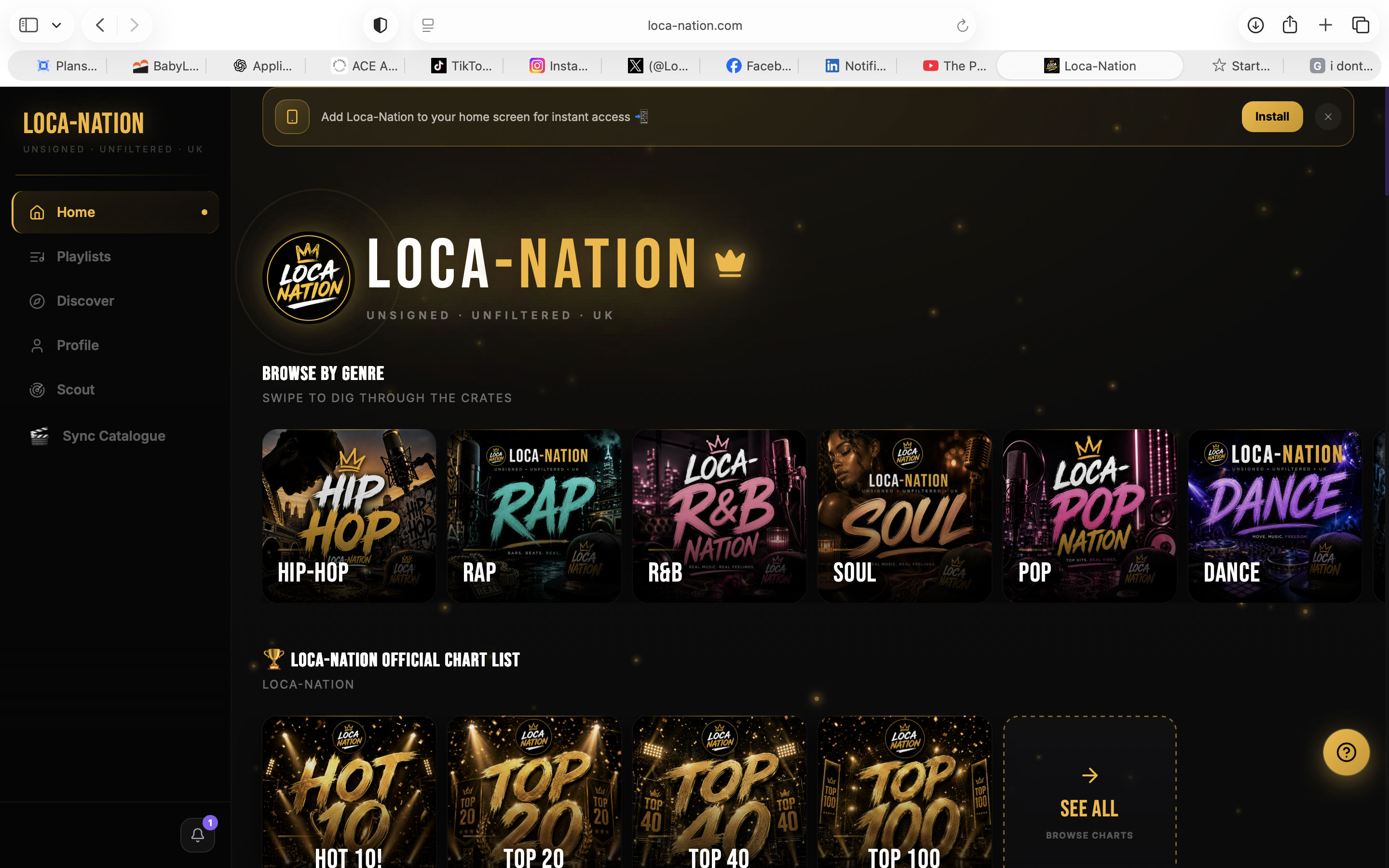
Artist profiles on the platform can carry analytics and track records that support sync pitches. Sync licensing opportunities may connect artists' catalogs directly to people actively looking for music, without subscription libraries taking large cuts of placements. Listeners can discover and vote for music without paying, helping ensure that audience engagement behind chart positions is genuine.
If you're ready to put a properly prepared, well-tagged catalog in front of the people who actually license music for a living, set up your artist profile on Loca-nation and start building the track record that makes your next sync quote easier to justify.
Sources
- Velveteen — Sync license fee ranges
- DropCue — What is sync licensing? Complete guide
- YouTube Creator Music — Help