
Algorithmic playlists are the automated recommendation slots Spotify generates for each listener, and the single biggest lever for landing in them is targeted early momentum, the right listeners saving and replaying your track fast enough for the system to notice. Watch three signals in the first 28 days: saves, unique listeners, and your track's popularity index. Get those moving with real fans, not just any traffic, and the algorithm does the rest.
TL;DR:
- Focusing on acquiring genuine fans who save, replay, and add your track to playlists significantly improves chances of algorithmic playlist placement, especially within the first 28 days.
- Early signals like high save rates, low skip rates, and multiple repeat listens outweigh sheer play counts and are critical to sustained algorithmic success.
- Coordinating a well-timed release campaign with targeted messaging to promote saves and follows, combined with retargeted ads, enhances organic momentum over the four-week release window.
- Avoid sending low-quality traffic, relying solely on editorial playlists, or neglecting metadata, as these mistakes weaken the track's ability to build genuine algorithmic engagement.
- Leveraging listener-added playlists and encouraging fans to add tracks to their personal collections boosts valuable behavioral signals that positively influence next-step recommendation cycles.
Table of Contents
- What Are Spotify's Algorithmic Playlists, Exactly?
- What Signals Actually Trigger the Algorithm?
- How Do You Launch a Release to Maximize Algorithmic Pickup?
- How Do You Know When to Scale or Pivot?
- What Kills Algorithmic Momentum Before It Starts?
- How Loca-Nation Fits Into an Algorithmic Growth Plan
- Does the Order of Songs in a Playlist Matter?
- What Should Artists Know About Privacy and Data Use in Recommendations?
- How Do Editorial and Algorithmic Playlists Work Together?
- How Do Playlists Made by Other Listeners Affect the Algorithm?
- Your Next Three Moves, Ranked by Priority
- Sources
What Are Spotify's Algorithmic Playlists, Exactly?
Discover Weekly, Release Radar, Daily Mix, Radio, and On Repeat all serve different jobs in a listener's week, and they matter to your career at different stages of a release.
- Release Radar delivers new music from artists a listener already follows or streams often. It's your launch-week spotlight, but Release Radar's boost is time-limited and fades fast if nothing sustains it.
- Discover Weekly is the long-tail discovery engine, thirty tracks refreshed every Monday for listeners who've never heard you. This is where new fans actually happen.
- Daily Mix groups your song with familiar tracks a listener already loves, reinforcing habit rather than driving discovery.
- Radio and Autoplay extend a session indefinitely based on what's already playing, useful for building repeat exposure once you're in someone's rotation.
- On Repeat rewards tracks a listener already plays often, a retention signal more than a discovery one.
None of this runs on pure math. Spotify's own engineers describe it as an "Algotorial" system: editors build a candidate pool of tracks that fit a mood or genre, then a personalization layer decides who actually sees each one and in what order. You need to qualify for the pool first. The algorithm handles who gets served after that.
What Signals Actually Trigger the Algorithm?
Spotify's recommendation engine doesn't care how many streams you bought. It cares whether the right listeners kept listening.
- Save rate: the percentage of listeners who add your track to their library. This is the strongest intent signal Spotify tracks.
- Skip rate: how fast people bail, especially in the first 30 seconds. High early skips tell the system your track doesn't fit the audience it reached.
- Completion rate: whether people listen to the end, a sign the track holds attention beyond the hook.
- Repeat listens: the same listener coming back to the same song multiple times in a short window.
- Playlist adds: listeners manually adding your track to their own playlists, a stronger vote than a passive stream.
- Profile visits and follower growth: signs a listener is curious enough to dig deeper into your catalog.
Fit beats volume here. A track that reaches 500 listeners who genuinely like that genre and saves it will outperform one that reaches 50,000 mismatched listeners with a 90% skip rate.
Pro Tip: Roughly 40% of Spotify streams now come from algorithmic playlists, and that recommendation engine weighs saves and repeat listens far more heavily than raw play counts. Chase saves before you chase reach.
The clock matters as much as the behavior. The first 48 to 72 hours after release set the initial trajectory, and sustained listener velocity across the following 28 days determines whether that early spike turns into lasting algorithmic placement. A hot opening weekend that dies by day ten tells Spotify the interest wasn't real.
How Do You Launch a Release to Maximize Algorithmic Pickup?
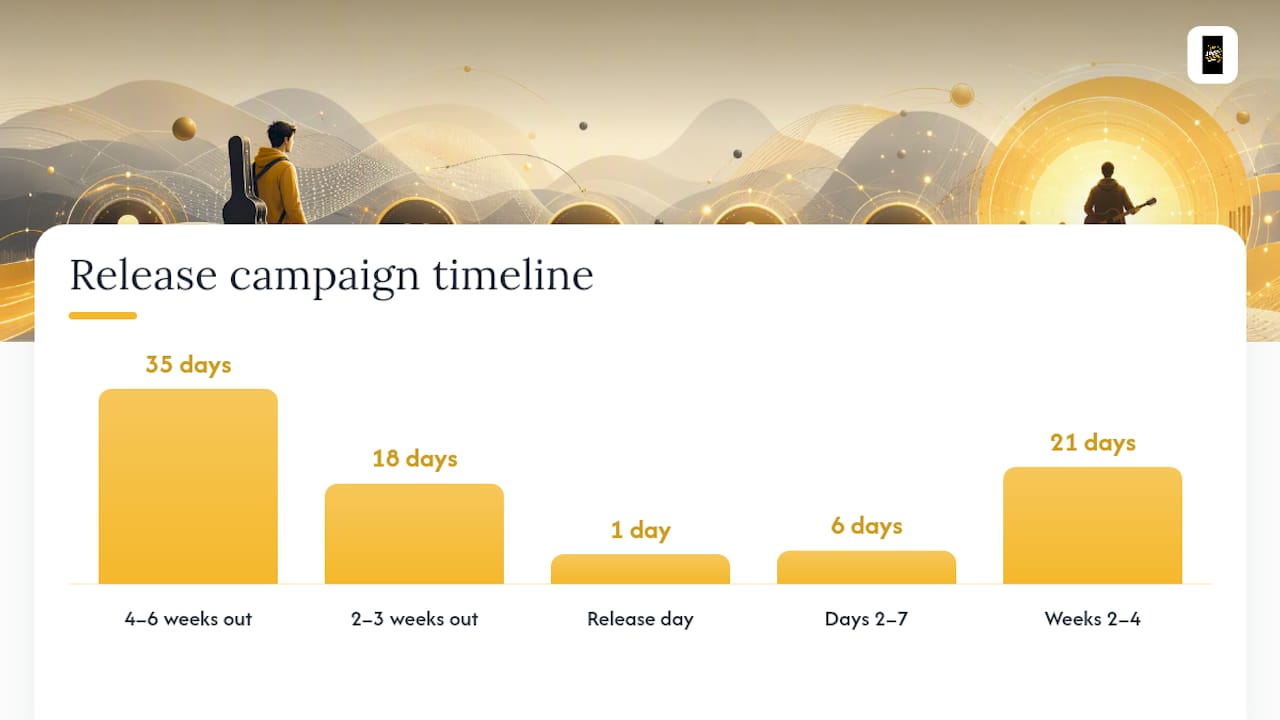
Treat your release like a four-week campaign, not a single day.
- Four to six weeks out: Finalize metadata, correct genre tags, accurate songwriter credits, and a clean artist profile image. Submit your Spotify for Artists pitch at least seven days before release, since editorial consideration requires lead time.
- Two to three weeks out: Launch a pre-save campaign with teaser content that drives follows, not just clicks. Followers are a ranking input for Release Radar eligibility.
- Release day: Coordinate traffic from email, social, and paid ads simultaneously rather than staggering it. Messaging should explicitly ask listeners to save the track and follow your profile, not just "check this out."
- Days two through seven: Monitor skip rate by traffic source. Cut anything converting poorly and shift budget toward the audience segments that are saving and completing the track.
- Weeks two through four: Retarget warm audiences (people who streamed but didn't save) with a different creative angle. Refresh ad copy weekly to avoid fatigue, and promote your own artist playlists to encourage playlist adds.
When running paid campaigns, treat them as a testing lab: measure cost per listener first, then narrow to cost per save, since save conversion predicts algorithmic pickup better than reach ever will. Layer your ad's call to action toward a save or follow action, not a generic stream, using deep links straight to the track rather than a landing page detour.
Budget-conscious artists can run this entire sequence on a relatively modest ad spend if targeting is tight. Consider paid promotional help only once you've confirmed organic momentum exists. Money spent amplifying a track nobody's saving is money wasted.
How Do You Know When to Scale or Pivot?
Two numbers tell you almost everything: 28-day unique listeners and your track's popularity index. Data modeling on activation thresholds suggests these rough bands:
Read the popularity index as relative momentum, not a scoreboard. A small, steady climb early matters more than a one-day spike that has no follow-through, since sudden jumps without sustained velocity tend to drop back just as fast.
Inside Spotify for Artists, watch the geographic and demographic breakdowns weekly. A spike in an unexpected city often reveals an audience cluster worth targeting directly with ads. To calculate cost per new listener, divide total ad spend by unique 28-day listeners gained; to isolate cost per saving listener, divide spend by total saves. The second number matters more.
What Kills Algorithmic Momentum Before It Starts?
Most artists who never crack algorithmic playlists aren't making bad music. They're sending weak signals through avoidable mistakes.
- Buying streams or driving broad, low-fit traffic. Mismatched listeners skip fast, and a high skip rate tells the algorithm your track doesn't belong wherever it landed, hurting future placement.
- Leaning entirely on one editorial placement. A single playlist add without sustained listener velocity behind it fades once that placement rotates off.
- Incomplete or inconsistent metadata. Missing genre tags, mismatched mood, or a thin artist profile blocks the personalization layer from matching your track to the right listener pool in the first place.
- Spreading budget across too many singles at once. Boosting five average tracks dilutes momentum; concentrating budget on the one track already showing signs of traction produces a stronger signal.
How Loca-Nation Fits Into an Algorithmic Growth Plan
This platform gives independent artists a free discovery and chart platform where genuine listener votes, not spend, decide who rises. That kind of unpaid, opt-in engagement is exactly the kind of signal Spotify's algorithm rewards elsewhere: real people choosing to interact because they like the music.
- Upload tracks and build a public profile that gives fans a reason to follow before your Spotify release.
- Use competition and listener voting to surface which songs already have pull, so you know which track deserves your ad budget.
- Pull analytics on regional and genre performance to sharpen the audience targeting in your Spotify and Meta campaigns.
- Combine platform exposure with email and retargeting so warm fans convert into Spotify saves and follows.
None of this guarantees a Discover Weekly slot. What it does is generate the kind of authentic, pre-release engagement signal that makes your subsequent Spotify campaign far more efficient.
Does the Order of Songs in a Playlist Matter?
Sequencing inside an algorithmic playlist isn't random, and where your track lands affects how long listeners stay engaged with it. Spotify's personalization layer orders tracks per listener based on audio-attribute similarity, tempo, energy, danceability, and mood consistency with what that person tends to play in that context.
A track placed early in a session tends to get a fuller listen because attention hasn't drifted yet; one placed deep into a 100-song Discover Weekly queue competes with fatigue and multitasking. This is part of why completion rate matters so much as a signal: a song that holds attention regardless of position earns better placement over time, while one that only performs well in slot one looks weaker to the system.
For your own artist-curated playlists, the same logic applies in reverse. Sequencing your strongest, most save-worthy track early increases the odds a listener commits to the full playlist instead of bailing after the opener. If you're promoting a multi-track project, opening with the song showing the highest save rate from early data, rather than the one you personally love most, gives the whole playlist a better shot at holding an audience long enough to register as a real listening session. That listening-session data feeds directly back into how Spotify treats future placements for every track on it.
What Should Artists Know About Privacy and Data Use in Recommendations?
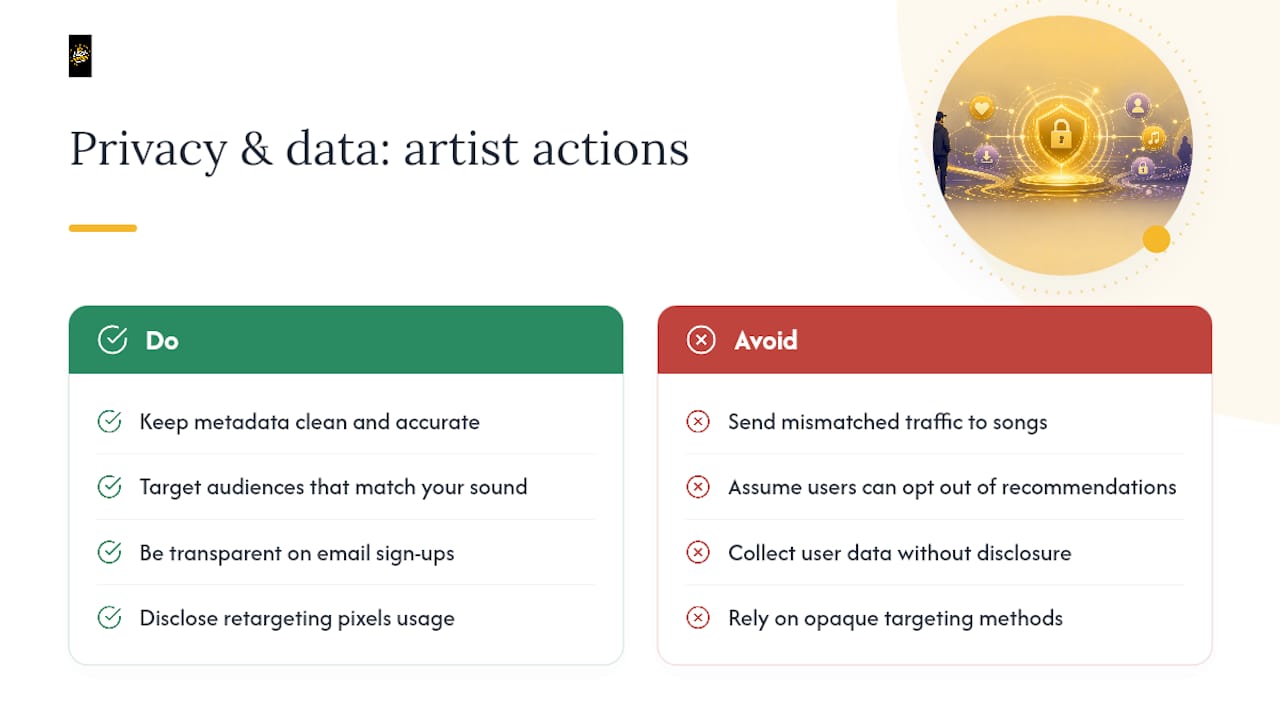
Spotify's recommendation engine runs on listening history: what you play, skip, save, and how long you stay before switching tracks. It also factors in audio-attribute matching, comparing a track's tempo and energy profile against what a listener already streams, which is separate from personal data but works alongside it.
For artists, this cuts both ways. The same behavioral tracking that can feel invasive from a listener's perspective is what makes precision targeting possible on your end: it's how Spotify Ads and Meta Ads can put your track in front of people who already stream sonically similar artists. Listeners can view and manage some of this through Spotify's account privacy settings, including ad personalization controls, though the core recommendation engine itself isn't something individual users can opt out of while still using personalized features like Discover Weekly.
The practical takeaway for independent musicians is narrower than it sounds: you don't need to understand Spotify's full data pipeline to benefit from it. You need clean metadata and genuinely well-matched audience targeting, because the system uses listening behavior to sort fit, and mismatched traffic just produces noise the algorithm has to filter past. Respecting listener privacy on your own end, being transparent in email sign-ups and retargeting pixels, keeps your promotional funnel compliant without touching how Spotify's internal recommendation logic works.
How Do Editorial and Algorithmic Playlists Work Together?
Editorial playlists are hand-picked by Spotify's in-house curation teams, human editors deciding which tracks represent a genre or mood well enough to earn a spot on flagship playlists. Algorithmic playlists are generated per listener by personalization software, no human touches the final Discover Weekly or Release Radar a specific person sees.
The two aren't separate systems competing for attention. Spotify's engineering team calls the combined approach "Algotorial": editors build a curated candidate pool, then personalization algorithms decide which listener sees which track from that pool, and in what order. An editorial add doesn't just get you one placement. It can feed your track into the broader candidate pool that algorithmic systems draw from later.
That's why an editorial placement without follow-up momentum tends to fade fast. If a curator adds your track to a flagship playlist but almost no one saves or replays it during that window, the algorithm reads that as weak fit and won't extend the track into Discover Weekly or Radio rotation once the editorial slot rotates off. The reverse also happens: a track with no editorial support at all can still build algorithmic traction purely through strong save rates and repeat listens among a well-targeted audience. Editorial exposure is a valuable accelerant. It isn't a requirement, and it isn't durable on its own.
How Do Playlists Made by Other Listeners Affect the Algorithm?
User-generated playlists, the ones built by individual Spotify users rather than Spotify's own editorial team, feed data into the recommendation system in a way many artists underestimate. When a listener adds your track to their own personal playlist, that's a stronger behavioral signal than a passive stream because it demonstrates active curation intent.
These playlists also create contextual associations that shape future recommendations. If your song keeps getting added to playlists alongside tracks from a particular subgenre or mood, the algorithm starts treating your track as belonging in that neighborhood, which affects which listeners it gets tested against next. This is part of why playlist adds appear as a distinct, valuable metric inside Spotify for Artists rather than getting folded into general stream counts.
Independent artists can influence this directly by making their music genuinely playlist-friendly: consistent mood and tempo across a project, clean transitions, and metadata that accurately reflects genre, all make it easier for a listener building their own mix to slot your track in naturally. Encouraging fans, through email or social prompts, to add a song to their personal playlists rather than just streaming it once is a small ask that produces a disproportionately strong signal. It's also one of the few algorithmic inputs an artist can request directly without spending a cent on advertising.
Your Next Three Moves, Ranked by Priority
Skip the overwhelm. If you're deciding what to do this week, do these three things in order.
First, get your profile and pre-release assets locked, metadata, pitch, pre-saves, before you spend a dollar on ads. Second, drive release-day traffic engineered to convert into saves and follows, not just streams; a smaller, save-heavy audience beats a broad, passive one every time. Third, watch your 28-day listener count and popularity index like a dashboard, and put your next dollar behind whichever track is already climbing.
— Jason
Sources
For a deeper look at the mechanics behind this article, these sources are worth reading directly:
- Humans + Machines: A Look Behind the Playlists Powered by Spotify’s Algotorial Technology | Spotify Engineering
- How to Turn Spotify Data into Algorithmic Growth - Music Ally
- Trigger Spotify Algorithmic Playlists in 2026: Data Study
If you want a practical next step rather than more reading, Loca-Nation's genre onboarding tool helps place your track into the right genre and playlist neighborhood on the platform itself, and the reactivation feature helps you bring past listeners back for a second look, exactly the kind of retargeting move that strengthens the save and repeat-listen signals covered above.