
For your next release, pitch one priority single through Spotify for Artists at least two weeks before it drops, back that pitch with a shortlist of 15 to 25 matched independent curators, and run a short promotion push you can point to as proof of momentum. That combination, editorial submission plus targeted outreach plus visible traction, is what actually moves playlist decisions.
TL;DR:
- Deliver your track to Spotify 3 to 4 weeks before release to ensure it is in the pitch window and avoid delays that close the opportunity.
- Fully complete your Spotify for Artists profile and focus the pitch on a single song with detailed metadata and tailored genre, mood, and artist comparisons.
- Build a curated list of 15 to 25 relevant independent playlists and research their update frequency and engagement signals before outreach.
- Start outreach to independent curators closer to the release date, as they often review submissions within days rather than weeks like Spotify editorial teams.
- Use concrete metrics from platforms like Loca-Nation, such as chart standings and listener votes, to strengthen your pitch evidence rather than vague claims of growth.
Table of Contents
- Quick Launch Checklist: What To Do Now For An Upcoming Release
- How To Pitch Through Spotify For Artists Step By Step
- Finding And Pitching Independent Curators: Research, Vetting, And Outreach
- Timing And Release Workflow: A Calendar From Week −4 To Day +14
- Writing The Pitch: A Three-Sentence Formula With Two Examples
- Promoting Placements And Measuring Success
- Risks And Red Flags: Spotting Scams Before They Cost You
- How To Use Loca-Nation As Evidence Of Engagement In Pitches
- A Practitioner's Takeaway On Pitching
- Loca-Nation: How The Platform Complements Your Pitching Strategy
- Sources
Quick Launch Checklist: What To Do Now For An Upcoming Release
Playlist pitching strategy fails most often because artists start too late or skip a step that seemed optional. Here's the order that actually works, ranked by urgency.
Do these first, in this order:
- Confirm your distributor will deliver the track to Spotify 3 to 4 weeks before release. Delivery delays are the single most common reason a pitch window closes before an artist even opens it.
- Complete your Spotify for Artists profile fully: bio, profile photo, and any upcoming tour dates. A half-finished profile signals inactivity to anyone reviewing your pitch.
- Pick the one song from your release that has the strongest first 30 seconds, and finalize its metadata: three accurate genres, a mood tag, listed instruments, and two or three comparable artists.
- Gather proof of promotion you can reference in your pitch text, a pre-save campaign, active social posts, or a recent local show.
- Build a curated list of 15 to 25 playlists that genuinely fit your sound, and note how often each one gets updated.
None of these steps takes more than an afternoon individually. Skipping the checklist entirely, though, is why so many artists submit a pitch the week of release with a blank bio and a song description that just says "check it out."
- Distributor delivery: 3 to 4 weeks out, non-negotiable.
- Profile completeness: bio, photo, tour data.
- One priority single, not your whole EP.
- Promotion proof: something concrete, not a plan.
- Curator shortlist: quality over quantity, always.
How To Pitch Through Spotify For Artists Step By Step
Log into Spotify for Artists, go to Music, then Upcoming, then Pitch. That's the entire navigation path, but you can only reach it once your distributor has confirmed the track is scheduled for delivery. Try to pitch before that confirmation and the option simply won't appear.
Once you're in the pitch form, Spotify's official guidance is blunt about what matters: the more detail you provide, the better your odds. That means filling in every field, not just the ones marked required. List three genres that actually describe the song rather than the genres you wish applied to it. Add a mood tag. Note the instruments on the track. Then write a short description naming two comparable artists whose fans would likely enjoy this song.
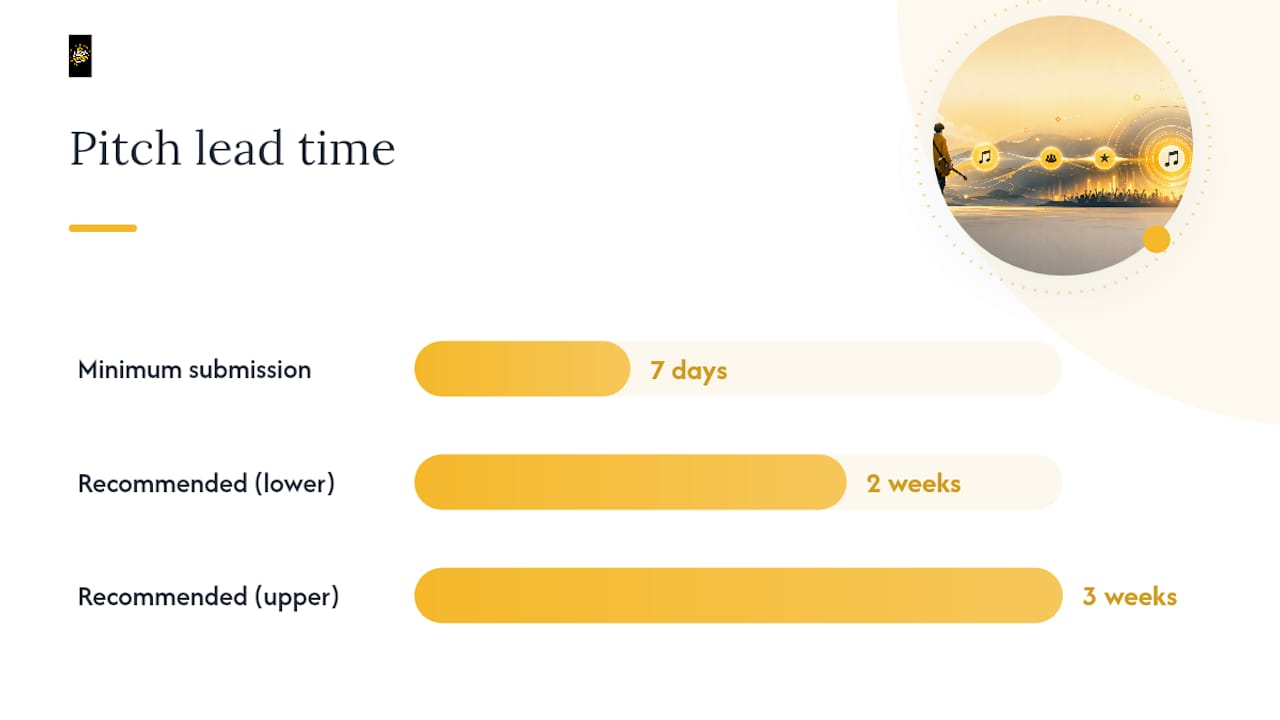
Timing matters more than most artists assume. Spotify states 7 days is the minimum submission window, but that's a floor, not a target. Submitting 2 to 3 weeks ahead gives editorial teams time to actually consider the track alongside dozens of others competing for the same playlist slots, and it builds in a buffer if your distributor's delivery runs a few days behind schedule.
In the pitch text itself, keep things focused on the song and the moment, not your career story. Mention your short promotion plan, the context of the release (is this a debut single, a deluxe reissue, a comeback after two years?), and why this specific track fits the editorial playlists you're hoping to land on.
Common mistakes that sink a pitch:
- Submitting a track that's already been released, which disqualifies it from editorial consideration entirely.
- Leaving genre or mood tags blank or vague.
- Writing a long biography-style narrative instead of a tight, song-focused pitch.
- Forgetting to list comparable artists, which gives editors nothing to anchor the recommendation to.
Pro Tip: Treat the comparable-artists field like a search query, not a compliment. Naming an artist who's too big or too far outside your genre wastes the field. Name the artist your listeners actually get recommended right before or after you.
Finding And Pitching Independent Curators: Research, Vetting, And Outreach
Editorial consideration through Spotify for Artists is only half of a working playlist pitching strategy. Independent curators, the people running genre and mood playlists outside Spotify's own editorial team, often move faster and respond to direct outreach in a way an algorithm never will.
Start your search inside Spotify itself. Search for playlists using your genre and mood as keywords, then check the "discovered on" section of artists whose sound overlaps with yours, it lists exactly which playlists picked up their music. Curator contact lists and niche community playlists on genre-specific blogs or forums round out a solid research base.
Vetting matters as much as finding. Before adding any playlist to your list, check when it was last updated. A playlist untouched for more than 12 months is effectively dead weight, no matter how many followers it lists. Look for engagement signals too: does the playlist's follower count track logically with how long it's existed, or does it show a suspicious spike that suggests bought followers?
Resist the urge to blast fifty curators at once. A shortlist of 15 to 25 well-matched playlists consistently outperforms mass submissions, because curators can tell the difference between a pitch written for their specific playlist and a form letter copied twenty times. Email or a dedicated submission form is the preferred first contact for most curators; direct messages work for smaller, more personal accounts where that's clearly the norm. A resource like verified curator contact lists can shortcut the research phase considerably.
One timing quirk worth knowing: independent curators often review submissions much closer to the actual release date than Spotify's editorial team does, so don't assume the same 2 to 3 week window applies universally.
Pro Tip: Save every curator's response, even the rejections. A curator who says "not quite right for this playlist, but keep me posted" is telling you exactly what to send them next time.
Timing And Release Workflow: A Calendar From Week −4 To Day +14
Playlist pitching strategy only works when it's mapped against a real calendar. Here's how the weeks before and after release should actually unfold.
- Weeks −4 to −3: Distribute the track and get written confirmation of delivery. Finish your Spotify for Artists profile, and lock in your song's metadata: genres, mood, instruments, comparable artists.
- Weeks −3 to −2: Submit your Spotify for Artists pitch, aiming for that 2 to 3 week window rather than the bare minimum. Simultaneously build and finalize your curator shortlist, and kick off your pre-save campaign and social content plan.
- Week −1 to release day: Send your final round of outreach to independent curators. Schedule social posts and any email announcements. Prepare the assets you'll need to promote a placement the moment it lands, graphics, short clips, a simple thank-you template for curators.
- Days +1 to +14: Actively promote any placements you land, tell your list, post on socials, thank the curator publicly if appropriate. Track saves and follower growth daily. If momentum is building, this is the window to send a second, smaller wave of outreach to curators you didn't reach the first time.
This timeline assumes 3 to 4 weeks of total lead time before release, which lines up with standard distributor delivery windows. Compress it further and you're gambling on everything going right the first time, which it rarely does.
Writing The Pitch: A Three-Sentence Formula With Two Examples
Curators reportedly decide whether a song fits their playlist within the first 15 to 30 seconds of listening, which means your written pitch has an even smaller window to earn that first click. Keep it under 100 words, always.
The formula that works: a one-line description of what the song actually sounds like, a short sentence of promotion context, and a direct note on why it fits their specific playlist, ideally naming a track already on it.
Example pitch for a mellow, late-night playlist: "Slow-burning indie folk with a warm, close-mic vocal and minimal percussion, think early-morning drive rather than a party. We're running a pre-save campaign with our local scene and picked up steady streams from a recent acoustic set. This would sit naturally next to [Song X] on your playlist. Would love your consideration."
Example pitch for an upbeat indie playlist: "Bright, guitar-driven indie pop with a hook that repeats in your head for days. We've built momentum through consistent short-form content and a small but engaged fan base. Given the energy of [Song Y] on your list, I think this track would fit right in."
- Lead with sound, not backstory.
- Name two comparable artists, never more.
- Reference a specific song already on their playlist when you can.
- Keep the whole pitch under 100 words.
Follow up once, and only once, seven to ten days after your initial message. If there's no response after that, move on. Chasing a curator past one polite follow-up tends to do more damage to the relationship than staying silent.
Promoting Placements And Measuring Success
Landing a playlist spot is the midpoint of the work, not the finish line. What happens in the days after placement often determines whether a curator keeps you on the list or quietly removes the track at the next update.
The metrics that matter most are saves, playlist adds, follower growth, and a low skip rate, not raw stream count. A song that gets streamed ten thousand times but skipped after fifteen seconds tells both curators and Spotify's algorithm that the placement isn't working, regardless of the total.
After a placement lands, run through this checklist:
- Share the playlist publicly and tag the curator where appropriate.
- Announce the placement to your email list.
- Post short-form video or a quick story mentioning the playlist by name.
- If budget allows, run a small targeted ad campaign pointing toward the track.
Driving your own traffic to a placement signals to both the curator and Spotify's algorithm that the song deserves its spot, which increases the odds of continued or expanded placement.
| Metric | What it tells you |
|---|---|
| Saves | Listeners intentionally kept the song, a strong quality signal |
| Skip rate | High early skips suggest the placement or song isn't landing |
| Follower growth | New followers post-placement show the song converted listeners to fans |
| Playlist adds | Listeners are building the song into their own rotation |
Attribute growth to a placement carefully. Spotify for Artists shows source data, but correlation isn't always causation, a spike might reflect a coincidental social post rather than the playlist itself. Once the numbers settle, thank the curator directly and let them know when your next release is coming. A broader marketing plan built around consistent curator relationships outperforms any single placement.
Risks And Red Flags: Spotting Scams Before They Cost You
Anyone offering a guaranteed editorial placement is lying to you or doesn't understand how Spotify's editorial process works. No legitimate service, curator, or middleman can promise a spot on an editorial playlist, because that decision rests entirely with Spotify's internal teams.
Watch for these warning signs:
- Guaranteed placements or promises of massive stream increases for a flat fee.
- Sudden, unexplained follower or stream spikes with no matching promotion activity.
- Vague answers when you ask exactly what a paid service delivers.
- Pressure to pay for "guaranteed" plays rather than a guaranteed listen or response.
The consequences of bought streams are severe: stream removal, revenue clawbacks, and account penalties that can follow an artist across future releases. Legitimate paid submission platforms like SubmitHub and Groover charge a small fee for a guaranteed listen or written feedback, which is fundamentally different from paying for a guaranteed playlist add. Ask any paid service to clarify which one they're actually selling before you hand over a card number, and request verifiable examples of past results.
Pro Tip: Document every suspicious offer, screenshots included. If a "curator" pressures you toward a purchased-streams deal, report it to your distributor or directly to Spotify rather than just ignoring the message.
How To Use Loca-Nation As Evidence Of Engagement In Pitches
A pitch backed by real numbers reads differently than one built on adjectives. Loca-Nation tracks chart positions, listener votes, and engagement analytics for independent artists, and those figures give you something concrete to drop into a pitch.
Instead of writing "we have a growing fan base," try a line like: "Recently reached #12 on a regional indie chart with over 300 listener votes." That's a specific, checkable claim, and curators respond better to specifics than to self-description.
Where to use this evidence:
- In the promotion-context line of your pitch, alongside your pre-save numbers.
- In your Spotify for Artists bio, as a standing credibility marker.
- In direct outreach emails to independent curators who ask for proof of traction.
Treat chart data as a supplement, not a substitute, for the editorial pitch itself. It strengthens your case; it doesn't replace the work of submitting through Spotify for Artists or building your curator shortlist.
A Practitioner's Takeaway On Pitching
Pitching is a skill you get better at through repetition, not a form you fill out once and forget. Every submission, every response, and every silence teaches you something about what your next pitch should say differently.
Treat each release as market research for the one after it. Track which pitch language got responses, which curators engaged, and which playlists actually moved the needle on saves. That record is worth more than any single placement.
— Jason
Loca-Nation: How The Platform Complements Your Pitching Strategy
A strong playlist pitching strategy needs proof, not just a good song, and that's where most independent artists come up short when a curator asks "what's your traction look like?" This platform gives you a free artist profile, a chart system built on genuine listener votes rather than industry connections, and analytics you can screenshot straight into a pitch email.
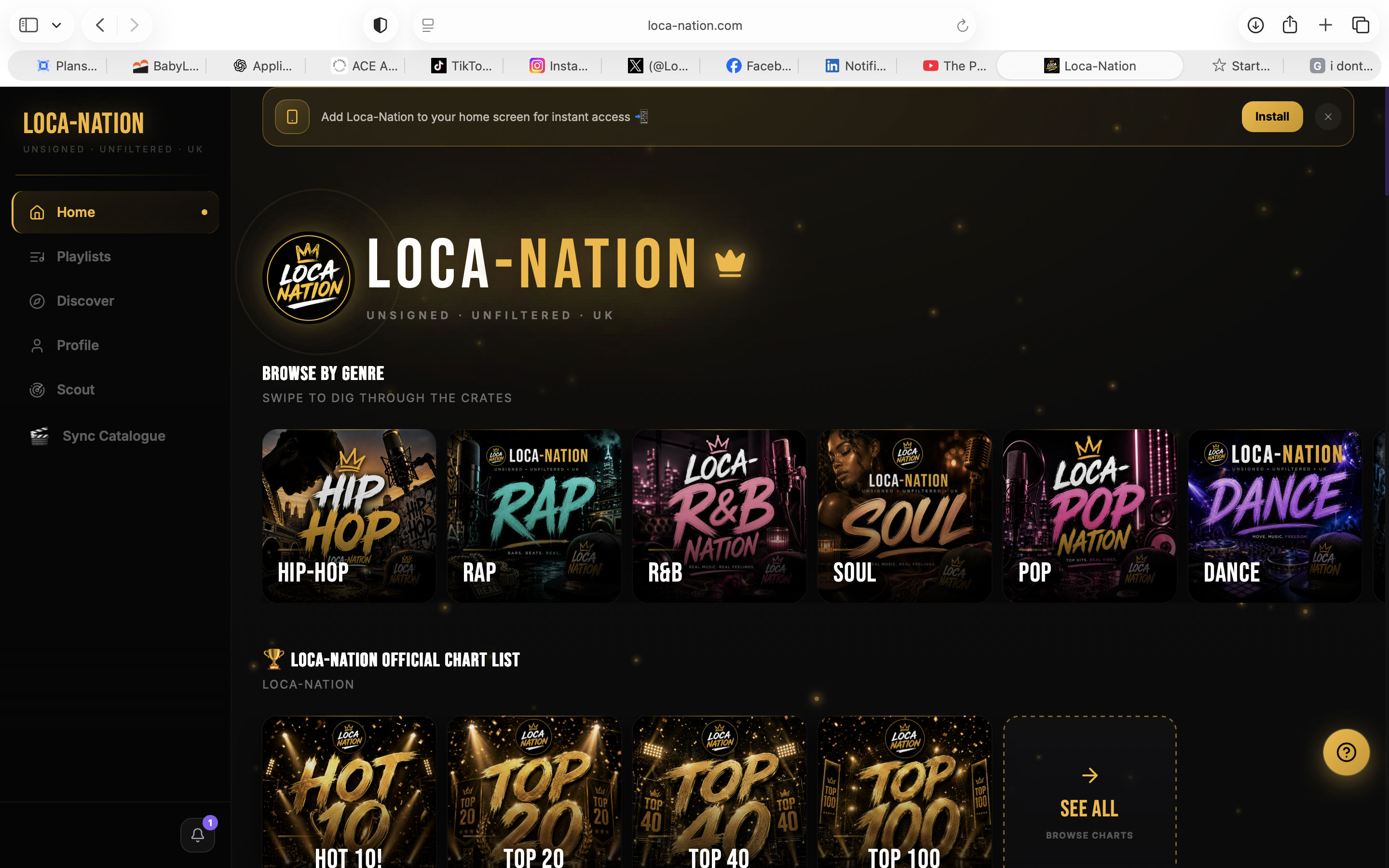
Because listeners vote for tracks they genuinely want to see progress, a chart position on the platform reflects real audience interest, exactly the kind of evidence curators and industry scouts want to see before they commit a playlist slot to an unfamiliar name. Unlike a paid streaming service that charges to boost numbers artificially, the platform's chart movement comes from listeners choosing your song over others, which is a very different signal to hand a curator than a purchased spike.
Create your free Loca-Nation profile before your next release, start building chart history and listener votes now, and you'll have a concrete engagement line ready for your very next pitch.
Sources
- Playlist pitching in 2026: What artists need to know - RouteNote Blog
- Playlist Pitching: Strategy, Timing, and Follow-Up