
Most real playlist curator contacts live in four places: the playlist description, the curator's Spotify profile bio, a linked website, or a public social handle. If none of those show a submission method, that curator most likely isn't accepting pitches right now, and no amount of DMing will change that. Spotify's own editors don't take outreach this way at all. Editorial playlist pitches go through Spotify for Artists, not email, and that's the one channel independent submission methods can't replace.
Here's the immediate move: stop hunting for a magic contact list and start building your own.
- Pull 20 playlists that genuinely fit your genre and sound
- Record whatever contact method each one actually publishes
- Draft one 80 to 150 word pitch with a private streaming link ready to send
That's a working outreach system before lunch, not a database you buy from someone else.
Key Takeaways
Verified curator contacts come from direct research on public playlist pages, not purchased lists, and a short, specific pitch with a private link and real engagement proof consistently outperforms generic mass outreach.
| Point | Details |
|---|---|
| Check the right channels | Look at playlist descriptions, curator bios, linked sites, and socials before assuming no contact exists. |
| Build a real tracker | Log contact, channel, playlist, genre, follower count, and outreach status in a spreadsheet. |
| Vet before pitching | Confirm recent activity, genre fit, and realistic engagement relative to follower count. |
| Keep pitches tight | Write 80 to 150 words, include one private link, and reference an existing playlist track. |
| Never pay for spots | Treat any guaranteed placement offer as a red flag and follow up only once after a week or more. |
Table of Contents
- How to Find Playlist Curator Contacts on Spotify
- Building a Contact List You Can Actually Work
- What Should a Cold Pitch to a Playlist Curator Say?
- Should You Ever Pay for Playlist Placement?
- How Loca-Nation Strengthens Your Curator Pitches
- What the Data Actually Tells Independent Artists
- Sources
How to Find Playlist Curator Contacts on Spotify
Curators who want submissions generally indicate so in common locations such as the playlist description, profile bio, or linked sites. Learning to scan these fast saves hours over a real campaign.
- Read the full playlist description. Curators who accept pitches often write "submit here," "DM for consideration," or paste a submission link right into the description text.
- Check the curator's Spotify profile. Look at the bio and any external link field. Independent curators frequently list a personal site, a Linktree, or an Instagram handle here instead of in the playlist itself.
- Follow linked websites to their actual submission page. A curator's site often hides the real intake form under a "Submit Music" or "Contact" tab rather than the homepage.
- Match the channel to what they've published. If they list an email, use it. If they only show an Instagram handle, DM there instead of guessing at an email address.
Record these details for every contact you find:
- The exact submission method they stated, word for word
- The playlist name and its approximate follower count
- Which platform you'll use to reach them (email, Instagram, X, a form)
- The date you checked, since curators change their preferences often
Curator contact info typically clusters in these same few places across genres, so once you've scanned a handful of playlists, the pattern becomes fast to spot.
Building a Contact List You Can Actually Work
A spreadsheet beats a stack of screenshots every time. Set up columns for contact name, channel, playlist name, genre, follower count, last known activity date, and a notes field for anything specific they've asked for. Log every outreach attempt with a status: not contacted, pitched, follow up sent, replied, placed, or declined. This turns a scattered search into something you can actually manage across weeks.
Before you add anyone to your active list, run a quick quality check:
- Does the playlist show recent additions, ideally within the last month?
- Do the tracks already on it sound like something you'd genuinely put next to your song?
- Does the follower count roughly match the engagement you'd expect (saves, plays, comments on related posts)?
- Has the curator posted or updated anything in the last 60 days?
A playlist with 40,000 followers and almost no visible engagement anywhere else is a weaker target than one with 3,000 followers and an active, responsive audience. Curator research tools recommend exactly this kind of quick vetting before you invest any outreach time.
For sizing, a modest number of well-vetted contacts per release is a practical target for an independent artist working alone. That's enough volume to get a handful of responses without turning outreach into a full-time job.

Pro Tip: Set a recurring 15-minute weekly slot to update your tracker instead of doing it all in one marathon session. Curator activity shifts fast, and a list that's a month stale wastes real pitches.
What Should a Cold Pitch to a Playlist Curator Say?
Keep it short. The strongest pitches run 80 to 150 words, read cleanly on a phone screen, and get to the point in the first sentence.
- Open with a one-line hook that names the playlist specifically. Generic pitches sent to fifty curators read exactly like what they are.
- Include a private streaming link, never a public Spotify link that buries your play count next to everyone else's.
- Reference one track already on the playlist and explain briefly why your song sits well next to it.
- Make a low-pressure ask. "Would love your take" beats "please add this to your playlist."
Subject lines matter more than most artists assume. Something like "Track for [Playlist Name]" or "New [genre] single, fits your sound" outperforms vague lines like "Music submission" almost every time, since curators scan inboxes fast and specificity earns the open.
A few structural notes worth locking in:
- Never attach audio files. Always link.
- Skip the full press bio. One sentence of context is plenty.
- Personalize the opening line every single time, even if the rest of the template stays fixed.
On follow-ups: send exactly one, seven to ten days after your first email, and only if you haven't heard back. Don't send a second follow-up unless you genuinely have something new to say, a fresh milestone, a chart placement, a new mix. Direct email still outperforms DMs and forms for response rate whenever a curator has actually published an email address, so use it when you can.
Should You Ever Pay for Playlist Placement?
No reputable curator sells guaranteed spots, and that's the clearest line in this entire process. Industry educators including Berklee Online warn that paid placement services routinely deliver bot streams and fake engagement instead of real listeners, which can actually hurt your Spotify algorithmic standing rather than help it.
Watch for these signals before you trust a curator or a paid service:
- A playlist with a sudden, unexplained follower spike and no matching jump in saves or comments
- Tracks that don't fit the stated genre or mood at all, a common sign of a playlist built purely for resale
- An email domain that doesn't match the curator's actual website or social handles
- Any service offering a "guaranteed" placement in exchange for payment
If you're evaluating a paid pitching tool rather than a curator directly, ask about their refund policy, how they verify curator identity, and whether they can show sample placements you can independently check. A tool that can't answer those three questions plainly isn't worth your budget.
How Loca-Nation Strengthens Your Curator Pitches
Chart placements give you something most cold pitches lack: proof a real audience already responded to your track. Loca-Nation runs on genuine listener voting rather than paid promotion, so a chart position or strong analytics window reflects actual engagement you can cite in outreach.
A simple workflow: build your Loca-Nation artist profile, run an active push around your release window, then reference specific results (a chart position, engagement numbers, regional traction) in your curator pitch's opening lines. "Currently charting in [genre/region] on Loca-Nation" reads as a credible signal, not a vanity claim, precisely because it's tied to votes from real listeners rather than purchased plays.
One rule matters here: only cite engagement you actually earned through genuine listener activity. Curators can tell the difference between organic traction and inflated numbers almost as fast as they can tell a form-letter pitch from a personal one.
Pro Tip: Screenshot your Loca-Nation chart position or analytics dashboard the week it happens. A dated screenshot in a pitch carries more weight than a vague claim made months later.
What the Data Actually Tells Independent Artists
Most advice on this topic treats curator outreach like a numbers game: blast enough emails and something sticks. That's backward. The research points the other way, a smaller list of genuinely vetted contacts, pitched with something specific to say, beats mass outreach almost every time, because curators can spot a form letter in the first sentence.
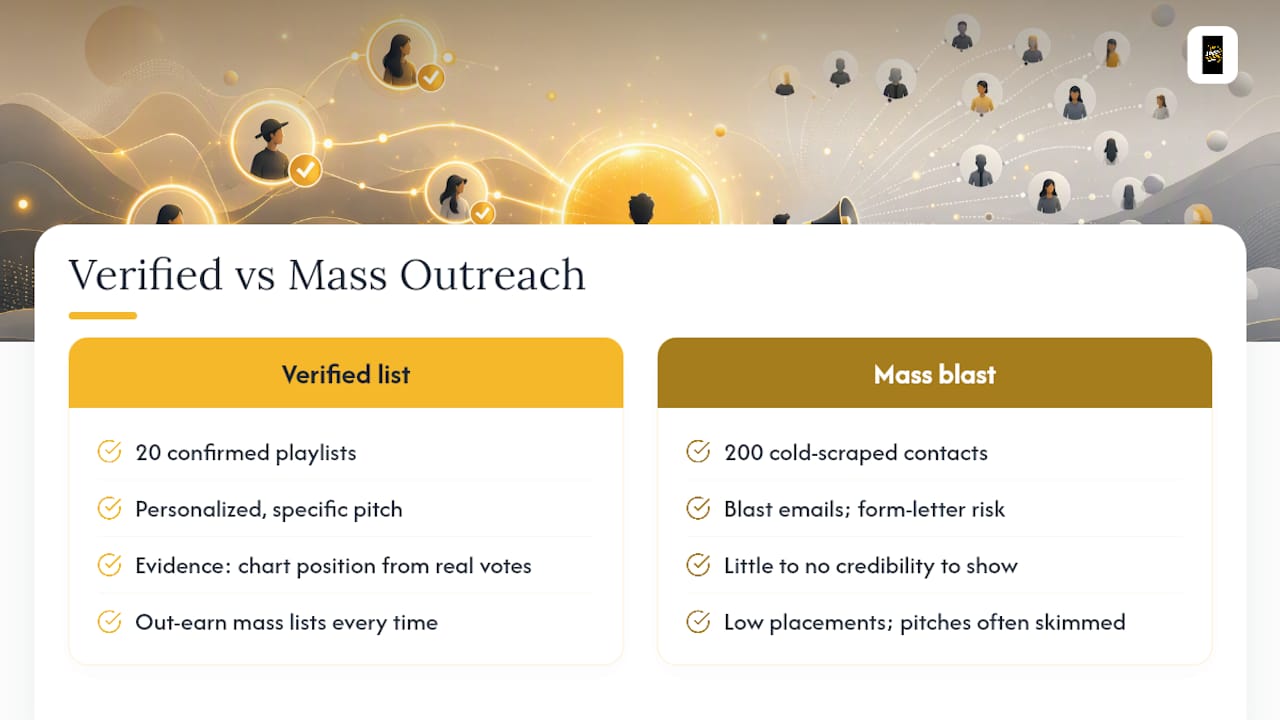
The bigger blind spot is proof. Artists spend hours polishing pitch copy and almost no time building anything to point to as evidence their music already connects with listeners. That's where a platform like Loca-Nation earns its place in the workflow, not as a replacement for outreach, but as the missing credibility layer. A chart position built on real votes gives a curator a reason to trust your one-line hook instead of skimming past it.
If you take one thing from this: vet harder than you pitch. Twenty confirmed, active playlists with real engagement will out-earn two hundred cold-scraped contacts every single time.
Sources
- How to get your music on Spotify playlists | Berklee Online
- Playlist pitching: Spotify playlist curators | Dynamoi
- How to Contact Playlist Curators (2026 Guide) | PlaylistSupply