
Start now: pick an email service provider, add a signup form to every place a fan already sees you, and send a three-email welcome sequence within the week. That single move puts you ahead of most independent artists still relying on Instagram followers they don't actually own.
Here's the 7-day plan:
- Day 1: Sign up for an ESP (starter tier, free plan is fine).
- Day 2: Build a landing page or popup form with one incentive.
- Day 3: Add the signup link to your bio, website, and merch table QR code.
- Day 4: Write email one of your welcome sequence (deliver the incentive).
- Day 5: Write email two (tell your story).
- Day 6: Write email three (share a key track, one clear action).
- Day 7: Tag new subscribers by source (gig, website, social) and launch.
The number that matters: the music industry's average open rate sits at 45.93%, based on MailerLite benchmark data. Compare that to the single-digit organic reach most artist posts get on social feeds. A tool like ConvertKit or MailerLite handles the form, automation, and sending for free at low subscriber counts, and a platform like Loca-Nation can feed engaged listeners into the same signup funnel.
Key Takeaways
A musician email list succeeds when you combine a free ESP, a friction-free signup form, and a three-email welcome sequence sent within the first week.
| Point | Details |
|---|---|
| Pick an ESP today | Choose a free-tier platform like MailerLite or ConvertKit and verify your sender email. |
| Launch your welcome series | Send three emails: deliver the incentive, tell your story, share a key track with one action. |
| Add signup points everywhere | Place forms on your link-in-bio, website, and merch table QR code. |
| Protect deliverability | Authenticate your domain, avoid buying lists, and clean inactive subscribers regularly. |
| Connect discovery to signups | Use a platform like Loca-Nation to turn engaged listeners into tagged, segmented subscribers. |
Table of Contents
- Why a Musician Email List Matters More Than Your Follower Count
- Setting Up Your List: Choose an ESP, Build a Form, Send Your First Email
- What Are the Best Ways to Grow a Musician Mailing List?
- What Should You Send and How Often?
- How Do You Keep Your Musician Email List Out of Spam?
- Which Email Tool Is Right for Your Stage as an Artist?
- Turning Streaming Behavior Into Email Signups
- Frequently Asked Questions
- Sources
Why a Musician Email List Matters More Than Your Follower Count
Your email list is the one channel you actually own. A platform can throttle your reach, change its algorithm, or shut down entirely, but your subscriber list stays yours regardless of what happens on Instagram or TikTok. That's not a small distinction. It's the difference between renting an audience and owning one.
The numbers back this up. With an industry-average open rate near 45.93%, a single email reaches a far larger share of your list than a typical social post reaches your followers. That gap compounds over a career: every subscriber you add today is someone you can reach directly for years, without paying for ads or hoping the algorithm cooperates.
For musicians, this translates directly into revenue and momentum:
- Ticket sales jump when fans get a direct heads-up, not a buried post.
- Merch drops convert better when subscribers get first access.
- Repeat streams increase when you point people straight to a new release.
Pro Tip: Frame early access as a reward, not a favor. "You're getting this 48 hours before anyone else" performs better than "New song out now, check it out."
Setting Up Your List: Choose an ESP, Build a Form, Send Your First Email
Pick an ESP before anything else, and don't overthink it. Free tiers on most creator-friendly platforms support landing pages and basic automation, which is all you need at the start. ConvertKit (now Kit), MailerLite, and Mailchimp all offer usable free plans for artists under a few thousand subscribers.
Step-by-step setup:
- Create your ESP account and verify your sender email address.
- Build a simple landing page or popup form with one incentive.
- Connect that form to your link-in-bio tool and add a QR code to your merch table.
- Set your sender name to your artist name, not a generic "team" label.
- Configure a three-email welcome automation to fire immediately after signup.
Signup copy that actually works:
- Popup: "Get my new song before anyone else. Drop your email below."
- Link-in-bio: "Join the list. New music, tour dates, no spam."
- Merch table: "Scan for a free download and first access to tickets."
Your welcome series does the heavy lifting. The highest-value automation you can build is three emails: the first delivers your promised incentive immediately, the second tells your story in a few honest paragraphs, and the third shares a key track along with one specific next action, like following your Loca-Nation profile or grabbing a ticket.
Keep the technical basics clean from day one: verify your domain so emails don't land in spam, use a real sender name, and always include a visible unsubscribe link. Skipping these steps early creates deliverability problems that are far harder to fix later.
What Are the Best Ways to Grow a Musician Mailing List?
Prioritize signup points with zero friction and a real reason to opt in. A generic "join my newsletter" box converts poorly. An offer like "get this unreleased track" converts far better, because it gives people something tangible in exchange for their inbox space.
Here are tactics that work for independent artists specifically:
- Unreleased track or demo: Offer a song not available anywhere else.
- Early ticket access: Give subscribers a 24 to 48-hour head start before public sale.
- Merch discount code: A 10 to 15% code delivered only through email.
- Stage call-to-action: Say the signup link out loud between songs at every show.
- QR code at the merch table: Point directly to your signup form, not your homepage.
- Link-in-bio placement: Put the signup link above your streaming links, not below.
- Contest or giveaway: Signed merch or a private acoustic set for one lucky subscriber.
One warning matters more than any tactic: never buy or rent an email list. Purchased lists wreck your sender reputation, trigger spam complaints, and can get your domain blacklisted by major inbox providers. Every subscriber on a purchased list didn't ask to hear from you, and that shows up in your open rates almost immediately.
Tag every new subscriber by source when they sign up. Someone who scanned a QR code at your last show behaves differently than someone who found you through a Spotify playlist. That distinction matters when you start segmenting emails by location or engagement later.
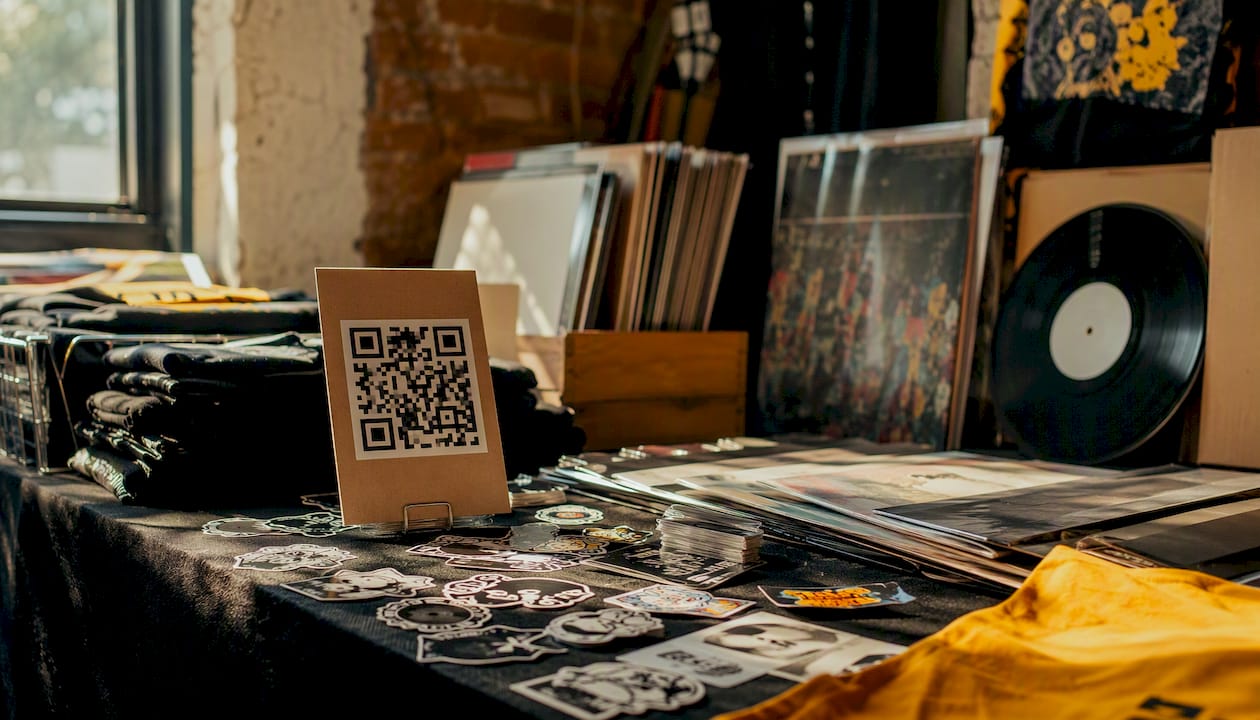
Pro Tip: Print a small, dedicated QR code just for your merch table sign-up sheet. A separate code lets you track exactly how many subscribers came from a specific show, which tells you whether touring is actually growing your list or just your applause.
What Should You Send and How Often?
Send a mix of three email types: release announcements get top priority, tour date emails get segmented by location, and personal or behind-the-scenes updates build the relationship between releases. Consistent, low-pressure communication builds far more trust than disappearing for months and only emailing when you have something to sell.
Your welcome sequence, mapped out:
- Email 1 (immediately): Deliver the incentive. Subject line: "Here's your free track."
- Email 2 (day 3): Tell your story. Subject line: "Why I started making music."
- Email 3 (day 6): Share a key track and one action. Subject line: "The song that changed everything for me."
For ongoing cadence, twice a month is a solid starting point for most independent artists. That's roughly in line with the 35.31% of creators who send one to three emails monthly, according to MailerLite's analysis. Increase frequency around a release cycle or tour, then pull back once things quiet down. Consistency matters more than raw volume.
Segmentation makes every send sharper:
- Location tags let you send gig invites only to fans near that city.
- Source tags show you whether merch-table signups or website visitors engage more.
- Engagement tiers let you re-target openers with a follow-up and skip the rest.
If you're planning a tour, treat ticket emails like their own category. Event-specific email flows that segment by location and send timed reminders tend to convert noticeably better than a single blast to your whole list.
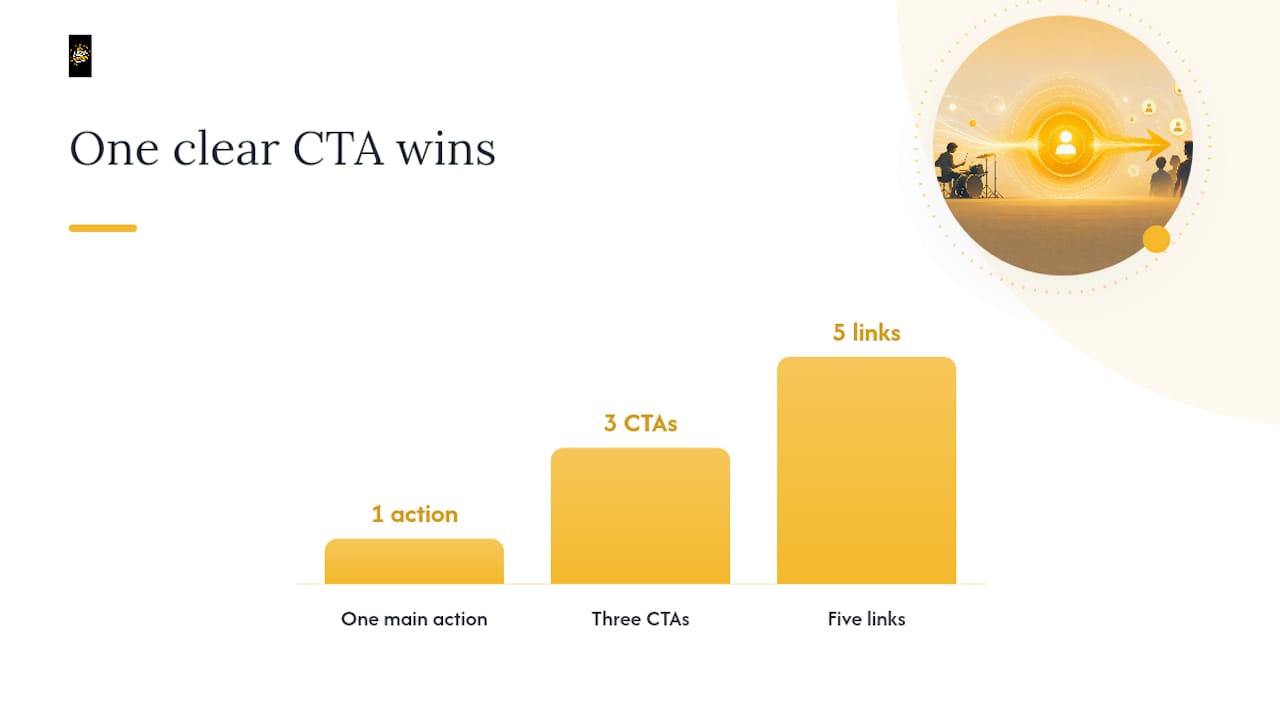
Follow one rule in every email: one main action. Giving subscribers five links and three calls-to-action creates the paradox of choice, where too many options leads to no action at all. Pick the single thing you want them to do, and make that the only button that matters.
How Do You Keep Your Musician Email List Out of Spam?
Authenticate your domain with SPF and DKIM records, keep your list clean, and only email people who actually opted in. Those three habits protect your inbox placement more than any subject-line trick ever will.
Cleaning your list, step by step:
- Identify subscribers who haven't opened an email in 90 days or more.
- Send a short re-engagement email asking if they still want to hear from you.
- Remove anyone who doesn't respond within a set window, usually two weeks.
- Repeat this process every few months, not just once.
A smaller, engaged list consistently outperforms a bloated one. Inbox providers track engagement rates per sender, so a list full of ignored subscribers actively drags down deliverability for everyone else on it, including the fans who genuinely want your music.
Consent basics for your signup form:
- "By signing up, you agree to receive emails from [your artist name]. Unsubscribe anytime."
- Record consent timestamps automatically. Most ESPs, including Mailchimp and MailerLite, do this by default under GDPR-aligned settings.
- Never add someone to your list manually from a business card or a DM without their explicit opt-in.
Deliverability checklist:
- Verify SPF and DKIM records through your ESP's domain settings.
- Never buy or rent a list, which damages your sender reputation permanently.
- Keep your sending frequency consistent, rather than silent for months then a sudden burst.
- Monitor your bounce rate and spam complaint rate inside your ESP dashboard monthly.
Which Email Tool Is Right for Your Stage as an Artist?
Start with a free tier and upgrade only when your list size or automation needs demand it. Most creator-friendly ESPs offer usable free plans that cover landing pages, basic automation, and a welcome sequence, which is genuinely all you need under a few thousand subscribers.
Mailchimp, ConvertKit (Kit), MailerLite, Sendinblue, SendGrid, and Substack all serve musicians differently. Mailchimp and MailerLite lean toward visual simplicity and strong free tiers. ConvertKit and Substack favor artists who lead with storytelling and long-form updates. Sendinblue and SendGrid tend to suit artists who also need transactional email support, like order confirmations from a merch store.
| Comparison factor | What to look for |
|---|---|
| Free tier / pricing shape | Free up to a subscriber cap, then priced by list size |
| Ease of use | Drag-and-drop editor with musician-friendly templates |
| Automation & welcome support | Pre-built welcome sequence templates, not just single sends |
| Deliverability | Built-in domain authentication tools (SPF/DKIM setup) |
| List-size limits | Free tier caps, usually around 500 contacts |
| GDPR compatibility | Automatic consent timestamp logging on signup |
Pick by stage:
- 0 to 500 subscribers: Free tier, focus entirely on the welcome sequence.
- 500 to 5,000 subscribers: Add automation for location-based gig emails.
- 5,000-plus subscribers: Upgrade for advanced segmentation and landing pages.
Pay once automation, landing pages, or smart-link integrations start saving you real time. Creators pairing an ESP with a portfolio or smart-link hub tend to see stronger conversion, because fans see a cohesive presentation instead of a bare signup box.
Turning Streaming Behavior Into Email Signups
Connect your smart links, streaming links, and website forms so subscriber behavior tells you who's actually engaged. When a fan clicks through to Spotify from your smart link, that click is data. Feed it into your ESP as a tag, and you know exactly who to prioritize for a follow-up.
A working example: a release campaign sends a smart link tracking clicks per platform, then follows up with a location-based gig invite sent only to fans who clicked through and live near an upcoming show.
Integration checklist:
- Link-in-bio page pointing to your signup form first.
- Loca-Nation profile linked from your smart link and bio.
- ESP tags applied automatically based on click behavior.
Pro Tip: Treat click-throughs as a ranking signal. Fans who click your smart link within 24 hours of a release are your warmest audience, so send them the next follow-up before anyone else.
A Note From Someone Who Builds for Independent Artists
Every artist deserves a fair shot at being heard, not just the ones with a label budget behind them. That's the whole premise behind giving unsigned musicians a real chart to climb. An email list is part of that same idea: it's how you turn a stranger who liked one song into someone who shows up for your next ten. Treat your subscribers as supporters you're building something with, not a database to extract sales from.
Turn Engaged Listeners Into Subscribers With Loca-Nation
Growing a musician email list works best when discovery and signup live in the same workflow. A smart-link capture page or a link-in-bio tool can collect emails from cold traffic, but a discovery platform gives you something different: listeners who already chose to engage with your music through genuine votes and plays, not an algorithm feed.
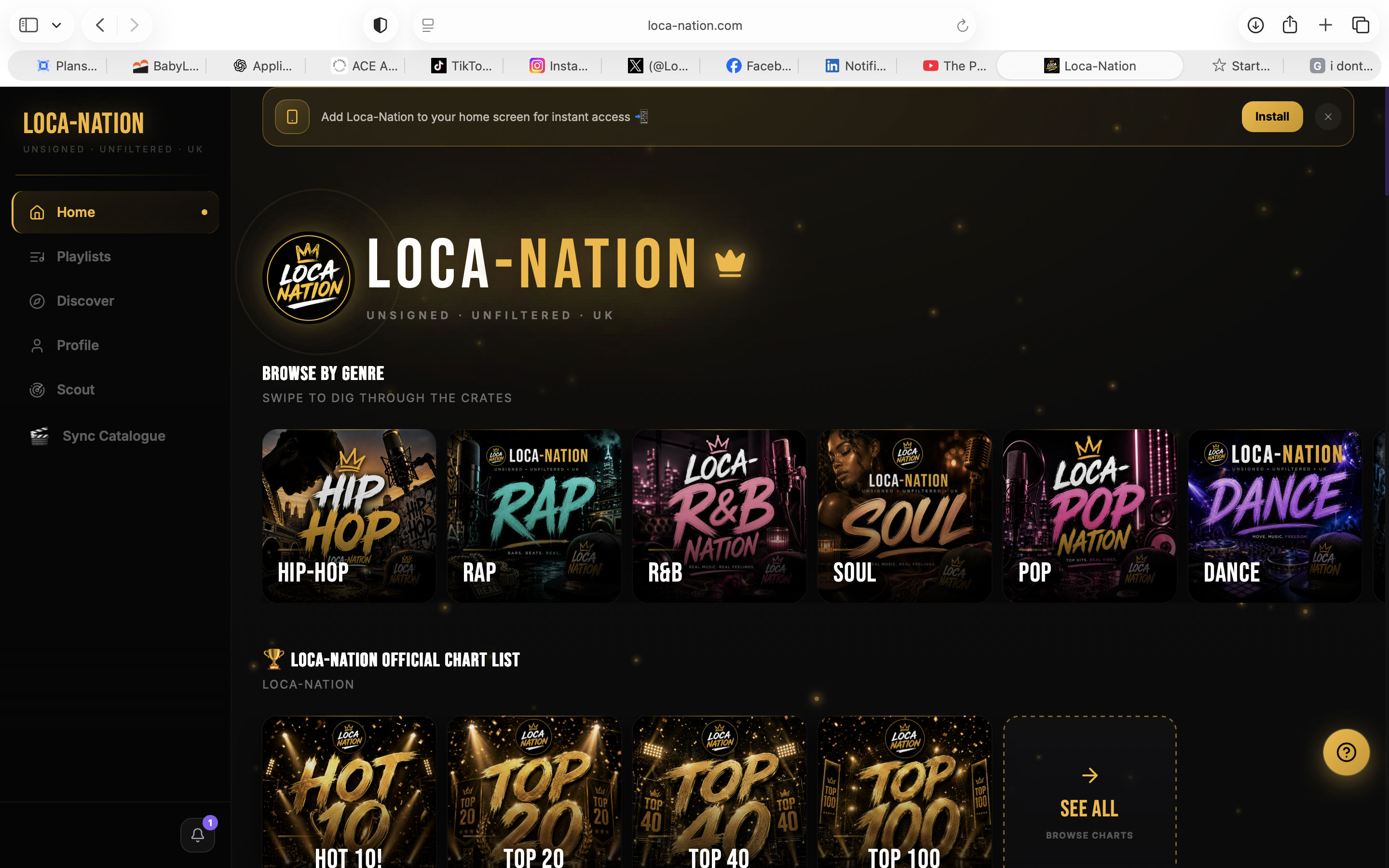
Loca-Nation's chart system surfaces your tracks to real listeners in your genre and region, and that engagement becomes the perfect moment to invite someone onto your list. Setting up your artist profile through genre onboarding takes minutes, and once you're charting locally, you can point every new listener toward your signup form while their interest is highest. Artists building toward sync placements can also explore the sync catalogue as a longer-term revenue path once their list and profile carry real momentum. If you already have a signup flow through a smart link or link-in-bio, keep it. Add your Loca-Nation profile as another engaged-listener funnel feeding the same list, then check your genre onboarding page to get started this week.
Frequently Asked Questions
Do I really need a musician email list if I already have social media followers? Yes. Social platforms can restrict your reach or disappear entirely, but your email list stays under your control regardless of algorithm changes.
How many subscribers do I need before an email list is worth the effort? Start at zero. Even a list of 50 engaged fans who open every email outperforms 5,000 disengaged social followers who never see your posts.
What's the best lead magnet for a musician email list? An unreleased track or early ticket access tends to convert best, since it gives fans something they genuinely can't get anywhere else.
How often should I email my subscribers? Twice a month is a solid starting point. Increase frequency around a release or tour, then scale back during quiet periods.
Is it okay to buy an email list to grow faster? No. Purchased lists damage your sender reputation, increase spam complaints, and can get your domain blacklisted by major inbox providers.
Sources
- Email Marketing for Musicians — Twilio SendGrid insights
- Email Marketing for Musicians: Build a List That Converts - Discovery Music Group
- Music Email Marketing: How to Build and Use an Email List as an Artist | NotNoise