
Getting noticed as an independent artist comes down to one thing: running a real campaign instead of just pressing upload. Music publishing basics, in practical terms, means uploading several weeks before release, driving saves and repeat listens hard in the first seven days, and giving your track a shot at charts and playlists through platforms built for discovery, including Loca-Nation.
TL;DR:
- Lock your release assets, metadata, and rights early, ensuring consistency and correctness to prevent coverage gaps and algorithm issues during the first week.
- Follow a strict 6-8 week release timeline, dedicating time to seed creators, pitch playlists, and finalize assets before launch to maximize first-week impact.
- Properly register your tracks with PROs and verify your ISRCs to ensure royalties are correctly tracked and your chart eligibility is not compromised.
- Focus promotion efforts on targeted playlists, creator seeding, and owned channels like email lists, rather than relying solely on algorithmic discovery or paid ads.
- Use platforms like Loca-Nation to build organic chart momentum through genuine listener engagement, which is vital for visibility among industry professionals.
Table of Contents
- Quick Release Checklist: Assets, Metadata and Rights to Lock Before You Upload
- The 8-Week Release Timeline: What to Do, and When
- Distribution and Metadata: Avoiding the Mistakes That Cost You Chart Eligibility
- Promotion Tactics That Actually Move the Needle
- What to Watch in the First 7 to 14 Days
- Jason's Take: What Actually Separates Releases That Chart From Ones That Don't
- What Music Publishing Actually Means for Independent Artists
- The Rights That Sit Behind Every Stream You Get
- What a Music Publisher Actually Does
- Registering Your Songs With a PRO
- Understanding Royalties and Where Your Money Actually Comes From
- Publishing Rights vs. Master Rights: The Distinction That Confuses Almost Everyone
- Why the Standard Release Advice Undersells Execution
- Get Your Music in Front of Real Listeners With Loca-Nation
- Further Resources for Your Release Campaign
- Sources
Quick Release Checklist: Assets, Metadata and Rights to Lock Before You Upload
Every wasted stream in week one usually traces back to a mistake made weeks earlier. Before you touch a distributor's upload page, get these locked:
- Audio: final WAV master, loudness checked, file named consistently (no "FINAL_v3_edit2.wav").
- Artwork: 3000×3000 PNG or JPEG, checked against each platform's aspect ratio requirements.
- Metadata: artist name spelled identically everywhere, full contributor credits, correct genre tags, verified UPC and ISRC, accurate explicit flags.
- Rights and registrations: PRS or your local PRO registration filed, ISRC confirmed if you're selling directly, any samples or co-writes cleared in writing.
- Platform assets: Spotify Canvas video, current press photo, a two-sentence bio, and one smart link that covers every store.
Skipping the metadata step is the most common unforced error. A mismatched artist name across two releases splits your streaming history and can quietly tank your algorithmic credibility before the song even drops.
Pro Tip: Build a single shared document (or spreadsheet) with every asset and its file location before release week. Chasing down artwork at the last minute is how release dates slip.
The 8-Week Release Timeline: What to Do, and When
Independent artists who treat release day as a single event, rather than the midpoint of a campaign, consistently underperform. A structured 6 to 8 week window gives you room to pitch editorial playlists, build a pre-save audience, and seed short-form content before anyone hears the track.
- Week 8: Lock your release date, upload to your distributor, and reserve editorial pitching windows.
- Weeks 6 to 4: Shoot teaser content, launch your pre-save page, and start seeding 20 to 40 micro creators.
- Week 4: Submit your Spotify editorial pitch and compile a list of independent curators to contact.
- Weeks 3 to 1: Push the pre-save link hard, send press outreach, finalize your Canvas and artwork, and batch your social content.
- Release week: Activate every channel at once, check analytics daily, and reply to fans in real time.
- Post-release: Keep working curator outreach, repurpose your best content, and start planning the next single.
Here's how that maps onto a working calendar:
| Timeframe | Primary focus | Key deliverable |
|---|---|---|
| Week 8 | Distributor upload | Release date locked, metadata submitted |
| Weeks 6–4 | Content and audience build | Teaser videos, pre-save live, creator seeding begins |
| Week 4 | Editorial and curator pitching | Spotify pitch submitted, curator list built |
| Weeks 3–1 | Final push | Pre-save promotion, press outreach, assets finalized |
| Release week | Full activation | All channels live, daily analytics checks |
| Post-release | Momentum and iteration | Curator follow-up, content reuse, next release planning |
Rushing this timeline is the fastest way to sabotage a good song. Guides on independent release strategy consistently point out that uploading late causes missed editorial windows and weaker first-week signals that never fully recover.
Distribution and Metadata: Avoiding the Mistakes That Cost You Chart Eligibility
Distributors need your release 4 to 8 weeks ahead of time for a reason. That window is what lets stores process the release properly and gives you access to pre-save tools and pitching windows that simply don't exist if you upload the week before.
Your ISRC (International Standard Recording Code) is the identifier that ties every stream and sale back to your track in reporting systems. Get it wrong, and those numbers may never reach the systems that determine chart position, because incorrectly linked ISRCs can be excluded from official chart data entirely.
Before you submit, check:
- Territory settings match where you're actually promoting.
- Your artist profile name matches exactly across every platform and prior release.
- Featured artists and producers are credited the same way every time.
Pro Tip: Pull up your ISRC in your distributor's dashboard a few days after release and cross-check it against your Spotify for Artists data. Catching a mismatch in week one is fixable. Catching it in week six often isn't.
Promotion Tactics That Actually Move the Needle
Not every promotional channel deserves equal time. Independent artists get the best return from a short list of tactics, executed consistently rather than sporadically.
Playlists split into three lanes: editorial (pitch 3 to 4 weeks early and don't expect a fast answer), algorithmic (driven almost entirely by saves and complete listens in the first 48 to 72 hours), and independent curators (who respond to personalized, specific outreach, not mass blasts).
Short-form video and creator seeding is where most discovery now happens. Seed 20 to 40 targeted creators whose existing content matches your sound, give them a clear format to model, and post your own content 3 to 5 times a week for the length of the campaign. This works best as genuine creative collaboration rather than a transactional ask.
Owned channels matter more than most artists assume. A smart link that funnels everyone to one destination is table stakes, but your email list remains the highest-converting channel you control, precisely because algorithmic attention is temporary and owned audiences aren't.
Paid promotion should come after organic traction shows up, not before. Start with a small budget, watch the return closely, and scale only what's clearly working.
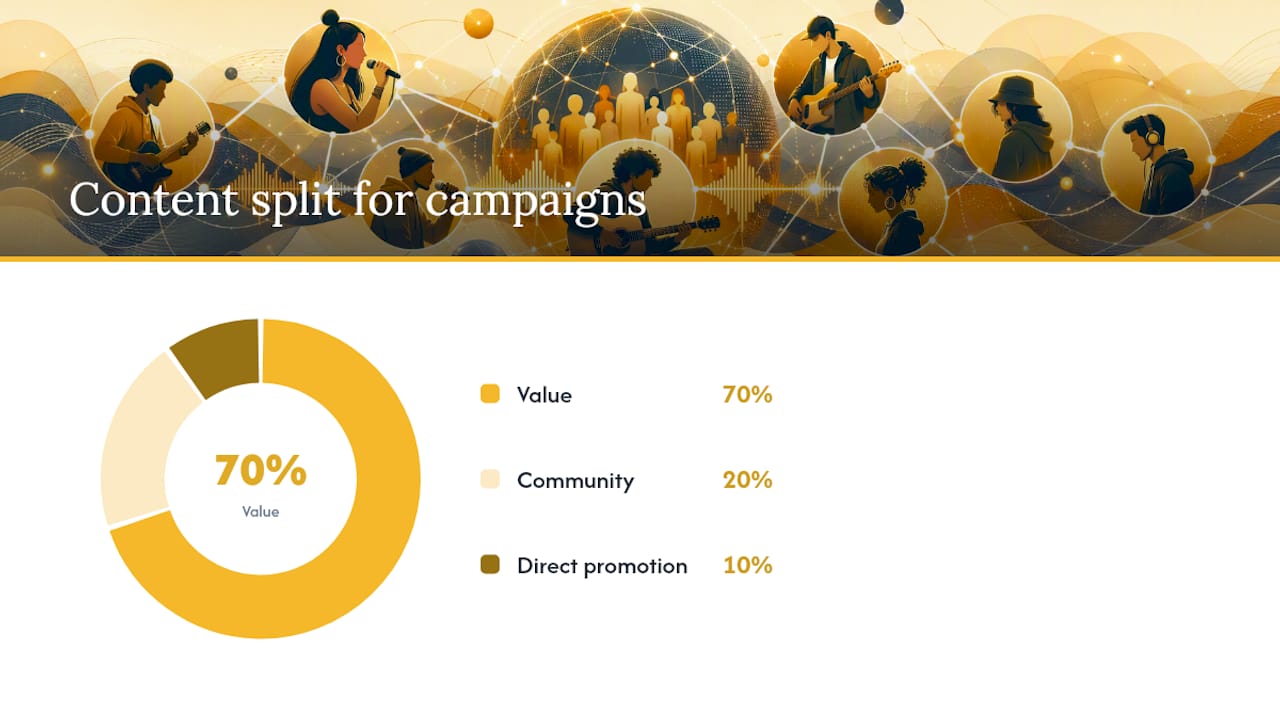
Across all of it, a content split favoring mostly value, some community, and little direct promotion keeps your feed from turning into a constant sales pitch: 70% value (behind the scenes, process, story), 20% community (replies, shoutouts, fan content), 10% direct promotion.
Pro Tip: *Treat your first 20 creator DMs as a test, not a campaign.
What to Watch in the First 7 to 14 Days
The first two weeks tell you almost everything about whether a track is finding an audience. Prioritize saves, repeat and full listens, skip rate, playlist adds, and any geographic spikes in your streaming data.
- High saves: Push more budget and creator outreach into whatever region is driving them.
- High skip rate: The hook isn't landing. Test a different opening 15 seconds, especially for TikTok clips.
- Strong organic traction: Consider Spotify's Discovery Mode or a small paid boost to extend reach.
- Flat but stable numbers: Keep doubling down on organic outreach rather than switching strategy entirely.
Properly linked ISRCs matter here too. Every stream and direct sale only counts toward chart position if it's correctly attributed, which is why the metadata work from week eight pays off in week one.
Jason's Take: What Actually Separates Releases That Chart From Ones That Don't
The gap is rarely talent. It's whether the artist treated release day as a finish line or a starting gun.
Do: lock your metadata early, seed creators like collaborators, and check analytics daily during release week. Don't: upload late and hope editorial notices, or blast the same DM to fifty creators.
For deeper templates, the music marketing plan and press release examples on the blog cover both in detail. Loca-Nation's chart system rewards exactly the engagement signals this plan is built to generate.
What Music Publishing Actually Means for Independent Artists
In the context of self-releasing, music publishing basics refers to the practical work of getting a recording distributed, discovered, and heard, not the legal machinery of copyright administration. It's the operational side of releasing music: choosing a distributor, setting a release date, uploading correctly formatted assets, and running the promotional push that turns a finished track into something people actually hear.
For unsigned artists, this is the entire game. You're not waiting on a label's marketing department or a publisher's connections. You're the one deciding when the track uploads, who hears the teaser first, and which curators get a personal message instead of a form email.
That doesn't mean the business side disappears. You still need your release registered, your rights in order, and your royalties flowing correctly. But the day-to-day work that determines whether a song charts or disappears is almost entirely about execution: timing, metadata accuracy, and how aggressively you seed the first week of attention. Treat that execution as seriously as a label would treat a signed act, and the platform-level playing field (charts, playlists, discovery algorithms) genuinely doesn't care whether you're signed.
The Rights That Sit Behind Every Stream You Get
Every time your track gets streamed, three different types of rights are quietly at work behind the scenes. Mechanical rights cover the reproduction and distribution of a composition, which is what gets triggered when your song is pressed, downloaded, or streamed. Performance rights cover the public performance of that composition, whether that's radio play, a streaming platform, or a live show, and these are the rights your PRO (Performing Rights Organization) is built to track and collect on.
Sync rights are different again: they govern the use of a recording paired with visual media, like a TikTok video, a film, or an ad. Sync deals are increasingly where independent artists find real income, because platforms and brands need music at a volume traditional licensing deals can't supply fast enough.
For a self-releasing artist, understanding which right applies to which use matters because it determines who owes you money and through which channel. A stream owes you both mechanical and performance royalties. A brand using your song in a commercial owes you a sync fee. Missing the registration that captures any one of these means leaving real money uncollected, even on a track that's performing well.
What a Music Publisher Actually Does
A music publisher's core job is administering the compositional side of a song: registering it with the right PRO, tracking where it's used, collecting royalties owed, and pursuing sync placements on the songwriter's behalf. Traditionally, publishers acted as the connective tissue between a songwriter and every entity that might owe them money for using their composition.
For most unsigned artists, that role either doesn't exist yet or is being handled by the artist themselves. That's not necessarily a disadvantage. Digital registration tools and PRO self-service portals have made it realistic for an independent artist to do the administrative side of publishing without signing away a percentage to a third party, at least in the early stages of a career.
The trade-off is that a publisher also brings relationships, sync pitching experience, and catalog leverage that an artist working alone has to build from scratch. If sync placement becomes a serious revenue goal, tools built specifically for sync licensing readiness can help close some of that gap without requiring a publishing deal.
Registering Your Songs With a PRO
Getting your compositions registered with a Performing Rights Organization is a non-negotiable step, and it's one many self-releasing artists put off far longer than they should. A PRO's job is to track public performances of your songs and collect royalties on your behalf. Without registration, those royalties either go uncollected or, worse, get misdirected.
The process itself is straightforward: create an account with your PRO, submit each composition with full and accurate writer and publisher splits, and list every recording tied to that composition as it releases. Splits matter enormously here. If you co-wrote a track and the percentages aren't documented and registered correctly, resolving a dispute later gets expensive and slow.
Registration should happen before or immediately alongside release, not months after. Streaming, radio play, and live performances all start generating royalty-triggering activity the moment your song is public, and any performance that happens before you're registered is revenue you likely won't recover retroactively. Building this into your release checklist, alongside your ISRC and metadata work, keeps it from becoming an afterthought.
Understanding Royalties and Where Your Money Actually Comes From
Royalties for an independent artist arrive through several distinct pipelines, and knowing which is which helps you spot when something's missing. Streaming royalties come from platforms like Spotify and Apple Music and get split, in simplified terms, between the recording side (your master) and the composition side (your publishing).
Mechanical royalties apply to reproductions of your composition, whether that's a stream, a download, or a physical copy. Performance royalties get collected by your PRO whenever your song is performed publicly, which includes radio, TV placements, and live shows. Sync royalties come from licensing a recording for use alongside visual media, and they're typically negotiated as a flat fee rather than an ongoing royalty stream.
The reason so many independent artists leave money on the table isn't a lack of talent. It's incomplete registration. A song streaming at a healthy pace but registered incorrectly with a PRO, or not registered at all, is quietly losing income every single day it stays live. Treating royalty registration with the same urgency as your release date is one of the more genuinely underrated habits separating artists who build sustainable careers from those who don't.
Publishing Rights vs. Master Rights: The Distinction That Confuses Almost Everyone
Publishing rights and master rights are two entirely separate forms of ownership, and confusing them is one of the most common mistakes independent artists make when negotiating anything from a sync deal to a distribution agreement.
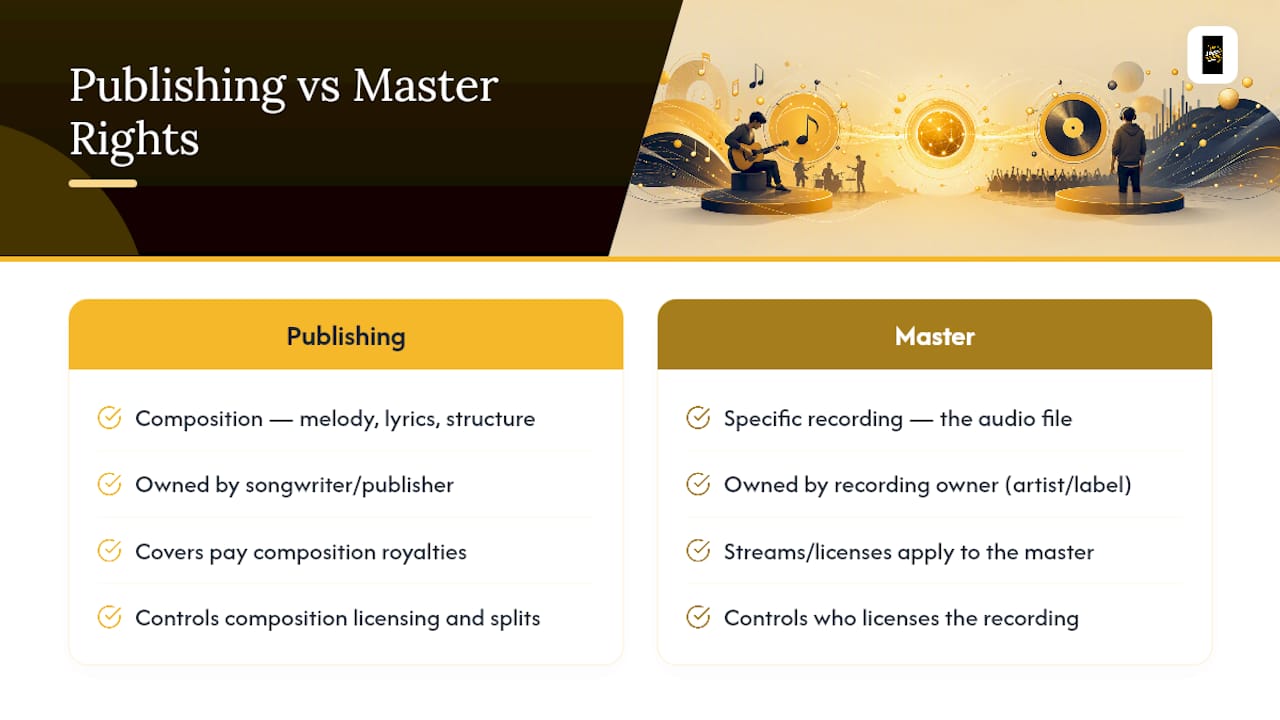
Publishing rights cover the composition itself: the melody, lyrics, and underlying musical structure, regardless of who performs it. If someone else covers your song, they owe composition royalties to you (or your publisher) as the songwriter, even though they own the recording of their own version.
Master rights cover the specific recording, the actual audio file that gets streamed or licensed. If you self-fund and self-release a track, you typically own both the master and the publishing outright, which gives you full control over how it's licensed and monetized. That changes the moment a label or investor funds the recording, since master ownership is frequently what gets negotiated away in those deals.
For a self-releasing artist, owning both rights outright is a genuine advantage worth protecting. It means every sync opportunity, every cover version, and every licensing inquiry routes back through you, with no split obligations to a label or outside master owner. Knowing which right you're being asked to license, or sign away, before agreeing to any deal is the difference between a fair deal and a costly one.
Why the Standard Release Advice Undersells Execution
Most guides to releasing independent music spend too much time on which platform to use and not nearly enough on the discipline of running a real campaign. The research is consistent on this point: systematic artists who plan assets, pitch early, and seed creators outperform artists relying on a single lucky playlist placement, and it isn't close.
The overrated piece of conventional wisdom is the idea that a strong track will "find its audience" through algorithms alone. Algorithms respond to early signals, saves, repeat listens, low skip rates, that you have to manufacture through outreach in the first 72 hours. Waiting passively for discovery to happen is the single most common reason a good song underperforms.
What should come first, before content calendars or paid ads, is the boring infrastructure: correct ISRCs, PRO registration, a locked release date with real pitching lead time. Get that right, and a platform built around genuine listener engagement, rather than industry connections or ad spend, becomes a real path to visibility instead of a long shot.
— Jason
Get Your Music in Front of Real Listeners With Loca-Nation
Loca-Nation is the discovery route built for exactly the campaign outlined above: an official chart for unsigned and independent artists where position is earned through genuine listener votes, not label budgets or ad spend.
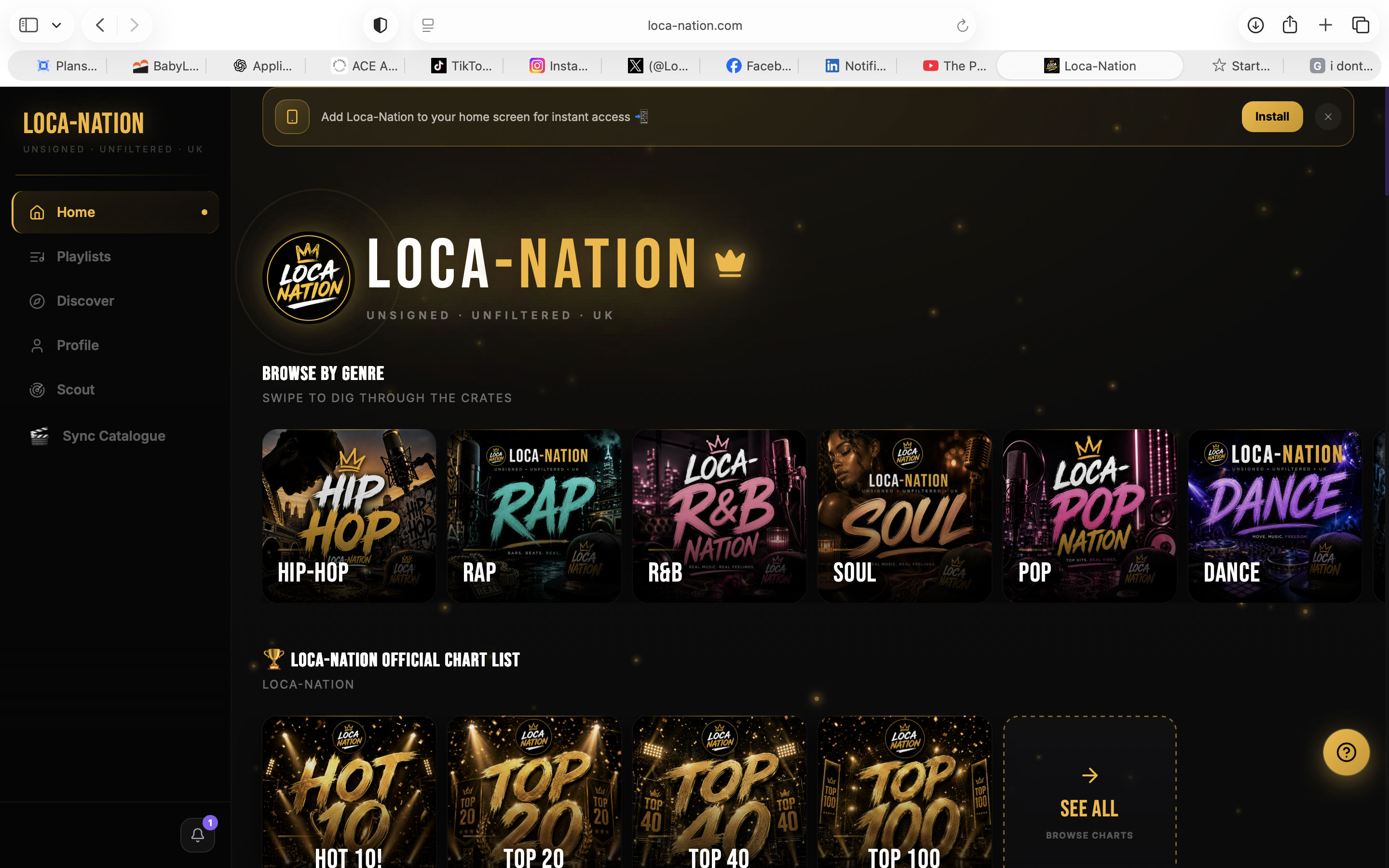
You upload your track, build a public profile, and compete for chart position by local area, region, genre, and eventually national level, all completely free for artists to start. That structure means the promotional work you're already doing during your 8-week campaign, driving saves, seeding creators, pushing engagement, directly feeds your chart standing and puts you in front of the labels, scouts, and industry professionals who use the platform to find new talent. There's no pay-to-chart mechanism working against you.
If you've got a release date locked and a campaign underway, create your artist profile on Loca-Nation and start building chart momentum around it now.
Further Resources for Your Release Campaign
For deeper templates: the release strategy guide and ISRC vs. UPC explainer cover the technical details in full.
Sources
- How to Promote Your Music Without a Record Label in 2026: Complete Independent Artist Guide | Harment
- How to Release Music Independently: A Step-by-Step Guide | Tools 4 Music Blog | Tools 4 Music 2026
- ISRC FAQ — SoundScan (ISRC explanation)
- Music Marketing Strategy: The Complete Guide for Independent Artists in 2026 | NotNoise