

Build a single, web-first EPK — one shareable URL that plays audio and video in-page, shows current numbers, and makes contact obvious. That is the format industry guidance consistently recommends, and it is the one bookers, A&Rs, and sync supervisors actually open. A rough version can be built quickly, and a polished one may take several hours.
Before you build anything, confirm you have these:
- A hero photo (high-res, professional or near-professional quality)
- A play button visible without scrolling — music that loads instantly, no redirects
- A direct booking email in plain sight
Recommended build path: Spend the first 15 minutes uploading your top 3 tracks, a hero photo, and a contact email to any hosted platform. Spend the next 2 hours adding video, press quotes, a polished bio, and metadata.
Pro Tip: Open your EPK URL on your phone the moment you think it is done. If the music does not play within 2 seconds or the contact email is below the fold, fix those two things before you send it to anyone.
Key Takeaways
A web-first EPK with inline playback, a visible contact email, and live analytics is the format that gets replies — everything else is a backup.
| Point | Details |
|---|---|
| Web-first format wins | A single responsive URL with inline audio/video outperforms any PDF or ZIP attachment. |
| Six finish-line checks | Mobile play, contact visible, hero photo, 3–10 tracks, 60–90s video, analytics active. |
| Bio length matters | Keep 60–80 words at the top; save the 200–300 word version for press and label outreach. |
| Update cadence | Refresh streaming numbers monthly; update your hero photo and credits at least once a year. |
| Loca-nation press centre | Loca-nation's hosted press page covers EPK basics for unsigned artists, with built-in analytics and industry exposure. |
Table of Contents
- How to make an EPK: what it is, who uses it, and when to send it
- Core elements every modern EPK must include
- Format choices and hosting: web-first vs PDF backup
- Templates, EPK builders, and when to use each
- Design guidance and technical media specs
- How to share your EPK and pitch it effectively
- Common EPK mistakes that kill replies
- Compact build plan: from 15 minutes to a polished EPK
- Why a web-first EPK outperforms a static PDF
- What I actually learned building mine in an afternoon
- Loca-nation's press centre as your hosted EPK
- Handy links and templates to get started
- Sources
How to make an EPK: what it is, who uses it, and when to send it
An EPK (electronic press kit) is a digital portfolio — ideally a single shareable URL — that gives music industry professionals everything they need to evaluate and book you without asking follow-up questions. Mi frames it as the artist's first impression: the document that either opens a door or closes it.
Different recipients scan for different things. Here is what each role looks for first:
| Recipient | First thing they check | What seals the deal |
|---|---|---|
| Booking agent | Hero photo + instant play | Availability, tech rider, recent show list |
| A&R / label | Streaming numbers + top track | Bio with credits, social traction |
| Music journalist | Long bio + press quotes | High-res photos, story angle |
| Sync supervisor | Catalog + metadata (ISRC, BPM) | Clean rights info, genre tags |
| Festival programmer | Live video + genre fit | Past festival credits, stage setup |
When to send it:
- Pitching a venue or festival slot
- Press outreach for a single or album release
- Sync licensing submissions
- Label or management introductions
- Any application form that asks for "artist info" or "press materials"
Short EPK for bookers and festival programmers; long version with full bio and press history for journalists and labels. Tailor the link or the page layout to match.
Core elements every modern EPK must include
A review of thousands of EPKs by Artist Results identifies eight elements that separate kits that get replies from ones that get ignored. Collect these assets before you open any builder.
Hero section
Your name, a professional photo, a one-line genre and location tag ("Indie Soul | Manchester"), and a visible play button. Nothing else above the fold. A booker should be able to hear your music before they scroll once.
Audio
Several curated tracks, embedded for instant in-page play. Lead with your strongest one or two. For sync submissions, include basic metadata: ISRC codes, BPM, key, and mood tags. WaterBear's EPK guide confirms that scannable, professionally presented music is non-negotiable for every recipient type.
Bio
Two versions. A short bio for quick scans sits at the top of the page. A longer version lives further down or on a dedicated press tab for journalists. NotNoise recommends leading the short bio with genre, base location, and two or three notable credits — that structure gives a booker everything they need in one read.
Video reel
About a minute of video, preferably live-performance footage. A short live clip often outperforms a high-production music video for booking purposes because it shows stage presence and technical fit. Embed via YouTube or Vimeo so it plays in-page without redirects.
Press and credits
Pull quotes from reviews, radio features, or playlist placements. Logos of outlets that have covered you. A list of recent shows from the last 12 months. These are your social proof layer — even one credible quote changes how a recipient reads everything else.
Contact and booking
A direct booking email, visible without scrolling. If you have a manager or agent, list their contact instead. Never bury this at the bottom of the page.
Optional but worth adding:
- Tech rider (for live performers — link to a downloadable PDF)
- Press photo pack (ZIP of 3–5 high-res images in landscape and portrait)
- Rights and publishing details for sync submissions
- Links to your sync catalogue if you are pitching supervisors
Format choices and hosting: web-first vs PDF backup
Most artists make an EPK as a PDF first. That is the wrong order. A static PDF cannot play music, cannot show live streaming numbers, and cannot tell you whether anyone opened it.
Web EPK vs PDF/ZIP — the real trade-off:
- Web EPK: inline playback, mobile-first, live analytics, auto-updating stats, shareable URL — the format industry professionals prefer
- PDF/ZIP: offline-friendly, printable, useful as a backup for email attachments or applications that require a file upload — not a replacement for the live URL
Pick the web EPK as your primary asset. Keep a PDF version for the rare cases where a form demands a file.
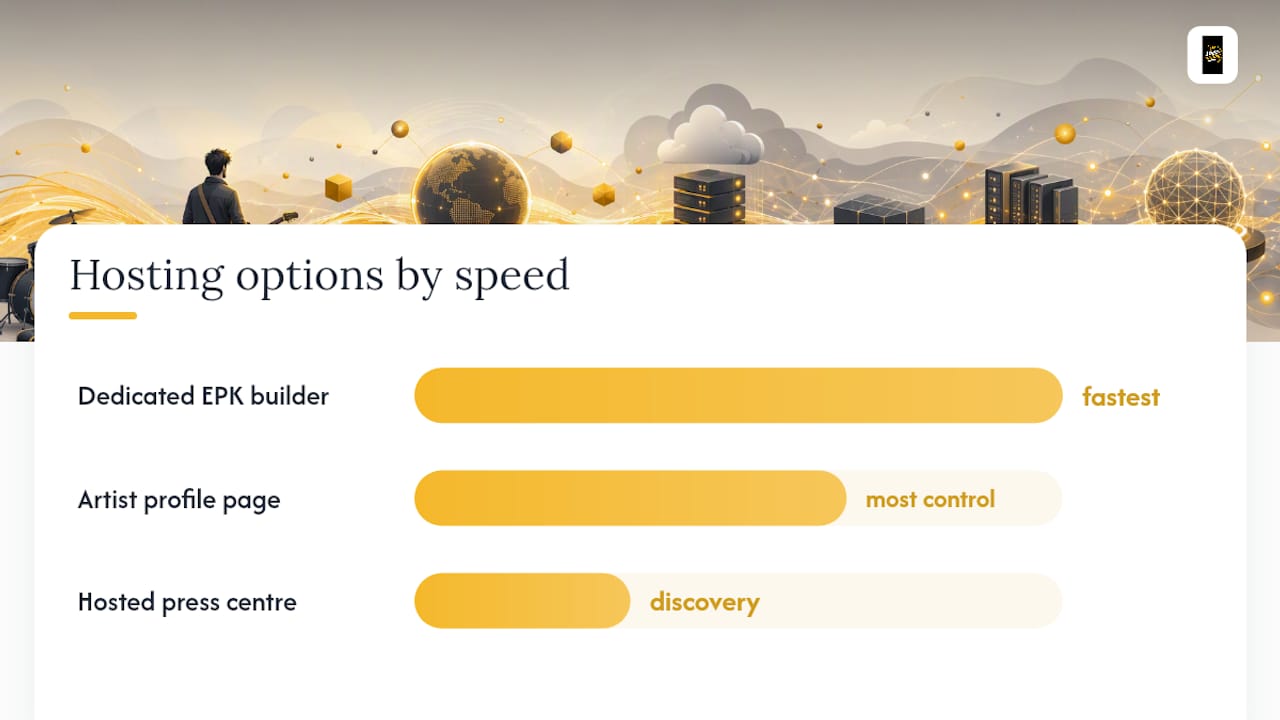
Hosting options, ranked by speed:
- Dedicated EPK builder (fastest setup, hosted URL, built-in analytics) — best for artists who want a live page in under an hour
- Artist profile page on your own site (most control, custom domain) — best when you already have a website and want everything in one place
- Hosted press centre on a music platform — best for unsigned artists who want built-in discovery alongside the press page
Quick setup steps:
- Choose your platform or builder
- Connect your streaming profile or upload your top 3 tracks directly
- Upload your hero photo and write your short bio
- Set your booking email as the primary contact
- Copy the shareable URL and test it on a phone
On custom domains: start with the platform's subdomain (e.g., yourname.platform.com). Move to a custom domain (yourname.com/epk) once you are booking regularly and the EPK is stable. The URL format matters less than whether the page loads fast and plays music immediately.
Templates, EPK builders, and when to use each
The right tool depends on one question: does it support inline audio/video playback and provide analytics? If the answer is no, do not use it as your main EPK.
| Tool type | Best for | Typical cost | Key limitation |
|---|---|---|---|
| Dedicated EPK builder (e.g., DropCue) | Fast setup, live analytics, sync pitching | Free trial → paid monthly | Limited design flexibility |
| Website builder with EPK template (e.g., Squarespace, Wix) | Full-site needs, custom domain, long-term brand | Low-cost monthly | More setup time required |
| Music platform press centre | Unsigned artists, built-in discovery, chart exposure | Free → premium tier | Platform-dependent URL |
| PDF template | Press packet backup, file-upload applications | Free | No playback, no analytics |
DropCue's EPK builder is a practical example of the hosted-builder category: artists can assemble a live, auto-updating page with embedded playback in minutes. For artists who need a press packet alongside a live page, a PDF template from a resource like ImprovisedMusic.ie covers the static backup case.
Decision rule: free tools are fine for a first version. Upgrade to a paid plan when you are pitching regularly and need analytics to prioritize follow-ups. Never pay for a tool that does not show you who opened your EPK and whether they played a track.
Design guidance and technical media specs
Speed and clarity are the design brief. A booker who has to wait for a photo to load or scroll past three paragraphs to find a play button will not wait.
Media specs:
| Asset | Recommended format | Spec |
|---|---|---|
| Hero photo | JPEG or WEBP | High-resolution, compressed for fast loading |
| Press photo pack | JPEG | 300 DPI, both landscape and portrait orientations |
| Audio (streaming) | MP3 or AAC | High-quality audio encoding |
| Video reel | MP4 (H.264) | 1080p, 60–90 seconds, under 500MB |
| PDF press pack | Under 10MB; embed fonts |
Design rules that actually matter:
Keep the above-the-fold area clean: name, photo, one-line tag, play button. That is it. High contrast between text and background is not a style choice — it is a legibility requirement on a phone screen in daylight. Use a minimum 16px body font size for mobile. Every extra element above the fold costs you a second of attention you cannot afford to lose.
Accessibility:
Add alt text to every image. Caption your video reel where possible — some recipients watch without sound. Run your color palette through a contrast checker (WebAIM's contrast checker is free) to confirm your text meets WCAG AA standards. An accessible EPK reaches more people and signals professionalism.
Lazy-load any assets below the fold so the hero and play button appear instantly.*
How to share your EPK and pitch it effectively
Sending the link is the easy part. Getting a reply requires a pitch that matches the recipient's job.
Short pitch formats by recipient:
- Booker: "Hi [Name], I'm [Artist], a [genre] act based in [city]. I'm looking to play [venue/festival] in [month]. Here's my EPK: [URL]. Available [dates]. Happy to send a tech rider."
- Music journalist: "Hi [Name], I'm [Artist] — [one-line story hook, e.g., 'a producer blending grime and classical strings']. My new single [Title] drops [date]. Full press kit and hi-res photos here: [URL]."
- Sync supervisor: "Hi [Name], I have a catalog of [genre] tracks with cleared rights, ISRC codes, and metadata. EPK and sync catalog: [URL]. Open to briefs."
Subject lines that get opened:
- Booker: "Booking inquiry — [Artist Name] | [Genre] | [City] | [Month]"
- Press: "Press release + EPK — [Artist Name] — [Single/Album Title]"
- Sync: "Sync-ready catalog — [Genre] — [Artist Name] EPK"
Follow-up schedule:
- Send the initial pitch with the EPK link
- Follow up after 48–72 hours if no reply — one sentence, same thread
- One final follow-up after 7 days: "Just checking this landed — happy to send anything else you need"
- After that, move on. Three contacts is the professional limit
Where to place your EPK link:
- Email signature (label it "EPK" or "Press Kit")
- Instagram, TikTok, and Twitter/X bios
- Linktree or similar link-in-bio page
- Festival and venue application forms
- Direct messages when relevant (always lead with context, not just a link)
Label the link clearly: "EPK — [Artist Name]" removes any ambiguity about what the recipient is clicking.
Common EPK mistakes that kill replies
The errors that cost artists the most replies are not about quality. They are about friction.
Do not do these:
- Send a PDF as your primary EPK — no playback, no analytics, no live numbers
- Attach a ZIP file to a cold email — it reads as spam and often gets blocked
- Bury the contact email below a long bio or a gig history list
- Include every track you have ever released — curate to 3–10, lead with your best
- Leave placeholder sections ("bio coming soon") — delete them or fill them
High-impact fixes you can make in under 10 minutes:
- Move the play button above the fold
- Cut the bio to 80 words at the top (keep the long version lower on the page)
- Replace a broken embed with a direct Spotify or SoundCloud link as a fallback
- Add a "Book [Artist Name]" button that opens a mailto link directly
Testing checklist before you send:
- Open the URL on an Android and an iPhone
- Confirm music plays within 2 seconds, no login required
- Click the contact email — does it open a mail client?
- Send the link to a trusted friend on a different phone and ask them to find your booking email in under 10 seconds
If they struggle, fix it before you pitch.
Compact build plan: from 15 minutes to a polished EPK
A 15-minute version that ships beats a perfect version that never does. DropCue's 2026 build guide makes the same point: ongoing iteration on a live page outperforms a months-long build every time.
15–30 minute "ship it" version:
- Choose a hosted platform or EPK builder (free tier is fine)
- Upload your hero photo
- Pick your top 3 tracks and embed or upload them
- Write a 60–80 word bio (genre, location, 2–3 credits)
- Add your booking email as the primary contact
- Copy the URL, open it on your phone, confirm music plays
That is a functional EPK. Send it.
2–3 hour polish pass:
- Add a short live-performance video, embedded via YouTube or Vimeo
- Pull 1–3 press quotes and add outlet logos
- Write the long bio (200–300 words) for the press section
- Add ISRC codes and metadata to each track for sync readiness
- Upload a press photo pack (A set of press images, landscape and portrait)
- Connect analytics so you can track opens and play-throughs
Cost brackets:
- Free: hosted platform free tier, Canva for photo editing, YouTube for video hosting
- Low-cost ($5–$15/month): dedicated EPK builder with analytics, custom subdomain
- Premium ($20–$50/month): full website builder with custom domain, advanced analytics, sync submission tools
Pre-send test checklist:
- Phone check on iOS and Android
- Play test: music loads in under 2 seconds
- Contact test: booking email is visible without scrolling
- Share the link with 3 trusted industry contacts and ask for honest feedback before your first real pitch
Why a web-first EPK outperforms a static PDF
Apple Music for Artists' guidance is direct: a single, responsive web-based EPK that plays audio and video inline, is mobile-friendly, and provides visitor analytics is the format industry professionals prefer. A PDF cannot do any of those three things.
The speed issue is the one most artists underestimate. Decision-makers scan an EPK in seconds, not minutes. If your strongest track is not playing before they scroll, you have already lost most of them. That is why content order above the fold matters as much as content quality.
What to track with analytics:
- Page opens (who opened it and when)
- Track play-throughs (which track gets played to completion)
- Click-throughs on the contact or booking link
- Repeat visits (a booker who opens your EPK three times is a warm lead)
How to use that data:
- Prioritize follow-ups with contacts who opened the page and played a track
- If a track gets skipped consistently, move a different one to the lead position
- A contact who opened your EPK multiple times but has not replied is worth a direct follow-up
Pro Tip: Before your next follow-up email, check your analytics. A recipient who opened your EPK twice and played the lead track to completion is a hot lead — mention it naturally: "I saw you had a chance to check the kit — happy to answer any questions."
What I actually learned building mine in an afternoon
The first hour of building an EPK is almost always wasted on the wrong things. Most artists spend it choosing fonts and color schemes. The booker does not care about your font. They care whether your music plays and whether they can reach you.
What actually moved the needle: getting a real photo (not a phone selfie), writing the short bio three times until it was under 80 words and led with something specific, and embedding a live clip instead of a studio music video. The live clip booked the first show. The studio video has never been mentioned by a single booker.
The one thing I wish I had known earlier: analytics change how you pitch. Once you can see that a contact opened your EPK and played the lead track twice, the follow-up email writes itself. Without that data, you are guessing. With it, you are having a conversation.
Loca-nation's press centre as your hosted EPK
For unsigned artists, setting up a separate website just to host an EPK is often overkill. Loca-nation's Press Centre gives you a hosted, shareable press page that maps directly to what an EPK needs: artist profile, music, analytics, and direct exposure to industry professionals.
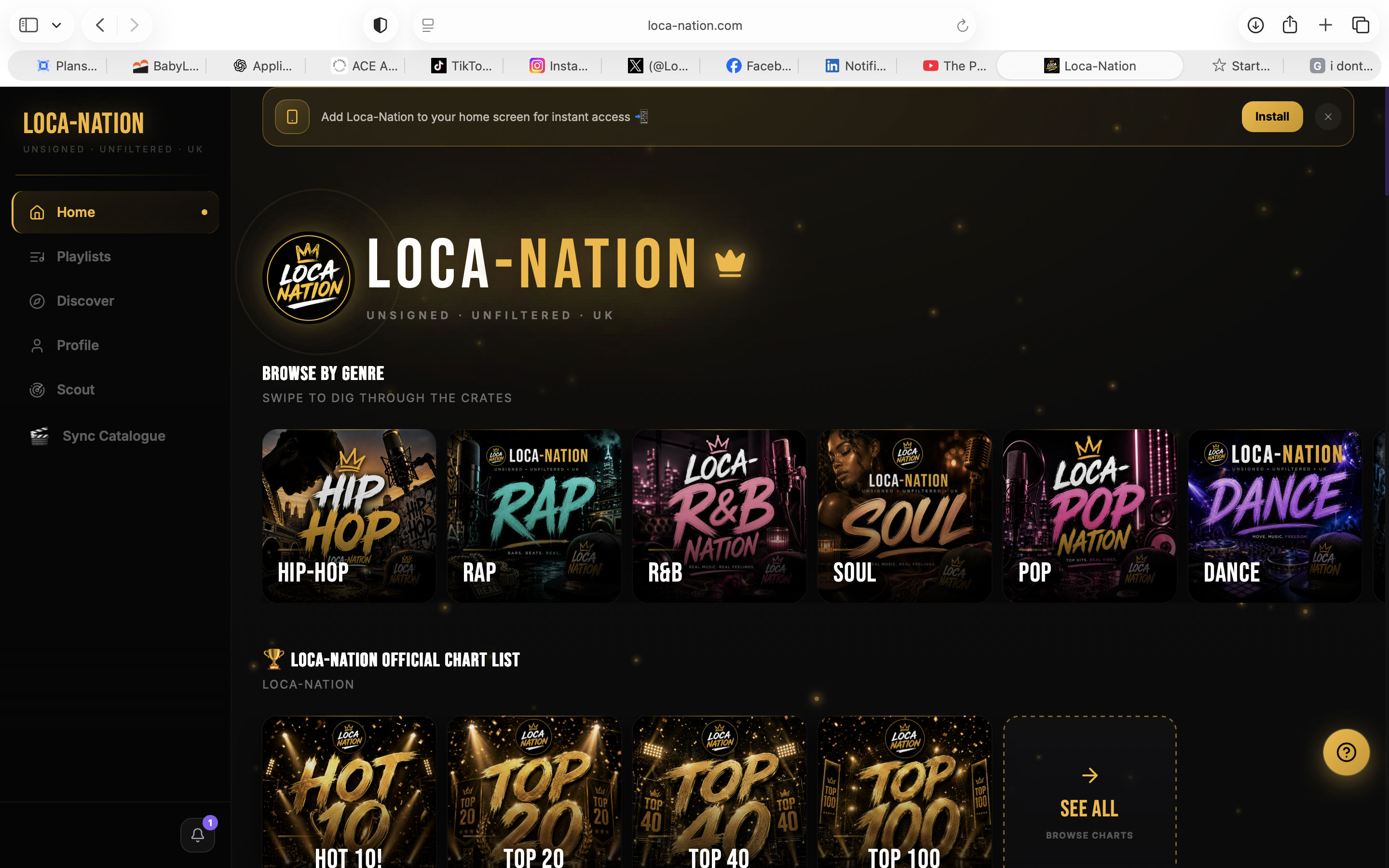
Here is what that looks like in practice:
- Your artist profile acts as the hero section — name, photo, genre, and playable tracks in one place
- Built-in analytics show you who is engaging with your music and how
- Chart positions and listener data give you live, auto-updating numbers to include in pitches
- Sync licensing opportunities surface your catalog to supervisors through the sync catalogue
- Industry professionals, labels, and scouts browse the platform directly — your press page is already in front of them
The free tier covers the basics. Upgraded features unlock advanced analytics, promotional resources, and priority placement. To get started, go through genre onboarding — it takes under 15 minutes and your profile is live immediately.
Handy links and templates to get started
- Apple Music for Artists — Why an EPK matters: the clearest industry-level case for a web-first, analytics-enabled EPK
- Artist Results — How to Make an EPK: a practical checklist built from reviewing thousands of real EPKs
- MI.edu — Build Your First EPK: step-by-step college-level guide covering every element from bio to contact
- NotNoise — EPK That Gets You Booked: bio-length guidance and photo orientation tips from a booking-focused perspective
- WaterBear — EPK for Musicians: clear component breakdown with emphasis on scannability and professional layout
- ImprovisedMusic.ie — Creating an EPK: practical templates and low-cost options for festival and community venue pitching
For live performance gear context when building your tech rider, Temple of Sound covers UK drum and cymbal specifications useful for stage setup documentation.
Sources
- Why an electronic press kit matters — Apple Music for Artists
- How to Make an EPK (2026 Complete Guide) - Artist Results
- Mi
- How to Make an EPK That Actually Gets You Booked and Featured — NotNoise