

ISRCs identify individual recordings; UPCs identify the release or product built around them. Get the two mixed up, and you risk splitting your streaming history across two different tracking histories, delaying royalty payments, or knocking your release out of chart eligibility entirely.
Here’s the rule of thumb that solves most of the confusion:
-
One ISRC per recording, forever tied to that specific master.
-
One UPC per release, whether that release is a single, an EP, or a full album.
-
Reuse the ISRC if a track appears again unchanged. Get a new UPC every time you package a new release.
Everything else in this guide fills in the “why” and the “how.” But if you only remember one thing before you upload your next single, remember this.
Key Takeaways
Correct ISRC and UPC assignment protects your royalty history and chart eligibility, and the two codes are never interchangeable substitutes for each other.
| Point | Details |
|---|---|
| ISRC identifies the recording | One permanent alphanumeric code per master; reuse it across every future release of that same recording. |
| UPC identifies the release | A fresh 12-digit (or 13-digit EAN) code for every new product you package, from singles to albums. |
| New versions need new ISRCs | Remixes, remasters, and edits that change runtime each require their own unique code. |
| Distributors usually assign both for free | Reserve paid agency registration for artists releasing at label-level volume. |
| Verify before you upload | Confirm ISRC reuse and UPC check digits before submission to avoid split royalty history. |
Check your codes before every upload. A five-minute review now beats months of untangling fragmented streaming history later.
Table of Contents
ISRC vs UPC: The Core Difference Explained
The confusion between these two codes comes from the fact that both look like meaningless strings of characters slapped onto your metadata form. They’re not interchangeable, and they’re not solving the same problem.
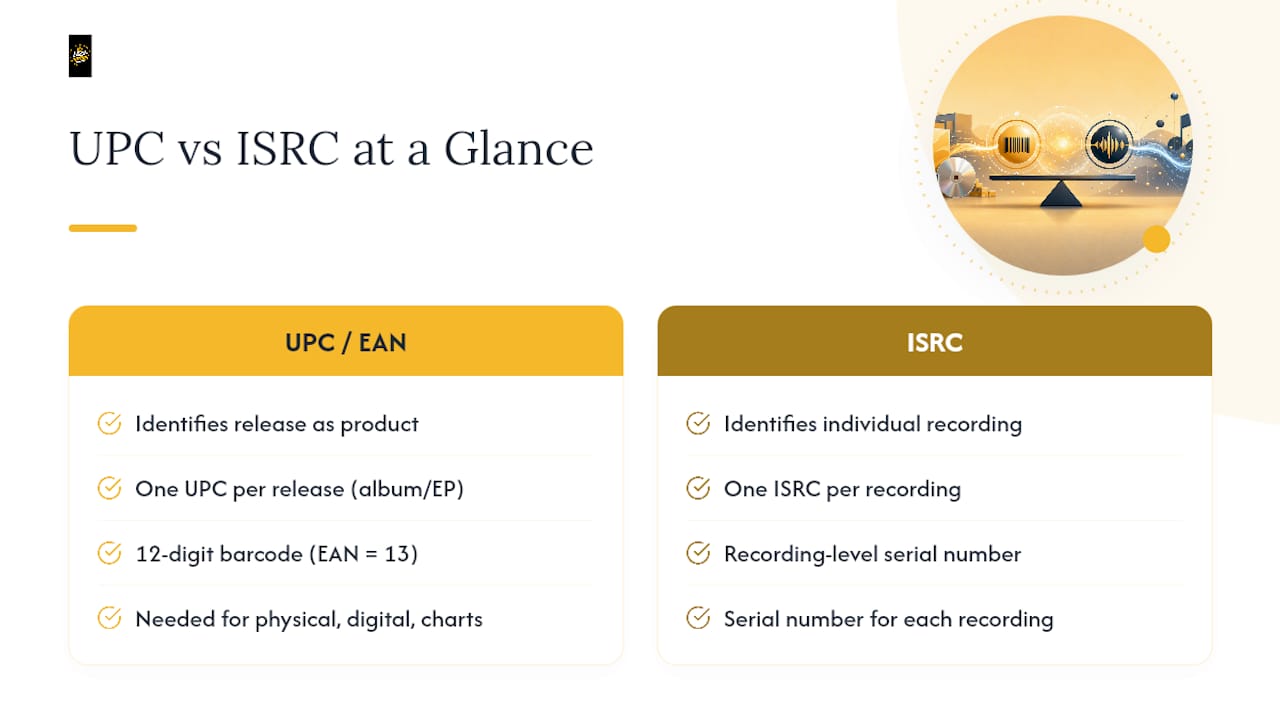
An ISRC (International Standard Recording Code) identifies one specific sound recording or music video. A UPC (Universal Product Code, with EAN as its international 13-digit cousin) identifies the release, the packaged product a listener buys or streams. Think of the ISRC as tracking the individual song, no matter where it ends up, and the UPC as tracking the shelf item, the album or single as a unit for sale.
This distinction is exactly why Songtrust’s ISRC guide describes an ISRC as a 12-character alphanumeric code and a UPC as a 12-digit numeric code. Different formats, different purposes. A song on an album carries its own unique ISRC, while the entire album carries one UPC that retailers and streaming platforms use for aggregate reporting.
Retailers, chart bodies, and collection societies each lean on one code more than the other, depending on what they’re counting. That’s the piece most beginner guides skip, and it’s the piece that actually determines what happens to your royalties.
What Is an ISRC and When Do You Need a New One?
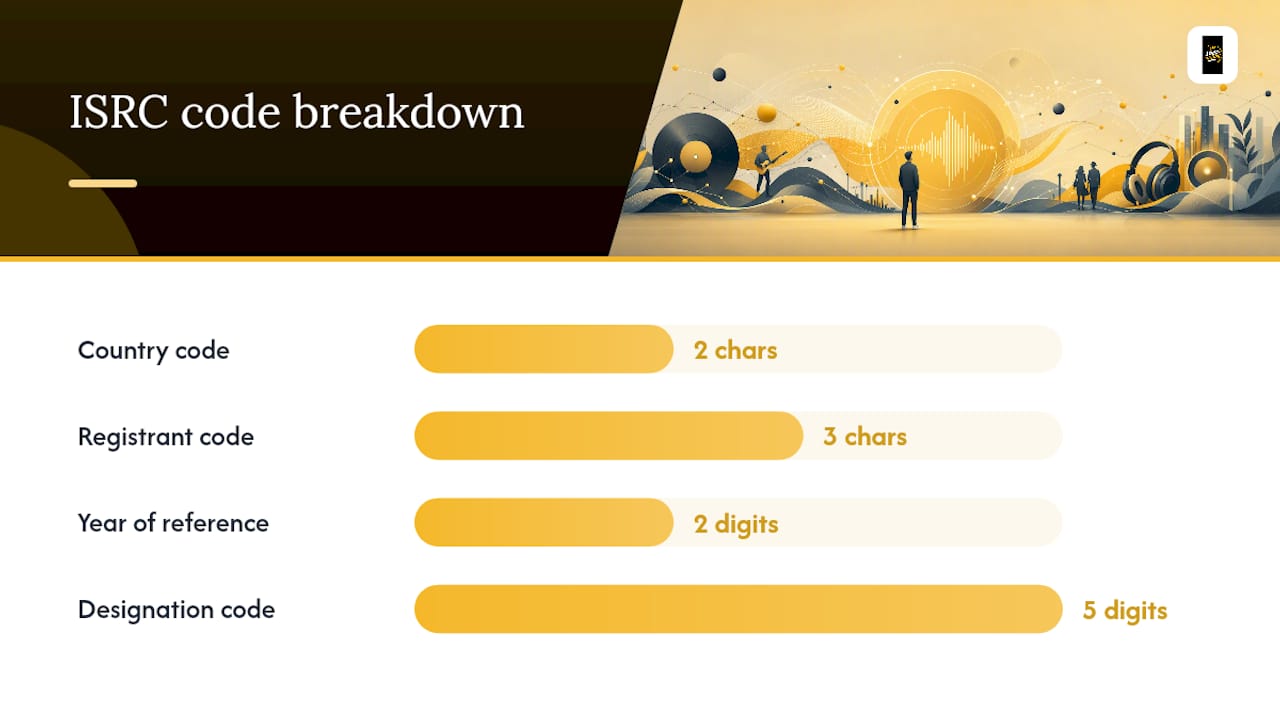
An ISRC is a permanent, 12-character alphanumeric fingerprint for a single recording. It never changes for that recording, and no other recording should ever carry the same one. The format breaks down into four parts, according to the official ISRC structure published by IFPI: a two-letter country code, a three-character registrant code, a two-digit year of reference, and a five-digit designation code unique to that recording. A finished code looks something like US-S1Z-24-00001, though it’s usually written without the hyphens.
What an ISRC identifies matters as much as its format. It tags the recording, not the underlying song. That distinction separates it from an ISWC, which identifies the musical composition itself, lyrics and melody, regardless of who performs it. You could have ten different ISRCs for ten different recordings of the same song, all sharing one ISWC.
You need a fresh ISRC whenever the recording itself changes in a way that matters for tracking. That includes:
-
A remix or alternate mix of the same track.
-
A remaster, even if it’s the “same” performance sonically cleaned up.
-
A live recording of a studio track (and vice versa).
-
An edit that meaningfully changes the runtime, not just a trimmed second of silence.
MusicBrainz’s ISRC documentation confirms this principle directly: different recordings, edits, remasters, and remixes should each carry their own ISRC because the code is meant to be a permanent, one-to-one identifier for that specific recording.
An ISRC is meant to function as a permanent identifier. Once assigned to a recording, it should never be reassigned, reused for a different recording, or duplicated across versions that differ meaningfully from the original.
IFPI runs the ISRC standard globally (it’s formalized as ISO 3901), and national ISRC agencies issue the country/registrant prefixes that make each code unique. If you’re releasing under your own name repeatedly, understanding who issues your prefix becomes relevant fast, more on that later.
What Is a UPC and Why Does Your Release Need One?
A UPC is the 12-digit numeric barcode that identifies your release as a product, the same kind of code you’d find on a can of soup, just applied to music. Outside the US and Canada, most of the world uses the 13-digit EAN format instead, which is functionally the same barcode with a leading zero added. Distributors and retailers treat the two as equivalent, and most stores handle the conversion transparently once you supply a valid code.
The UPC (or its GTIN family, as GS1’s barcode framework defines it) maps to the release, not the individual recording. Your three-track EP gets one UPC. Your twelve-track album gets one UPC. Every retailer, streaming platform, and chart aggregator uses that single number to group all the tracks inside as one cataloged product.
GS1 is the global body that issues UPC prefixes to companies and individuals who want to own their own code block. National GS1 organizations, including GS1 UK, handle that registration for artists and labels based in their territory. Most independent musicians never deal with GS1 directly, though, because their distributor supplies a UPC automatically at upload.
A properly formatted UPC includes a check digit, a final number calculated from the preceding eleven digits, that validation systems use to catch typos instantly. Enter a UPC with the wrong check digit, and most retail systems will reject the upload outright rather than let a broken code slip through.
A UPC identifies the product; an ISRC is the serial number for each recording inside it. Distributors handle the UPC/EAN distinction transparently for stores, so either format works once it’s supplied correctly, according to Velveteen’s release metadata guide.
You’ll need a UPC for physical releases (vinyl, CDs), most digital release packages across major platforms, and for chart eligibility. The Official Charts Company’s submission guidance confirms that chart bodies use UPCs to aggregate release-level sales and streaming figures, which means a missing or incorrect UPC can knock an otherwise-eligible release out of contention entirely.
Which Scenarios Need an ISRC, a UPC, or Both?
Most independent artists never sit down and map out which code applies where until something breaks. Here’s the decision framework broken into common release scenarios.
| Scenario | ISRC needed | UPC needed | Notes |
|---|---|---|---|
| Single release | Yes, one new ISRC | Yes, one new UPC | Standard case, both codes are fresh |
| Album release | Yes, one ISRC per track | Yes, one UPC for the whole album | Never reuse one ISRC across multiple tracks |
| Remix or alternate version | Yes, new ISRC | Yes, new UPC if released separately | Remix is a distinct recording, even if it’s the same song |
| Reissue of an existing release | No, reuse original ISRCs | Yes, new UPC for the reissue | Preserves streaming history on the recordings |
| Moving to a new distributor | No, request and reuse old ISRCs | Depends on distributor policy | Reusing ISRCs protects your play counts |
| Compilation featuring existing tracks | No, reuse each track’s ISRC | Yes, new UPC for the compilation | Multiple ISRCs, one new UPC |
The rule that trips up the most people: an ISRC stays with the recording across releases, but a UPC is born fresh every time you assemble a new product. Put the same already-released song on a new compilation, and that track keeps its original ISRC while the compilation gets a brand-new UPC.
Edge cases worth flagging: if the same master appears on both a single and later an album, it should carry the same ISRC in both places. If you’re releasing a “clean” edit alongside an “explicit” version, that’s usually treated as two separate recordings, and therefore two separate ISRCs, since the audio content genuinely differs.
Pro Tip: Before you upload anything, check your distributor’s specific policy on code assignment. Some auto-assign fresh ISRCs by default even when you’re re-uploading an existing recording, which quietly fragments your play history without you noticing until royalty statements look wrong.
How to Get ISRC and UPC Codes for Your Release
You have two broad paths for ISRCs: let your distributor assign them automatically, or get your own prefix and assign them yourself. Here’s how each works.
Getting ISRCs:
-
Use your distributor’s auto-assignment at upload; this is the fastest and usually free.
-
Apply through a national ISRC agency (RIAA handles this in the US, PPL in the UK) if you want to own and control your own codes.
-
Work with an authorized ISRC manager if you’re releasing at scale and need in-house control over your registrant code.
-
Once you have a prefix, IFPI’s own assignment portal also lets registrants generate and manage codes online, sometimes through a paid credit-based system for those who prefer assigning directly through the agency rather than through a distributor.
Getting UPCs/EANs:
-
Take the UPC your distributor provides automatically at upload; this is the default for most independent releases and comes at no extra charge.
-
Register with your national GS1 member organization (GS1 UK, for instance) if you want to own your own prefix and assign UPCs to every future release yourself.
-
Confirm whether your target platforms expect UPC or EAN formatting; most distributors handle the conversion without you needing to think about it.
Distributor behavior varies more than people expect. DistroKid, RouteNote, Ditto Music, and EmuBands each typically auto-assign both ISRCs and UPCs at no extra cost as part of standard distribution, though policies on reusing prior codes differ by platform. RouteNote’s own guidance confirms that many distributors handle both codes automatically, and recommends artists actively request their existing ISRCs from a previous distributor rather than accepting freshly generated ones, specifically to preserve streaming history.
If you decide to apply for your own ISRC prefix directly through an agency rather than through a distributor, IFPI’s guidance on getting an ISRC notes that labels or artists releasing frequently often find it worthwhile to hold their own prefix and assign codes in-house, though that comes with a real recordkeeping burden: you become responsible for tracking every code you’ve ever issued.
Most independent musicians releasing occasionally will find distributor auto-assignment is genuinely free and sufficient. The paid registrar route makes sense once you’re releasing often enough that owning your own block saves real time.
Common ISRC and UPC Mistakes That Wreck Your Metadata
Metadata errors are almost always invisible until royalties come in wrong or a release fails to chart. Here’s what goes wrong most often:
-
Swapping the ISRC and UPC fields entirely, entering a 12-digit numeric UPC where the alphanumeric ISRC belongs.
-
Typing letters into a UPC field, which should be purely numeric and will usually fail check-digit validation on submission.
-
Getting a brand-new ISRC assigned for a recording that already has one, splitting its play history in two.
-
Ignoring a check-digit mismatch, which can cause a retailer’s system to silently reject or misfile the release.
-
Failing to request your existing ISRCs from a previous distributor before switching platforms.
Each mistake has a real cost. Swap ISRC and UPC fields, and your distributor’s system may reject the upload outright. Get a duplicate ISRC assigned to the same recording, and InterSpace’s metadata help center points out that DSPs, collection societies, and SoundExchange use ISRCs to match plays and route royalties, so a split code means split, incomplete royalty attribution across two histories instead of one clean one.
Before you re-upload anything, run this quick fix list:
-
Verify every ISRC on the release matches what was previously assigned, if the track has existed before.
-
Confirm your UPC or EAN passes check-digit validation before submission.
-
Make sure the ISRC is embedded in the actual audio file’s metadata, not just listed in the distributor’s web form.
-
Request your ISRC history in writing from any distributor you’re leaving, before you lose access to that dashboard.
Your Release-Ready Metadata Checklist
Before you hit “submit” on your next release, run through this:
-
Assign exactly one ISRC per master recording, never shared, never reused across different versions.
-
Embed that ISRC directly in the audio file’s metadata, not only in your distributor’s upload form.
-
Use exactly one UPC per release, generated fresh for every new product you package.
-
Keep a running metadata master file recording every ISRC and UPC you’ve ever assigned, along with the date and release it belongs to.
Different players in the ecosystem lean on different codes for different jobs, and knowing who uses what clarifies why both matter.
| Who uses the code | Code relied on | What it affects |
|---|---|---|
| Streaming platforms (DSPs) | ISRC | Matching plays to the correct recording for royalty calculation |
| Collection societies / SoundExchange | ISRC | Routing performance and mechanical royalties accurately |
| Chart bodies (Official Charts Company) | UPC | Aggregating release-level sales and streams for chart position |
| Retailers and physical stores | UPC/EAN | Cataloging and inventory for the packaged product |
The Official Charts Company’s submission guidance notes that chart organizations aggregate consumption at the release level using UPCs, while ISRCs handle the granular work of reconciling individual track plays and matching different versions correctly.
The ISRC functions as the recording’s passport. It travels with the master across every service and territory, and it’s the piece that makes accurate royalty routing possible in the first place.
Run a quick validation pass before submission: confirm the ISRC follows the twelve-character alphanumeric format, confirm the UPC passes its check digit, and confirm neither code has been typed into the wrong field. That five-minute check catches the overwhelming majority of the mistakes covered above.
What I’d Actually Do as an Independent Artist
For a single release, I’d use distributor auto-assignment without hesitation. Speed matters more than ownership when you’re putting out one or two tracks a year, and the code your distributor generates works exactly as well as one you’d pay an agency for.
The moment that math flips is volume. If you’re releasing under a label name, putting out several EPs a year, or building a catalog you plan to manage for a decade, owning your own ISRC prefix and UPC block starts to make practical sense. You stop depending on any single distributor’s assignment system, and you gain the ability to move platforms without losing your streaming history.
The mistake I see most often isn’t about which code to use. It’s artists not tracking their own codes at all, then discovering months later that a remaster picked up a duplicate ISRC, or that switching distributors reset a track’s play count to zero. A simple spreadsheet with every ISRC, UPC, release date, and distributor solves this before it ever becomes a problem. Building that habit early costs you five minutes per release and saves you a genuinely painful cleanup later.
If you’re serious about protecting sync opportunities down the line, clean, consistent metadata is also what makes a track easy to license once industry professionals start looking at your catalog through something like Loca-Nation’s sync catalogue.
Where to Go Next for ISRC and UPC Guidance
For rules on format and structure, IFPI’s ISRC structure page is the definitive reference on how the 12-character code is built. If you’re ready to apply for your own prefix, IFPI’s assignment portal walks through the registration process directly.
For UPC and barcode fundamentals, GS1’s national member organizations (including GS1 UK) handle prefix registration for anyone who wants to own their own code block rather than relying on a distributor. The barcode structure comparison at Barcode Graphics is a solid plain-language reference for how UPC and EAN relate to each other.
For chart-specific requirements, the Official Charts submission guide lays out exactly how release-level aggregation works and why mismatched codes cause eligibility problems. For a distributor’s-eye view of how codes get assigned in practice, RouteNote’s explainer on ISRC and UPC codes and Songtrust’s ISRC breakdown both cover the practical side well. If you want a technical deep dive into recording-level identification, MusicBrainz’s ISRC documentation is thorough and freely accessible.
Frequently Asked Questions
Do I need an ISRC for every single track? Yes. Every distinct recording, including alternate mixes and edits with meaningfully different runtimes, needs its own unique ISRC.
Can I use a UPC instead of an ISRC? No. They identify different things. A UPC covers the release as a product; an ISRC covers each individual recording inside it. Platforms need both to route royalties and catalog your music correctly.
What’s the difference between UPC and EAN? A UPC is 12 digits; an EAN-13 is the same code with a leading zero added, used more commonly outside the US and Canada. Most distributors and retailers convert between them automatically.
Is getting an ISRC or UPC free? Often, yes, through your distributor at upload. Agencies and GS1 prefix registration typically charge a fee if you want to own and self-assign your own codes long-term.
What happens if I lose track of my ISRCs when switching distributors? You risk your new distributor assigning fresh ISRCs to recordings that already have them, which splits your streaming and royalty history across two separate codes for the same song.