
An independent music artist today is anyone who retains ownership of their work while using distribution and discovery tools instead of a traditional label deal. Success comes down to running independence like a small business: building a focused audience and controlling your rights, release by release. The smartest next move is mapping a single release plan around one platform, one audience channel, and one measurable goal.
TL;DR:
- Building ownership of distribution and rights is more accessible, allowing artists to reach mainstream audiences without signing a traditional label deal.
- A thorough release plan includes locking branding assets early, registering metadata correctly, and running pre-save campaigns four to six weeks in advance.
- Success depends on community-based growth and local scenes rather than viral algorithms, with focus on consistent content and diversified income streams from day one.
- Chart placement platforms that prioritize listener engagement can supplement local and social strategies but should not replace owned channels and direct fan engagement.
- Strategic networking through local shows, genuine collaborations, and industry events helps build lasting support, while mental health requires boundaries, shared routines, and peer support.
Table of Contents
- The Modern Independent Music Landscape: Why Independence Works Differently Now
- The Release Checklist Every Independent Artist Needs
- Where to Get Real Industry Support and Funding
- Real Independent Artist Case Studies and What to Copy From Each
- How Discovery Platforms and Charts Speed Up Visibility
- Legal Considerations Every Independent Artist Should Understand
- Building Real Industry Connections as an Independent
- Protecting Your Mental Health on the Independent Path
- An Editorial Take on What Actually Moves the Needle
- Get Your Music on the Chart With Loca-Nation
- Sources
- FAQ
The Modern Independent Music Landscape: Why Independence Works Differently Now
Independence used to mean a binary choice: you had a record deal or you didn't. That model is gone. Today's unsigned artists operate on a spectrum, hiring the same distributors, publicists, and sync agents that major-label acts use, without signing away ownership. Industry reporting on platforms built specifically to promote UK talent shows that artists can now reach genuinely mainstream audiences while staying independent, something that was rare a decade ago.
The independent sector's market share has grown steadily, and that growth has a downside: the middle tier of the industry is now more crowded than ever, according to analysis of the post streaming-boom indie landscape. More artists are releasing more music, which makes standing out harder, not easier.
That's why local scenes still matter more than viral algorithm hits. Guidance from artist management specialists points to community-based growth, homecoming shows, and repeat local audiences as a sturdier foundation than chasing a single viral moment. A well-planned independent single or EP typically costs a modest budget factoring in mixing, mastering, artwork, and promotion, spread across a realistic several-week campaign window.
The Release Checklist Every Independent Artist Needs
Most independent releases fail not because the song is weak, but because the plan around it is thin. Here's the sequence that actually works, in order.
- Lock your branding assets first. You need professional photos, a one paragraph bio, and a complete streaming artist profile (Spotify for Artists, Apple Music for Artists) before you touch a distributor.
- Choose a distributor and register metadata correctly. Get your UPC and ISRC codes sorted, and double check songwriter and producer credits. Sloppy metadata is the single most common reason tracks get miscredited or delayed.
- Build a pre-save campaign starting four to six weeks before release. This is where early streaming momentum gets built, not on release day itself.
- Sequence your audience channels deliberately. Start with YouTube and short-form video content to build discovery, layer in an email list for direct owned contact, and use gigging to convert casual listeners into repeat fans. Our guide on YouTube promotion strategies covers video-first sequencing in more depth.
- Diversify income from day one. Treat streaming as a discovery funnel rather than a paycheck. Merch, live shows, and sync licensing usually generate more per-fan revenue than streams alone, an approach backed by insight into post-boom indie economics. Our sync licensing guide walks through pitching tracks for placement.
- Track three metrics religiously: playlist adds, save-to-stream ratio, and repeat listener rate. Vanity follower counts tell you almost nothing about whether a fan will show up twice.
- Spend your promotion budget on owned assets before ads. A good photo shoot and three months of consistent short-form content beat a $200 ad boost with no creative behind it.
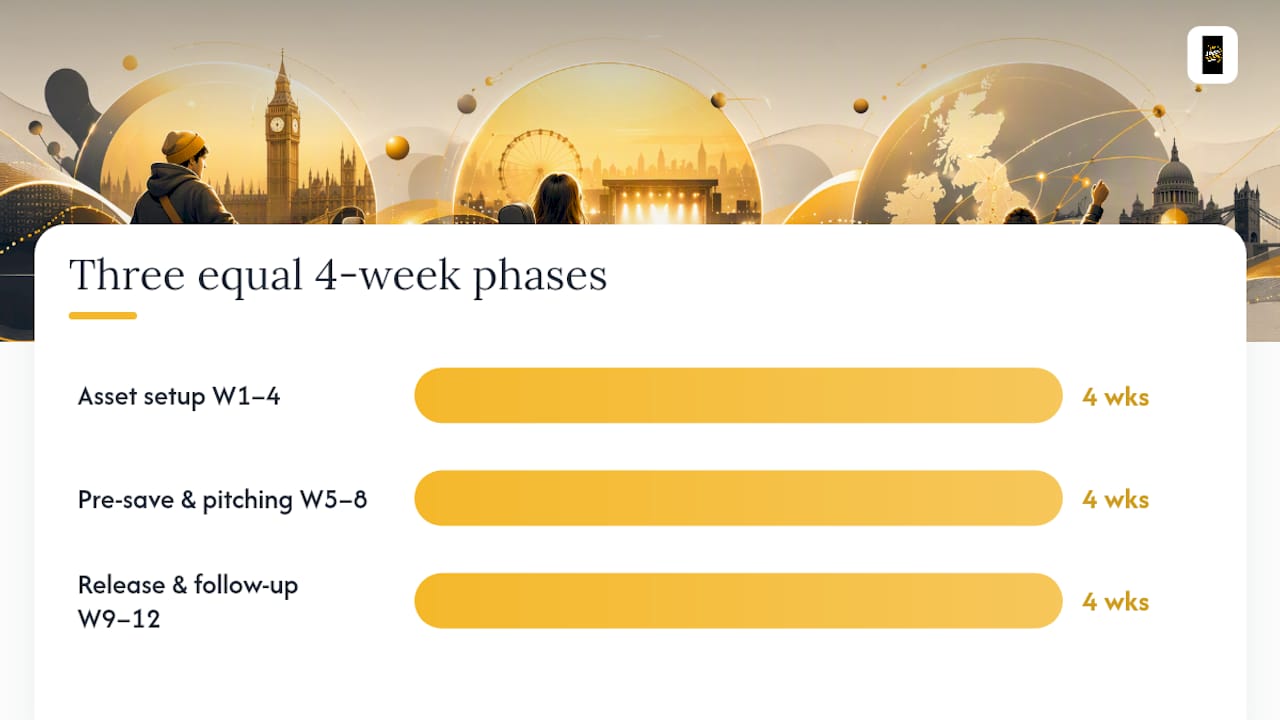
A realistic 8 to 12 week timeline looks like this: weeks 1 through 4 for asset creation and distributor setup, weeks 5 through 8 for pre-save campaigns and playlist pitching, and weeks 9 through 12 for release week execution and follow-up content. Our step-by-step release strategy breaks each phase down further, and the release checklist guide covers launch-day specifics.
Pro Tip: Don't release on a Friday just because "that's when everyone does it." If your fan base is concentrated in one city or scene, release timing around a local show or event often beats the standard release-day convention.
Where to Get Real Industry Support and Funding
You don't have to build a career in isolation, and you shouldn't try to. A handful of organizations and opportunities exist specifically to support artists who never sign a traditional deal.
- The Association of Independent Music is the UK trade body representing the independent recorded music sector, and it offers education, networking, playlist opportunities, and advocacy for rightsholders and self-releasing artists.
- AIM membership tiers give smaller acts access to the same industry conversations that major-label artists get, often for a fraction of what a manager or PR firm would charge.
- Local arts councils and regional music funds frequently offer small grants for recording, touring, or video production. These are worth checking before spending your own savings.
- Showcase events and festival submission programs remain one of the most reliable ways to get in front of scouts and bookers without paying for exposure.
When you're weighing a paid membership or training program against a free grassroots opportunity, ask what it actually gets you: direct industry contact and structured feedback usually justify a fee, while generic "exposure" promises rarely do.
Real Independent Artist Case Studies and What to Copy From Each
Different independent paths lead to different kinds of success, and each one has a tactic worth stealing.
- Building your own label ecosystem. Some artists, like South African rapper Nasty C, have built their own label infrastructure around their music, giving them ownership of distribution and creative decisions rather than renting it from someone else, a route profiled in detail by GQ. The transferable tactic: even a small artist can set up a simple LLC and publishing entity to formalize ownership early.
- Scene-driven growth over algorithm chasing. Chicago's current indie rock wave, including acts covered in roundups of the city's DIY scene, shows how a tight local circuit of venues and shared bills builds real audiences without relying on a viral moment.
- Hybrid partnerships without a full label deal. Plenty of acts now use artist-services companies for distribution and marketing muscle while keeping their masters and publishing, the "spectrum" model that industry coverage of new discovery platforms increasingly documents.
The common thread across all three: they kept ownership, diversified income beyond streaming, and treated their release cadence as a repeatable system rather than a one-off event.
How Discovery Platforms and Charts Speed Up Visibility
Chart-based discovery works differently than algorithmic playlists. Loca-Nation surfaces unsigned acts by weighting genuine listener votes over paid placement, giving smaller artists a fair shot at local, regional, and national chart positions based on engagement rather than budget.
Here's how it plugs into an 8 to 12 week release cycle:
- Upload your track and build a free artist profile during your weeks 1 to 4 asset phase.
- Enter your local and genre chart during pre-save and pitching (weeks 5 to 8) to start building vote momentum before release day.
- Use the built-in analytics during weeks 9 to 12 to see which regions and listener segments are actually responding, then double down there.
Pro Tip: Chart placement works best as one channel in a broader plan, not a replacement for your own email list or gigging. Use it to get in front of new listeners and industry scouts, and use owned channels to keep the ones who stick around.
Legal Considerations Every Independent Artist Should Understand
Copyright exists automatically the moment you record a song, but registering it formally matters once money starts moving. In the US, that means filing with the Copyright Office; in the UK, copyright is unregistered but still enforceable, and keeping dated session files and contracts is your practical proof of ownership.
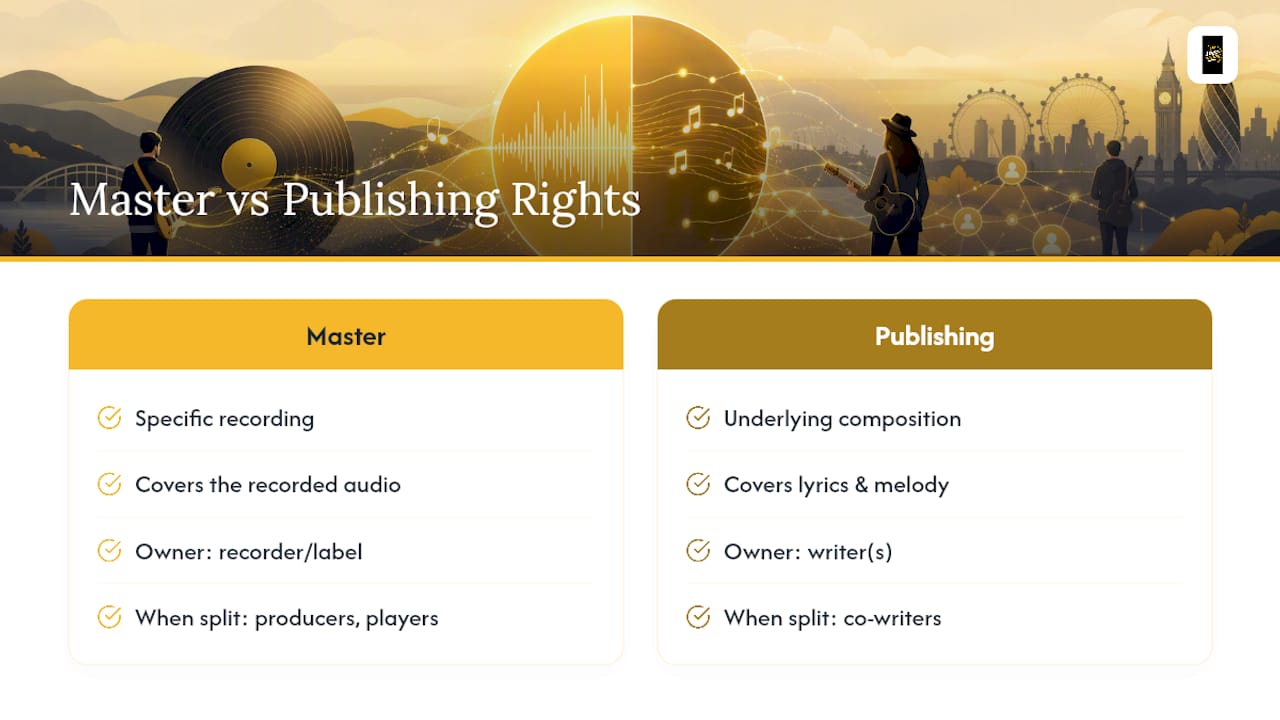
Publishing and master rights are two separate things, and conflating them costs artists real money. The master is the specific recording; the publishing covers the underlying composition, lyrics and melody. If you write and record your own songs, you likely own both, but the moment you bring in a co-writer, producer, or session musician, you need a clear split sheet before release, not after.
Sync licensing deals, distributor agreements, and any artist-services contract deserve a real read before signing, ideally by someone other than the person offering the deal. Watch for clauses that ask for a cut of your master rights in exchange for marketing spend. That's a common structure in artist-services partnerships, and it isn't automatically bad, but you should know exactly what percentage you're trading and for how long.
Distributors like the ones covered in our sync licensing guide typically require you to confirm you hold the rights you're claiming, so keep your paperwork organized from the first session onward. A simple shared folder with contracts, split sheets, and metadata records saves enormous stress later.
Building Real Industry Connections as an Independent
Networking as an independent artist isn't about collecting contacts, it's about finding two or three people whose work genuinely complements yours. Co-writing sessions, feature verses, and shared bills at local shows do more for your reach than a hundred cold DMs to industry accounts.
Start local. The same community-based growth that strengthens your fan base also builds your professional network. Playing regularly in one scene means you'll eventually cross paths with producers, engineers, and other artists who can open doors you can't open alone.
Features and collaborations work best when they're genuinely mutual. Reach out to artists at a similar career stage rather than only chasing people with bigger followings than yours. A feature that shares audiences roughly evenly tends to produce better long-term results than one where you're clearly the smaller act along for the ride.
Industry events and showcases matter too, but treat them as a chance to build a handful of real relationships, not a chance to hand out fifty business cards. One producer who genuinely likes your work and remembers your name is worth more than a stack of contacts who don't.
Online communities and platforms built for creators, such as Aria, can help you formalize a fan community or paid membership tier once you have a base worth organizing, giving collaborators and fans a home beyond social media feeds you don't control.
Protecting Your Mental Health on the Independent Path
The independent path asks you to be your own artist, manager, marketer, and accountant, often at the same time, and that workload takes a real toll if you don't build boundaries early.
Comparison is the fastest route to burnout in this career. Streaming numbers, follower counts, and chart positions are visible to everyone, which makes it easy to measure your week three release against someone else's year five momentum. Set your own benchmarks based on your last release, not someone else's current one.
Build recovery time into your release calendar the same way you build promotion time. A common mistake is treating the week after release as a rest period when it's actually your highest-leverage window for follow-up content and fan engagement. Schedule your actual rest before or well after that window, not during it.
Separate the business decisions from the creative ones where you can. Reviewing streaming analytics and negotiating a sync deal use a different part of your brain than writing a song, and doing both in the same sitting tends to drain the creative side faster. Some artists find it helps to batch admin tasks into set days and protect the rest for writing and recording.
Talking to other independent artists, even informally, remains one of the more underused tools available. The isolation of doing everything yourself is real, and a small peer group that understands the specific pressures of self-releasing music can catch burnout before it becomes a reason to quit entirely.
An Editorial Take on What Actually Moves the Needle
Most advice aimed at independent artists overweights the creative side and underweights the operational side. The reality is that the artists who build lasting careers treat each release like a small, repeatable project with a plan, a budget, and a review process afterward. That's not a romantic idea, but it's the one the evidence actually supports.
The conventional wisdom that a single viral moment changes everything doesn't hold up well. The WaterBear guidance on artist management makes a strong case that local, community-based growth produces more durable careers than chasing algorithmic spikes, and the case studies here back that up.
If you take one thing from this article, prioritize the plan over the platform. AIM membership, chart discovery, sync licensing, all of it works better once you have a repeatable release cycle in place. Skip the plan, and even the best tools underperform.
— Jason
Get Your Music on the Chart With Loca-Nation
Loca-Nation is a platform that supports music discovery emphasizing genuine listener engagement over paid placement or algorithmic bias. Upload your track, build a free public profile, and enter your local, regional, or genre chart based purely on how listeners respond to your music.
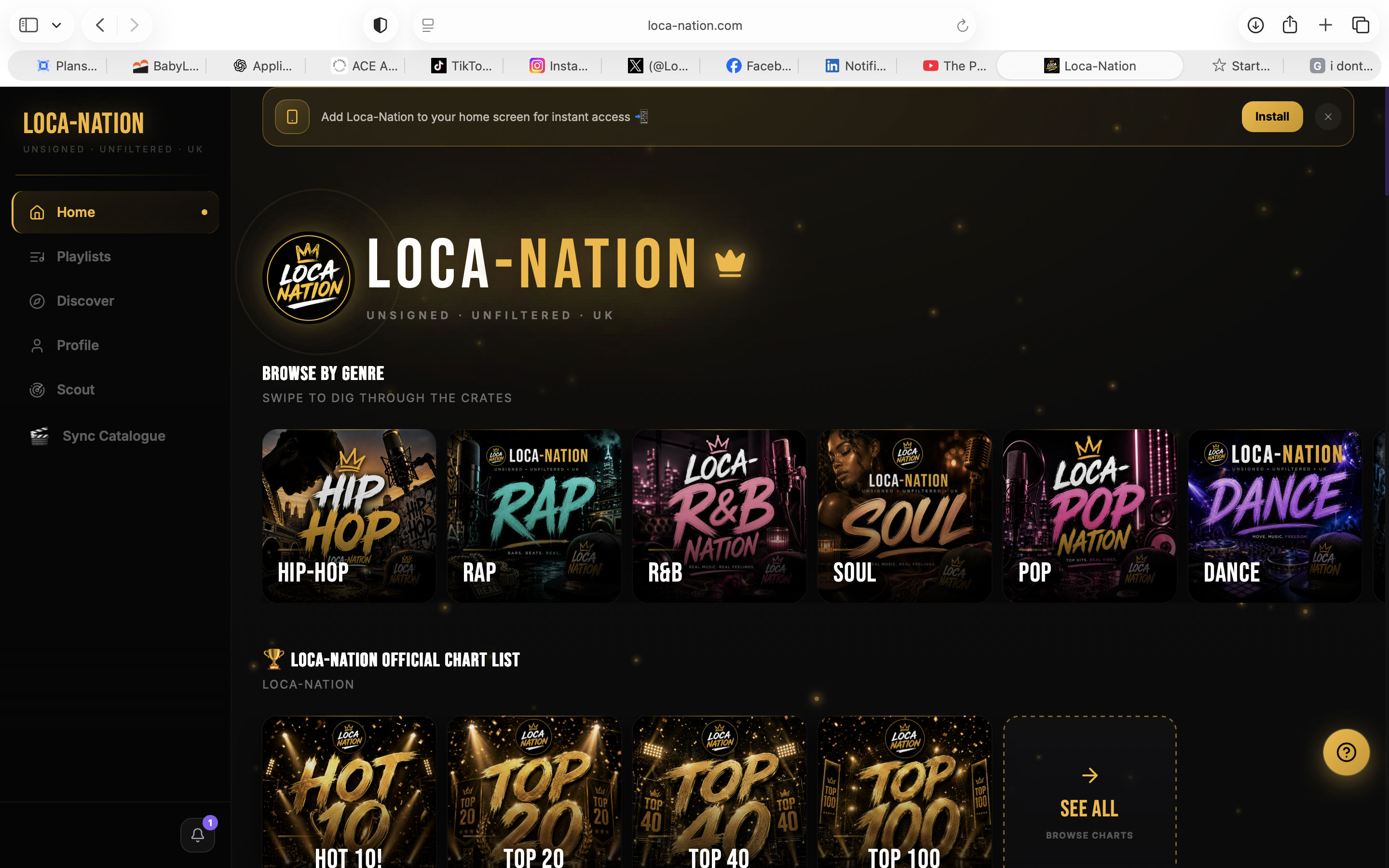
Getting started takes minutes: create a profile, upload your release, and let listener votes do the work of moving you up the chart. If you're not sure which genre or discovery lane fits your sound, genre onboarding matches you to the right chart pathway so your first campaign starts in front of the audience most likely to respond. Already released something that didn't get the push it deserved? Reactivate gives past releases a second chance at visibility instead of leaving them buried in your catalog. Sign up, upload your next single, and see where your listeners take it.
Sources
- Richer Sounds launches music discovery platform to promote UK acts — Music Week
- Association of Independent Music (AIM)
- Unsigned artist — Wikipedia
- Finding artist management — WaterBear
FAQ
Who Are the Most Popular Independent Artists Right Now?
Popularity shifts constantly, but the artists getting the most attention tend to be the ones who built strong local or online audiences before scaling up, often through the artist-services model rather than a traditional label deal, as industry reporting has documented.
Is Billie Eilish an Independent Artist?
No. Billie Eilish is signed to Darkroom/Interscope, a major-label imprint, so she doesn't fit the independent or unsigned definition even though her early breakout came through self-released SoundCloud uploads.
Who Are Some Famous British Independent Artists?
Several UK acts have built major careers through independent or artist-services routes rather than traditional major-label contracts, a path that groups like AIM actively support through membership and advocacy for self-releasing musicians.
Is Taylor Swift an Independent Artist?
No. Taylor Swift owns her master recordings following her re-recording project, but she remains signed to Republic Records for distribution, which makes her label-affiliated rather than independent under the standard definition of an unsigned artist.