
Effective independent artist promotion runs on three pillars: streaming and playlist strategy, short-form video and creator seeding, and live shows paired with an owned audience. Start right now by drafting a 6–8 week release plan and uploading your track to your distributor. Everything else builds from that single action.
Launch essentials checklist:
-
Claim and optimize your DSP profiles (Spotify for Artists, Apple Music for Artists, YouTube channel)
-
Prepare your EPK: short bio, press photos, streaming links, and contact info
-
Set up a smart link for pre-saves and email capture before release day
Key Takeaways
Independent artist promotion works when you combine a consistent release cadence, a data-driven social strategy, and an owned audience that no algorithm can take away.
| Point | Details |
|---|---|
| Release every 4–8 weeks | Singles-first cadence keeps DSP algorithms evaluating your music and opens repeated discovery windows. |
| Pitch Spotify editorial early | Submit through Spotify for Artists three to four weeks before release for the best chance at editorial consideration. |
| Seed audio to 20–40 creators | Target nano and micro creators in your sound’s content category on TikTok for stronger algorithmic reach. |
| Spend only after organic signals | Paid promotion amplifies traction; without saves, completion rates, and playlist adds, ad spend rarely builds a durable audience. |
| Use Loca-nation for chart-driven exposure | Upload your music, compete in genre and local charts, and get discovered by industry professionals without paying for placement. |
Table of Contents
-
How do you build a strong online foundation for independent artist promotion?
-
Why does a singles-first release cadence work better for indie artists?
-
What do you need to do before release day for streaming and playlist pitching?
-
Which social platforms should you focus on and what content mix works?
-
What metrics tell you if your promotion campaign is working?
-
How do you build and engage a fanbase through email marketing?
-
How do collaborations and networking grow your reach as an indie artist?
-
How do music blogs, podcasts, and online communities drive organic promotion?
-
How do you use data analytics tools beyond basic streaming numbers?
-
How do you handle rights management and copyright during promotion?
-
What separates hobbyists from career-minded independent artists?
-
Loca-Nation gives independent artists a fair place to compete and get discovered
How do you build a strong online foundation for independent artist promotion?
Your digital presence is the first thing a curator, blogger, or sync supervisor checks. If your profiles are incomplete or inconsistent, you lose the pitch before it starts.
Profiles to claim and optimize:
-
Spotify for Artists: Verify your profile, add a bio, upload a canvas, and pin your latest release. Fill in every metadata field, including genre tags and artist pick.
-
Apple Music for Artists: Claim your profile and monitor your analytics dashboard for listener demographics.
-
YouTube: Set up a channel with a consistent banner, channel description, and organized playlists separating music videos from live footage.
-
Bandcamp: Write a detailed artist bio, price your music intentionally, and use the “supporter” feature to build a direct-purchase relationship with fans.
-
SoundCloud: Keep your profile active with reposts and comments; it still drives discovery in electronic and hip-hop communities.
Your website should do one job: convert visitors. A single landing page with a smart link covers pre-saves, streaming links, and an email sign-up form. Keep it clean. A complete EPK includes a short bio (100 words), a long bio (300 words), high-resolution press photos in both vertical and horizontal formats, streaming links, and a direct contact email.
Metadata hygiene matters more than most artists realize. Your artist name must be spelled identically across every platform. ISRC codes should be registered for every track. Artwork must meet each platform’s spec (typically 3000x3000 pixels, RGB, JPEG or PNG). A mismatch in any of these creates friction that slows down editorial consideration.
Pro Tip: Offer a free download, exclusive demo, or early-access track as a lead magnet on your landing page. Place the email sign-up above the fold. A small incentive can double your opt-in rate compared to a plain “subscribe” button.
Why does a singles-first release cadence work better for indie artists?
Releasing singles every 4–8 weeks keeps DSP algorithms evaluating your music more frequently, which creates more discovery windows than a single album drop. Slow Oak Studio’s 2026 playbook confirms that this cadence produces stronger algorithmic momentum and higher ROI for creator seeding than infrequent album cycles.
Sample 6–8 week release timeline:
-
Week 1–2: Finalize master and artwork. Upload to your distributor. Confirm ISRC and metadata.
-
Week 3–4: Submit to Spotify editorial via Spotify for Artists. Pitch independent curators. Begin teaser content on social.
-
Week 5–6: Launch pre-save campaign. Seed audio to 20–40 nano and micro creators on TikTok. Run email announcement to your list.
-
Week 7 (Release Day): Post across all platforms. Send release-day email. Push pre-save link to convert to streams.
-
Week 8: Analyze Day 1–7 data. Pitch remaining curators. Repurpose performance clips and behind-the-scenes content.
A structured 6–8 week campaign that uploads at least four weeks ahead and pitches Spotify editorial three to four weeks pre-release gives you the best shot at editorial consideration and strong Day 1 traction.
When to bundle into an EP or album: Once you have three to five singles with consistent listener data, bundling them signals catalog depth to DSPs and gives press a bigger story to cover. Slow the cadence to every 8–12 weeks when you are preparing a body of work, not before.
Budget reality: a lean marketing stack covering distribution, smart links, email capture, and scheduling tools can run under $100 per month for most independent artists. Frequent releases do not require expensive production. A well-recorded single at a mid-range studio rate beats a delayed album every time.
Those numbers tell you the song is connecting. Without them, paid spend rarely fixes the problem.*
What do you need to do before release day for streaming and playlist pitching?
Distribution timing is where most indie artists lose ground. Upload your track to your distributor at least four weeks before release. This gives stores time to deliver the file and opens the Spotify editorial pitch window.
Step-by-step pitch process:
-
Log into Spotify for Artists and navigate to the “Upcoming” tab.
-
Select your unreleased track and complete the pitch form: genre, mood, instrumentation, and a one-paragraph description of the song’s story.
-
Submit at least three to four weeks before release. Spotify requires a minimum of seven days, but earlier submission gives editors more time to consider your track.
-
Do not resubmit the same track. One pitch per release.
Playlist types and how to prioritize:
-
Editorial playlists (Spotify’s New Music Friday, Apple Music’s New in Genre): pitch through official channels only. No guarantees, no shortcuts.
-
Algorithmic playlists (Discover Weekly, Release Radar): driven by saves, completion rates, and listener behavior. Focus on Day 1–7 signals.
-
Independent curator playlists: research curators on SubmitHub or Groover. Personalize every pitch. Reference a specific track of theirs you like.
The first seven days after release are decisive. Saves, completion rates, and playlist adds in that window determine how aggressively DSPs push your track into algorithmic discovery. Drive your audience to save the track, not just stream it.
Pre-save campaigns work best when you give fans a reason to act early: exclusive content, a personal message, or a limited merch offer tied to the pre-save link. Never use bot services or playlist placement guarantees. Both violate platform terms and can result in track removal or account suspension.
Which social platforms should you focus on and what content mix works?
Pick one platform first. Match it to where your audience already spends time, not where you feel most comfortable. For most genres in 2026, TikTok and Instagram Reels drive the most discovery for unsigned artists. YouTube is the long-game platform for catalog depth and search.
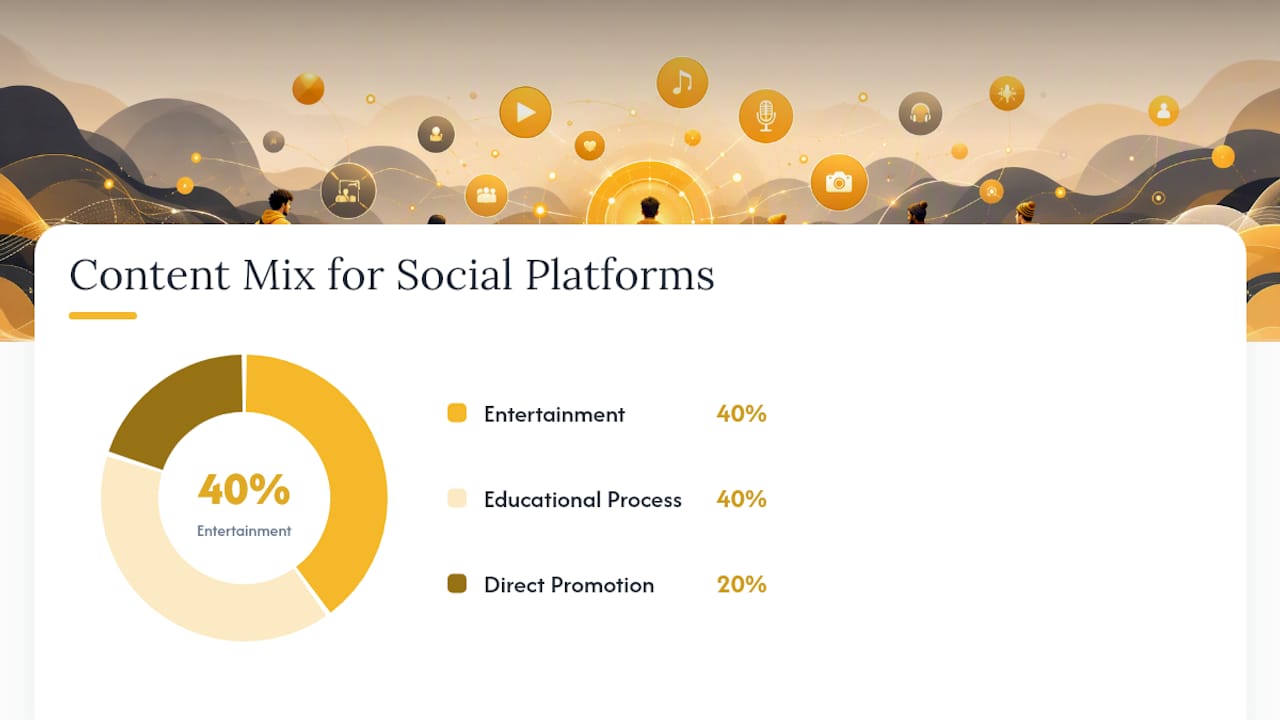
A balanced content mix of roughly 40% entertainment, 40% educational or process content, and 20% direct promotion sustains engagement while converting followers to listeners and email subscribers.
| Content Type | Share | Examples |
|---|---|---|
| Entertainment | 40% | Relatable music moments, humor, trending audio |
| Educational / Process | 40% | Studio sessions, songwriting breakdowns, gear talk |
| Direct Promotion | 20% | New release posts, pre-save links, show announcements |
TikTok: Treat it as audio infrastructure. The platform distributes your sound through creator content, not your artist account alone. Seed your audio to 20–40 nano and micro creators who post in the content category where your sound fits naturally. A folk artist seeds to travel and lifestyle creators. An R&B artist seeds to relationship and fashion creators. Give creators the audio file and a brief, not a script.
Instagram Reels and Stories: Reels extend reach; Stories deepen connection. Post Reels with sound-on hooks in the first two seconds. Use Stories for polls, Q&As, and behind-the-scenes clips that don’t need high production value. Cross-post your TikTok content to Reels, but trim the TikTok watermark first.
YouTube: Use it for full music videos, live session recordings, and documentary-style content. A single well-produced YouTube video can drive search traffic for years. Repurpose live performance footage from gigs as YouTube content.
Post consistently: three to five times per week on your primary platform, two to three times on secondary. Batch-create content in one session per week to avoid burnout.
Pro Tip: To find creator partners who drive saves rather than just views, check their comment sections for phrases like “what’s this song?” or “link to the full track?” Those comments signal that their audience acts on audio discovery, which is exactly the behavior you need.
How do live shows and local gigs feed your digital growth?
A live show is a conversion event. Every person in that room is a potential email subscriber, repeat listener, and social follower. Treat the gig as a campaign touchpoint, not a standalone performance.
Pre-show promotion checklist:
-
Announce the show on all platforms at least two weeks out
-
Create a short video teaser using a clip from your last performance
-
Email your list with the date, venue, and a direct ticket or RSVP link
-
Partner with the venue’s social accounts for cross-promotion
Post-show follow-up:
-
Collect emails at the merch table with a tablet sign-up form or a QR code linking to your landing page
-
Post performance clips within 24 hours while engagement is high
-
Tag the venue and any supporting acts to extend reach
To get on the right bills, research venues by genre. Attend shows at the venues you want to play before reaching out. When you pitch a venue, include your EPK, a streaming link, and your draw estimate. Offer flexibility on set time to get your foot in the door.
Numbered steps for local collaboration:
-
Identify two or three artists in your genre and city with a similar audience size.
-
Propose a co-headline or support swap: you open for them at their next show, they open for yours.
-
Cross-promote each other’s releases on social the week of the show.
-
Share email lists with a co-branded newsletter (with subscriber consent).
Converting attendees into owned-audience members is the highest-value outcome of any live show. Streaming numbers fluctuate with algorithm changes. Your email list does not.
When should you spend money on paid promotion or PR?
Spend money only after you have organic signals. Paid promotion amplifies verified traction; without it, ads and paid tools rarely produce durable audience growth. The sequence is: organic first, validate, then amplify.
Decision rules before spending:
-
Save rate above 20% of listeners on your latest release
-
At least one independent playlist add without outreach
-
Consistent follower growth week over week on at least one platform
-
An email list with a measurable open rate
Questions to ask any PR or promotion vendor before hiring:
-
What targeting criteria do you use, and can you show me a sample report?
-
What does your reporting include, and how often do you send it?
-
What is your refund or revision policy if results fall short?
-
Are your methods compliant with Spotify’s, TikTok’s, and YouTube’s terms of service?
Red flags to walk away from:
-
Guaranteed playlist placements (no legitimate service can guarantee editorial placement)
-
Bot-driven stream counts or follower packages
-
Opaque reporting with no breakdown by source or geography
-
Requests for your Spotify for Artists or distributor login credentials
Test any paid tactic with a small budget first: $50–$150 on a Meta or TikTok ad targeting a specific interest and age group. Run it for seven days. If cost per save or cost per click is trending in the right direction, scale. If not, stop and adjust the creative before spending more.
Typical starter PR budgets for independent artists range from a few hundred to a couple of thousand dollars per campaign, depending on the scope and the publicist’s track record. At early career stages, a well-targeted independent curator pitch campaign often outperforms a full PR retainer.
What metrics tell you if your promotion campaign is working?
Track these primary KPIs across every release:
-
Saves: The single strongest signal of genuine interest on Spotify
-
Completion rate: Percentage of listeners who hear the full track; above 50% is a positive signal
-
Playlist adds: Both editorial and user-generated; track source in Spotify for Artists
-
Listener source: Where streams originate (search, playlist, profile, external); shifts here tell you what’s working
-
Follower growth: Week-over-week change on Spotify, Instagram, TikTok, and YouTube
-
Email signups: New subscribers per week, tied to specific campaigns or content
-
Cost per stream or subscriber: When running paid ads, this is your efficiency metric
The first 7–14 days after release are the most informative. A track gaining saves and playlist adds in that window is getting algorithmic lift. A track with high streams but low saves is likely getting passive exposure without genuine connection.
Weekly report template:
Fill this in every Monday. After four weeks, patterns emerge. If saves are low but completion rate is high, the song is connecting but your call-to-action is weak. If completion rate is low, the intro needs work. Use the data to make decisions about the next release, not to second-guess the current one.
How does Loca-Nation fit into your promotion plan?
Loca-Nation is built specifically for unsigned and independent artists who want fair, merit-based exposure without paying for chart positions or buying streams. The platform runs an official chart system where artists compete by local area, region, genre, and national level, with positions driven by genuine listener engagement and votes.
What Loca-Nation offers:
-
Artist profiles with analytics and promotional resources
-
Chart competitions at local, regional, genre, and national levels
-
Sync licensing catalogue access for artists seeking placement opportunities
-
Direct visibility to music industry professionals, including labels and scouts
-
Artist forums for community and networking
-
Free listener access with no ads, no subscriptions
How to use Loca-Nation in a release campaign:
-
Create your artist profile by selecting your genre and completing your profile with bio, photo, and streaming links.
-
Upload your new single and enter the relevant chart competition for your genre and location.
-
Share your voting link with your email list, social followers, and live show attendees.
-
Use chart progress as social proof in your press pitches and curator outreach.
-
Monitor your analytics dashboard to track listener engagement and geographic reach.
-
If sync licensing is a goal, submit your catalog to the Loca-Nation sync catalogue for access by music supervisors and industry professionals.
Use cases by career stage:
-
Early-stage artist: Use local chart competition to build credibility in your city before pitching venues or press.
-
Mid-tier artist: Target chart competitions in tour cities to build local listener bases ahead of shows.
-
Sync-seeking artist: List your catalog in the sync section to get discovered by supervisors without a manager or agent.
The platform is freemium. The core features, including profile creation, chart entry, and basic analytics, are free. Premium features covering advanced analytics and promotional resources are available as you scale.
Pro Tip: Use your Loca-Nation chart position as a concrete credential in your EPK and press pitches. “Currently ranked #X in [genre] on Loca-Nation” gives curators and bloggers a verifiable signal of audience traction that a stream count alone doesn’t provide.
How do you build and engage a fanbase through email marketing?
Email is the one channel you own outright. Spotify can change its algorithm. TikTok can restrict your reach. Your email list stays yours.

Start collecting emails before your first release. Use your smart link landing page, your Bandcamp profile, and your merch table at shows. A simple welcome sequence of three emails, sent over the first week after sign-up, establishes the relationship: who you are, what you make, and what subscribers get by staying on the list.
Send at minimum one email per month, ideally one per release cycle. Each email should have a single clear action: stream the new track, buy a ticket, vote on Loca-nation. Avoid emails that ask for multiple things at once. Subject lines under 40 characters open at higher rates than longer ones. Keep the body short: two to three paragraphs, one image, one button.
Segment your list as it grows. Separate subscribers by geography (useful for tour announcements), by how they signed up (merch table vs. online), and by engagement level. Inactive subscribers after six months should receive a re-engagement email before you remove them. A smaller, engaged list outperforms a large, cold one every time.
How do collaborations and networking grow your reach as an indie artist?
Collaborations work because they expose you to an audience that already trusts the artist you’re working with. A feature, a co-write credit, or a joint live show puts you in front of listeners who are already primed to engage.
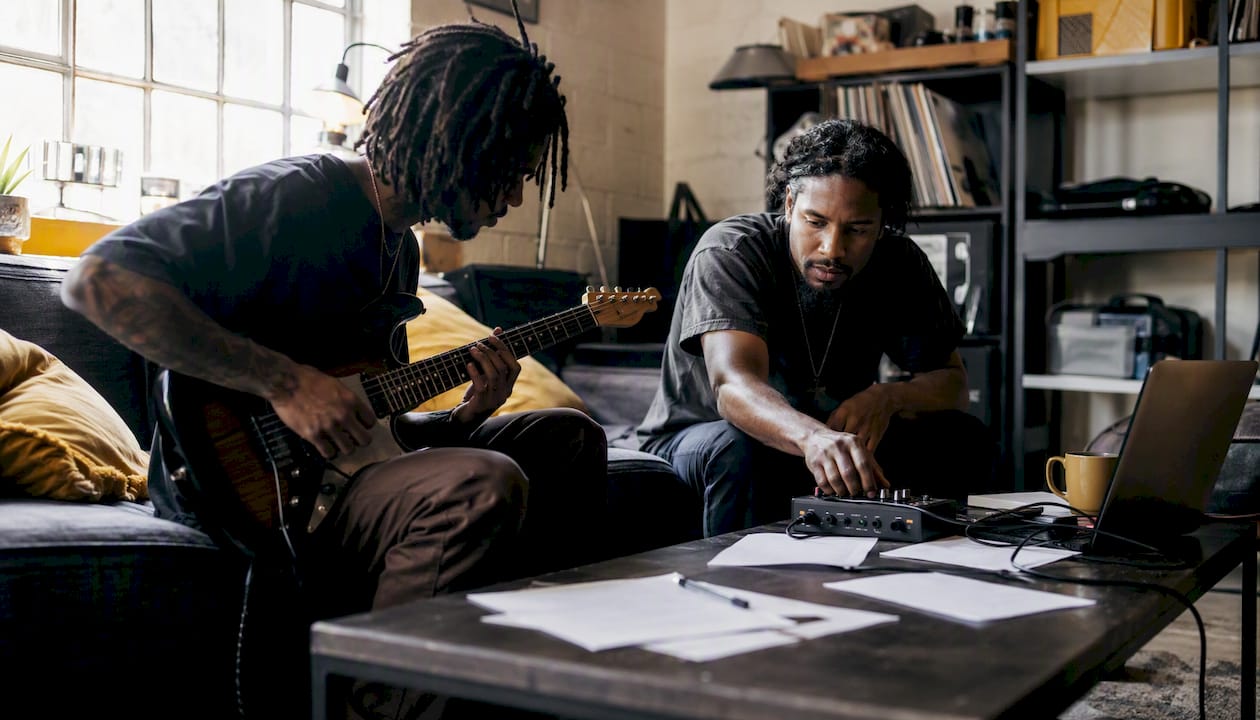
The most effective collaborations happen between artists at similar career stages with complementary sounds, not identical ones. An indie folk artist collaborating with an acoustic pop artist reaches a new audience without confusing either fan base.
Networking online is straightforward: engage genuinely with artists whose work you respect. Comment on their posts with specific observations, not generic praise. Share their releases to your Stories. Reach out with a direct, specific proposal rather than a vague “let’s collab” message. Specify the format (a feature, a joint playlist, a live show swap) and why it makes sense for both of you.
For influencer outreach, focus on micro-influencers in your genre’s adjacent communities rather than chasing large accounts. A lifestyle creator with 15,000 engaged followers who genuinely loves your sound will drive more saves than a celebrity post that disappears in 24 hours.
How do music blogs, podcasts, and online communities drive organic promotion?
Music blogs still matter for SEO and credibility. A review or feature on a genre-specific blog creates a backlink, a Google search result, and a press quote you can use in your EPK. Target blogs that cover your genre specifically, not general music news sites that are unlikely to cover unsigned artists.
Podcasts are an underused channel. Pitch yourself as a guest to music-adjacent podcasts: local culture shows, genre-specific interview programs, and music business podcasts that feature artist stories. A 30-minute interview reaches a focused audience and creates a piece of content you can repurpose across social.
Online communities, including Reddit’s music subreddits, Facebook genre groups, Discord servers, and niche forums, offer direct access to listeners who are actively looking for new music. Participate genuinely before promoting. Post your music only in threads or channels where it is explicitly invited. Artists who contribute value to a community before promoting receive far warmer responses than those who drop a link and disappear.
How do you use data analytics tools beyond basic streaming numbers?
Spotify for Artists and Apple Music for Artists give you listener demographics, geographic data, and source breakdowns. Use the geographic data to identify cities where you have organic traction, then target those cities with tour dates, local press pitches, and geo-targeted ads.
Chartmetric and Soundcharts track your playlist adds, follower growth, and chart positions across platforms in one dashboard. They also show you which curators are adding tracks similar to yours, which is a direct shortlist for your next pitch campaign.
On social, native analytics from TikTok, Instagram, and YouTube show you which content formats drive profile visits and link clicks, not just views. A video with 50,000 views but zero profile visits is not moving your promotion forward. A video with 5,000 views and 200 profile visits is.
Google Analytics on your website tracks where traffic comes from and which pages convert to email sign-ups. If your Bandcamp link drives more sign-ups than your Instagram bio link, that tells you where to focus your traffic-driving efforts.
Use data to make one decision per week. Not to obsess, but to adjust. The artists who improve fastest are the ones who treat each release as a test and each data point as feedback.
How do you submit music for sync licensing opportunities?
Sync licensing places your music in film, TV, advertising, and video games. It pays well and builds catalog value. The path in for independent artists is through music supervisors, sync agencies, and platforms that maintain searchable catalogs.
If you co-wrote the track, you need a co-publishing agreement or written confirmation from your co-writer before licensing. Supervisors will not place a track with unresolved ownership.
Prepare a sync-ready version of every track: a full mix, a vocal-up mix, a vocal-down mix, and an instrumental. Label every file with your artist name, track title, BPM, key, and mood tags. Supervisors search by mood and tempo, not by artist name.
Research music supervisors who work on projects in your genre’s visual world. A supervisor who places music in horror films is not the right target for upbeat indie pop. Personalize every pitch: reference a specific project they worked on and explain why your track fits that aesthetic.
Loca-Nation’s sync catalogue gives independent artists a direct submission path to industry professionals without requiring an agent or a label deal.
How do you handle rights management and copyright during promotion?
Register your music before you promote it. In the US, register with the Copyright Office. In the UK, copyright is automatic upon creation, but registration still provides legal protection in disputes. Internationally, your home country’s registration typically covers you under the Berne Convention, but confirm the specifics with a music attorney for your jurisdiction.
Register with a Performing Rights Organization (PRO) before your music goes live on any platform. In the US, that means ASCAP, BMI, or SESAC. In the UK, PRS for Music. Your PRO collects performance royalties every time your music is played publicly, including on streaming platforms, radio, and at live venues.
Register your sound recording with SoundExchange if you are in the US. SoundExchange collects digital performance royalties for master recordings, separate from what your PRO collects for the composition. Many independent artists miss this and leave money on the table.
When you collaborate, document everything in writing before the track is released. A simple split sheet signed by all contributors covers ownership percentages for both the master and the composition. Verbal agreements do not hold up when a track gets placed or goes viral.
This section covers general information about rights management. For advice specific to your situation and jurisdiction, consult a qualified music attorney or your PRO directly.
What separates hobbyists from career-minded independent artists?
The gap is not talent. It is systems.
Career-minded artists treat each release as a campaign with a start date, a checklist, and a post-mortem. They release on a schedule, not when inspiration strikes. They track their numbers every week, not to obsess, but to make one better decision per cycle. They build an email list from day one because they understand that algorithmic reach is rented, not owned.
What I see consistently is this: hobbyists wait for the right moment, the perfect song, the industry contact who will change everything. Career artists ship the work, measure the result, and adjust. They are not more talented. They are more disciplined about the process.
The single habit worth adopting immediately: a weekly 30-minute review. Pull your Spotify for Artists data, check your email open rate, look at which social post drove the most profile visits. Write down one thing that worked and one thing to change. That habit, repeated over 12 months, compounds into a real understanding of your audience that no marketing course can replicate.
Owned audience is the metric that matters most at every stage. Streams pay fractions of a cent. An email subscriber who buys a ticket, a record, or a piece of merch is worth orders of magnitude more. Build the list. Protect it. Use it.
Loca-Nation gives independent artists a fair place to compete and get discovered
Most unsigned artists spend months promoting into a void: pitching playlists that never respond, posting content that reaches no one new, and wondering whether anyone in the industry is paying attention. Loca-Nation changes that dynamic.
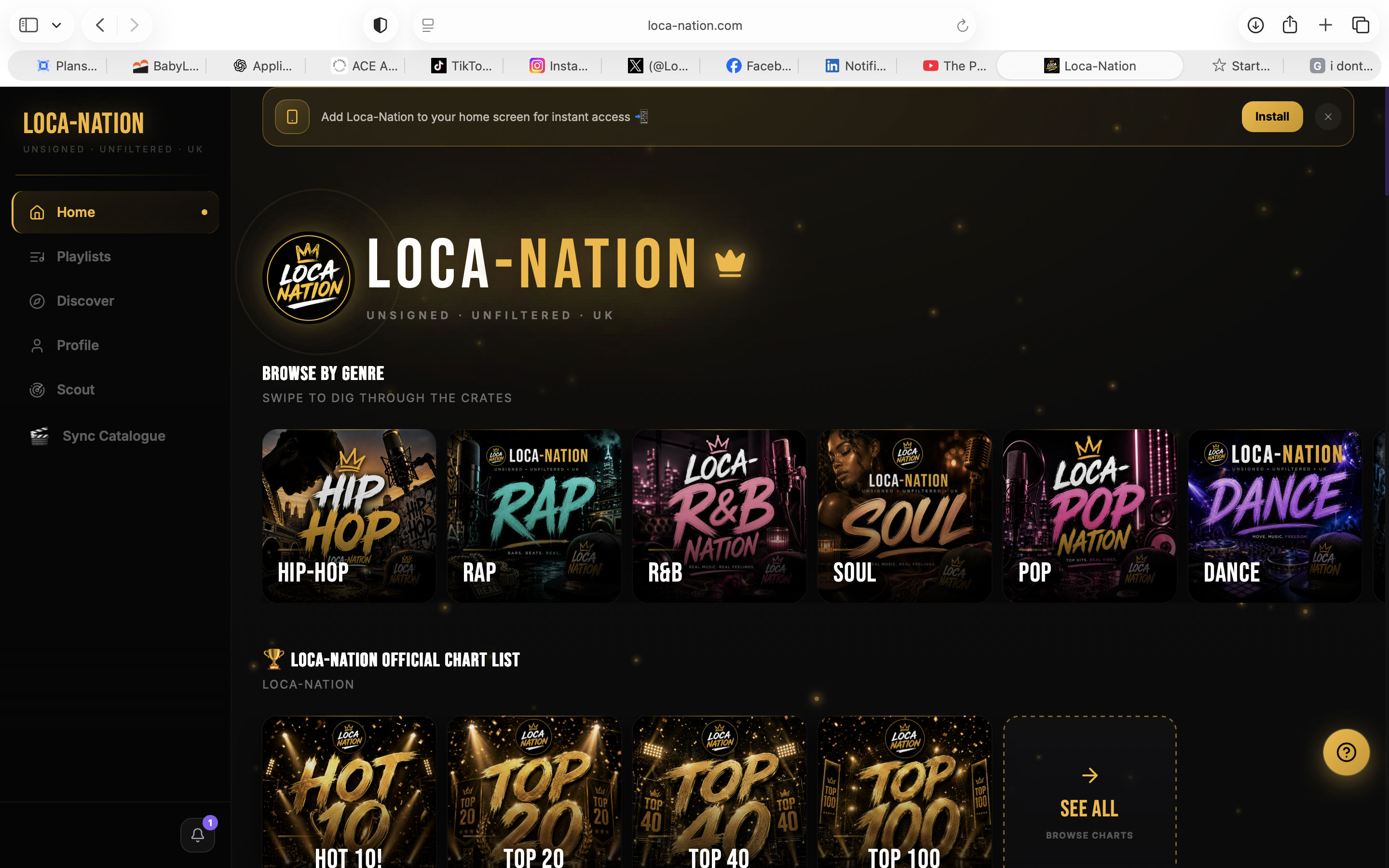
The platform runs an official chart for independent and unsigned artists, with positions earned through genuine listener engagement and votes, not paid placement. You upload your music, build your profile, and compete at local, regional, genre, and national levels. As you climb the chart, your music gets in front of music industry professionals, including labels and scouts, who use the platform to discover emerging talent. The press centre gives you promotional resources to support your pitches. Core features are free. Premium tools, including advanced analytics and sync catalogue access, are available when you are ready to scale. Create your profile, upload your next single, and start competing.
Useful links and tools to execute this plan
Distribution and delivery:
-
DistroKid, TuneCore, or CD Baby: Upload your music to all major DSPs. Compare annual fees and royalty splits before choosing.
-
Spotify for Artists: Claim your profile, submit editorial pitches, and monitor listener data post-release.
-
Apple Music for Artists: Access demographic and geographic analytics for your Apple Music streams.
Pitch and outreach:
-
SubmitHub: Submit to independent playlist curators and music blogs with a structured pitch form and response tracking.
-
Groover: Paid curator and media outreach platform with guaranteed feedback from recipients.
Smart links and landing pages:
- Linkfire or Toneden: Build smart links that route listeners to their preferred DSP and capture email addresses before or after the stream.
Email marketing:
- Mailchimp or MailerLite: Free tiers cover most early-stage artists. Use automation to send a welcome sequence to new subscribers.
Analytics:
-
Chartmetric: Track playlist adds, follower growth, and curator activity across platforms.
-
Native platform analytics: TikTok, Instagram, and YouTube all provide free, detailed performance data. Check weekly.
Rights and royalties:
-
ASCAP, BMI, or SESAC (US) / PRS for Music (UK): Register before your music goes live to collect performance royalties.
-
SoundExchange (US): Register your master recordings to collect digital performance royalties separately from your PRO.
Sources
-
Independent Artist Marketing Strategy 2026: The Complete Playbook | Slow Oak Studio
-
DIY Marketing Strategy for Independent Artists Guide 2026 | AndR. Learning Center
-
Complete Guide to Music Promotion for Independent Artists | Musicians Institute (MI)
-
Music Marketing for Indie Artists — The 2026 Guide | liminl.