
Claim your Spotify for Artists and Apple Music for Artists dashboards, post short-form video daily, build an email list, pitch playlists directly, and collaborate with other artists. None of it costs money, but all of it costs time, and time spent consistently beats any single viral moment. Free platforms like Loca-Nation add a structured path to exposure on top of that routine.
TL;DR:
- Claim and optimize your streaming and artist profiles immediately to increase discoverability and ensure curators see your latest visuals and focus track.
- Use short-form video templates consistently across platforms and analyze their engagement over ten days before adjusting your strategy.
- Pitch playlists with concise, targeted messages based on follower-to-engagement ratios, avoiding paid guarantees that violate platform rules.
- Build and nurture your email list and community engagement strategies because they remain unaffected by platform algorithm changes.
- Focus on free promotional tools like Loca-Nation and community involvement, emphasizing genuine engagement over paid shortcuts to sustain growth.
Table of Contents
- Your 7-Day Free Music Promotion Checklist
- How Do You Use Streaming Dashboards to Get Discovered?
- What Short-Form Video Formats Work for Musicians?
- How Do You Pitch Playlist Curators for Free?
- Why Owning Your Email List Beats Chasing the Algorithm
- How Can Artists Get Creators to Use Their Music for Free?
- Which Free Tools Actually Get a Release Out the Door?
- Do Live Shows and Local Radio Still Matter for Promotion?
- What Free Promotion Mistakes Put Your Music at Risk?
- How Does Loca-Nation Support a No-Cost Promotion Strategy?
- Can Reddit and Discord Actually Grow Your Fanbase?
- How Should You Optimize Your Social Profiles for Music Discovery?
- How Do You Get Featured on Music Blogs for Free?
- How Do Fan Challenges and Interactive Content Build Reach?
- Why Should Independent Artists Cross-Promote Each Other?
- Why Time and Community Beat Budget in the Early Years
- Start Building Your Chart Journey on Loca-Nation
- Quick Resources to Act On Right Now
- Sources
Your 7-Day Free Music Promotion Checklist
You don't need a marketing budget. You need a plan you'll actually finish. Here's a week that fits around a day job:
- Day 1 (30 min): Claim and complete your Spotify for Artists and Apple Music for Artists profiles.
- Day 2 (45 min): Research five playlists in your genre and send one pitch.
- Day 3 (60 min): Film three short-form videos for TikTok, Reels, and Shorts.
- Day 4 (20 min): Send one email to your list with a personal update, not just a link.
- Day 5 (30 min): Message one creator or small artist about a free collaboration.
- Day 6 (15 min): Update your link-in-bio page with your latest release.
- Day 7 (20 min): Review dashboard analytics and note which city or platform grew.
Pro Tip: Batch your video filming on Day 3 so you have a backlog. Posting daily is easier when you're editing, not shooting, on the days in between.
How Do You Use Streaming Dashboards to Get Discovered?
Spotify for Artists and Apple Music for Artists are the two dashboards you should claim before doing anything else. An unclaimed profile means you're leaving free real estate empty, and curators checking you out will notice a blank bio before they notice your music.
Update these fields the day you claim your profile:
- Your artist bio, written for a fan who has never heard of you.
- A high-resolution profile photo and header image that match your release art.
- Your Artist's Pick, pinned to whatever you want new visitors to hear first.
- A Canvas video loop for your lead single, since visual motion tends to hold attention longer than a static cover.
Spotify's editorial pitch tool inside the dashboard is your shot at algorithmic and human playlist consideration, but it only works if you submit at least a week before release and pick one focus track rather than spreading attention across an EP. Dashboard analytics also show which cities are streaming you most, which tells you exactly where to target local playlists and radio outreach next, a workflow Orphiq's guide to free promotion tools lays out well.
What Short-Form Video Formats Work for Musicians?
Short-form video is the closest thing to free advertising that still exists. TikTok, Instagram Reels, and YouTube Shorts all reward sounds that get reused by other creators, which means one clip can generate discovery loops you never touch again.
Three templates cover most situations:
- The teaser: 15 seconds of your best hook, captioned with the release date.
- The behind-the-scenes clip: you in the studio, on tour, or writing a lyric, which builds the personal connection that turns listeners into fans.
- The fan-usage clip: you dancing, lip-syncing, or reacting to your own song the way you'd want a fan to use it as a sound.
Post the same video across all three platforms with minor edits (different captions, no watermark carried over) rather than treating each platform as a separate content pipeline.
Pro Tip: Post at the same time each day for two weeks straight before judging whether a format works. One video rarely tells you anything; ten videos over ten days tells you everything.
How Do You Pitch Playlist Curators for Free?
Legitimate curators are found in three places: Spotify's own algorithmic playlist ecosystem (which rewards saves and completion rate more than pitches), independent curator accounts on Instagram and Twitter/X, and free curator directories that list contact preferences.
A pitch that gets read is short:
- Subject line: your artist name plus genre plus one comparable artist ("Indie folk, think early Bon Iver").
- First line: one sentence on what makes this track fit their playlist specifically.
- Second line: the Spotify link and your location, since local curators often prioritize local talent.
- Close: thank them, and don't follow up more than once.
Before pitching, check a playlist's follower count against its save rate. A playlist with 50,000 followers and no visible engagement is a weaker bet than one with 2,000 followers and active listener comments. Never pay for "guaranteed" placement. Spotify's own terms treat manufactured engagement as a violation, and any curator promising a guaranteed slot for money is not running a curated playlist in any meaningful sense.
Why Owning Your Email List Beats Chasing the Algorithm
Every platform algorithm can change overnight. Your email list can't be deprioritized by a policy update, which makes it the one channel you fully control.
Free tiers on providers like Mailchimp or MailerLite typically cap you at a few hundred contacts, which is sufficient for most independent artists starting out. Pair that list with a simple release landing page or link-in-bio tool that consolidates every streaming destination into one clickable link, since smart links remove friction for fans deciding where to listen. Send emails around releases and shows, and write them like a note to a friend, not a press release.
How Can Artists Get Creators to Use Their Music for Free?
You don't need a marketing budget to get creators using your track. You need a track worth using and a low-friction way for them to find it.
- Search TikTok's Commercial Music Library and creator-focused Discord communities where artists post tracks for creator pickup.
- Offer a simple trade: free use of your song in exchange for a tag and link back to your profile.
- Track usage through TikTok's sound page or by searching your song title, and note which creators' audiences convert into new followers or saves.
Small creators with a few thousand followers often respond faster and use tracks more authentically than accounts chasing brand deals.
Which Free Tools Actually Get a Release Out the Door?
Canva and CapCut cover most of an artist's design and video needs at zero cost, from cover art variations to caption-ready video edits. Meta Business Suite lets you schedule Instagram and Facebook posts in advance, while free tiers on tools like Buffer add basic cross-platform scheduling, though both trade off queue depth or platform coverage once you outgrow the basics.
- Canva: templates for cover art, story graphics, and press kits.
- CapCut: video editing with trending effects built in.
- Meta Business Suite: scheduling for Instagram and Facebook without a third-party tool.
- Free link-in-bio builders: consolidate streaming links, though advanced click analytics usually sit behind a paid upgrade.
Upgrades tend to get triggered by team collaboration features or bulk scheduling, both of which most solo artists can live without for the first year.
Do Live Shows and Local Radio Still Matter for Promotion?
Yes, because offline proof of an audience is exactly what online algorithms and curators look for. Reach out directly to venue bookers for support slots, and pitch community and college radio stations, which often have far lower barriers to entry than commercial stations.
- Promote shows through Instagram Stories, event pages, and a free, permanently hosted press release that gets indexed by search engines.
- Collaborate with other local artists on bills or features to instantly reach their existing fans.
What Free Promotion Mistakes Put Your Music at Risk?
Fake streams and "guaranteed placement" services violate Spotify's platform rules and can get tracks or entire catalogs removed. Red flags include upfront payment for placement, vague promises of "millions of streams," and no verifiable playlist links.
A quick verification checklist: can you find the playlist publicly? Does the curator have a real history? Free, transparent tactics like direct pitching remain the safer path, since genuine promotion relies on channels you control rather than shortcuts you pay for.
How Does Loca-Nation Support a No-Cost Promotion Strategy?
Loca-Nation gives unsigned artists a structured chart journey based on genuine listener engagement rather than industry connections or ad spend, which makes it a natural fit alongside the free tactics above. Listeners vote for tracks they believe deserve to progress, so growth on the platform reflects real audience interest, not manufactured plays.
Fold it into your weekly plan this way:
- Upload your track and complete your artist profile the same week you claim your streaming dashboards.
- Use your chart position and analytics as social proof when pitching playlists or press.
- Treat rising chart placement as a talking point in outreach emails to blogs and curators.
The platform also offers artist analytics, promotional resources, and sync licensing opportunities that extend past basic exposure into career development tools.
Can Reddit and Discord Actually Grow Your Fanbase?
Music-specific communities on Reddit and Discord reward artists who show up as people first and promoters second. Subreddits like r/WeAreTheMusicMakers or genre-specific communities have explicit rules against pure self-promotion, and breaking them gets posts removed or accounts banned. The artists who succeed there spend weeks commenting on other people's work, offering feedback, and answering questions before ever posting their own link.
Discord operates differently. Genre-based servers and label-run communities often have dedicated "share your music" channels where feedback threads are the norm rather than the exception. The value isn't a single post reaching thousands of people. It's the slow build of a reputation as someone worth listening to, which turns into people actually clicking through when you do share a release.
A few practical rules keep you out of trouble and get you further:
- Read the community rules before posting anything, since most forums have specific self-promotion days or threads.
- Give feedback on other artists' tracks before asking for feedback on yours.
- Join three to five communities that match your actual genre rather than casting a wide net across generic music subreddits.
- Treat these spaces as long-term relationship building, not a distribution channel for every release.
The payoff shows up slowly: a curator who remembers your username from a helpful comment months earlier, or a fellow artist who shares your track unprompted because they've seen you support others first.
How Should You Optimize Your Social Profiles for Music Discovery?
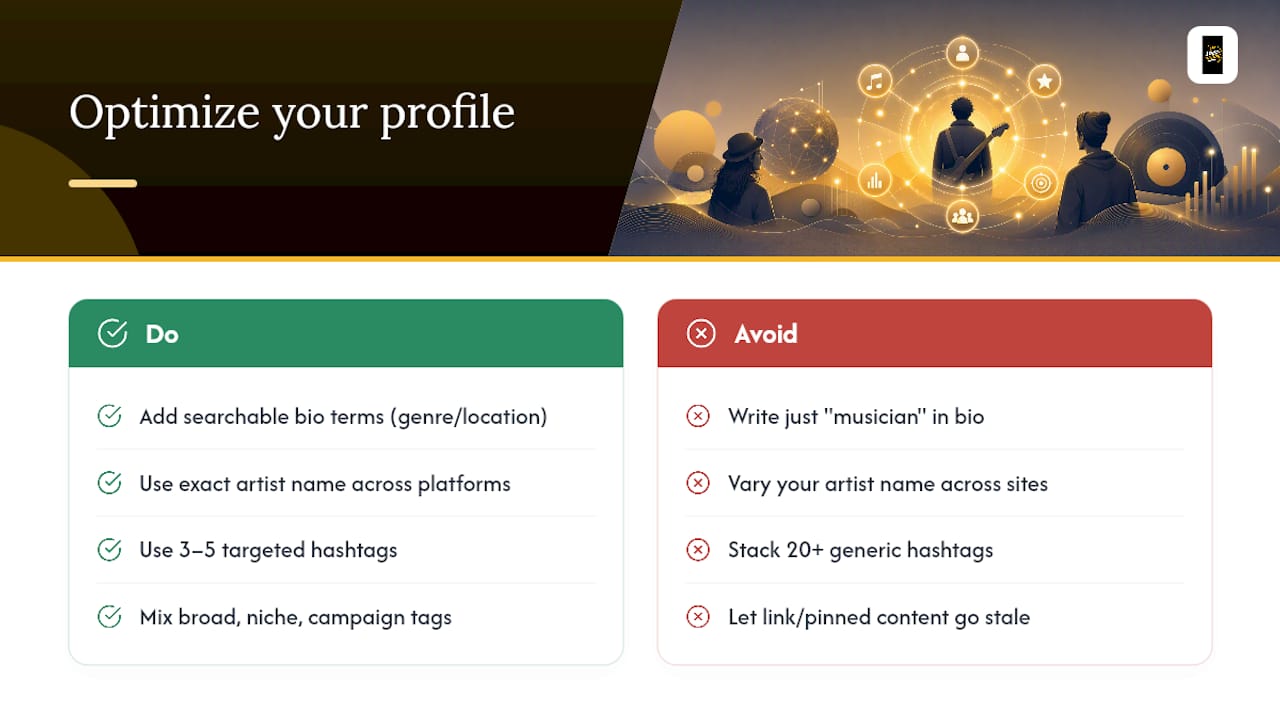
Your bio is discoverable text, not decoration. Search engines and in-app search both index profile names, bios, and captions, which means an artist bio that just says "musician" wastes searchable space that could include your genre, location, or a comparable artist name.
Structure your username and display name to include your actual artist name exactly as it appears on streaming platforms. Inconsistency between "DJ Marcus," "Marcus Official," and "Marcus Music" across platforms splits your searchability and confuses fans trying to find you after hearing a song.
Hashtags still function as a discovery layer, particularly on TikTok and Instagram, but strategy matters more than volume. Mix three types: broad genre tags (#indiefolk), niche community tags (#bedroompop), and specific campaign tags tied to your release. Stacking twenty generic hashtags under a caption reads as spam to both algorithms and human viewers, while three to five well-chosen tags tend to perform better because they reach people actually searching those terms.
Your link-in-bio should update with every release, and your pinned content should always represent your most recent or most successful work rather than whatever you happened to post last. A profile visitor decides whether to follow you within seconds, so the first three grid posts or pinned video on any platform functions like a mini pitch deck for who you are as an artist.
How Do You Get Featured on Music Blogs for Free?
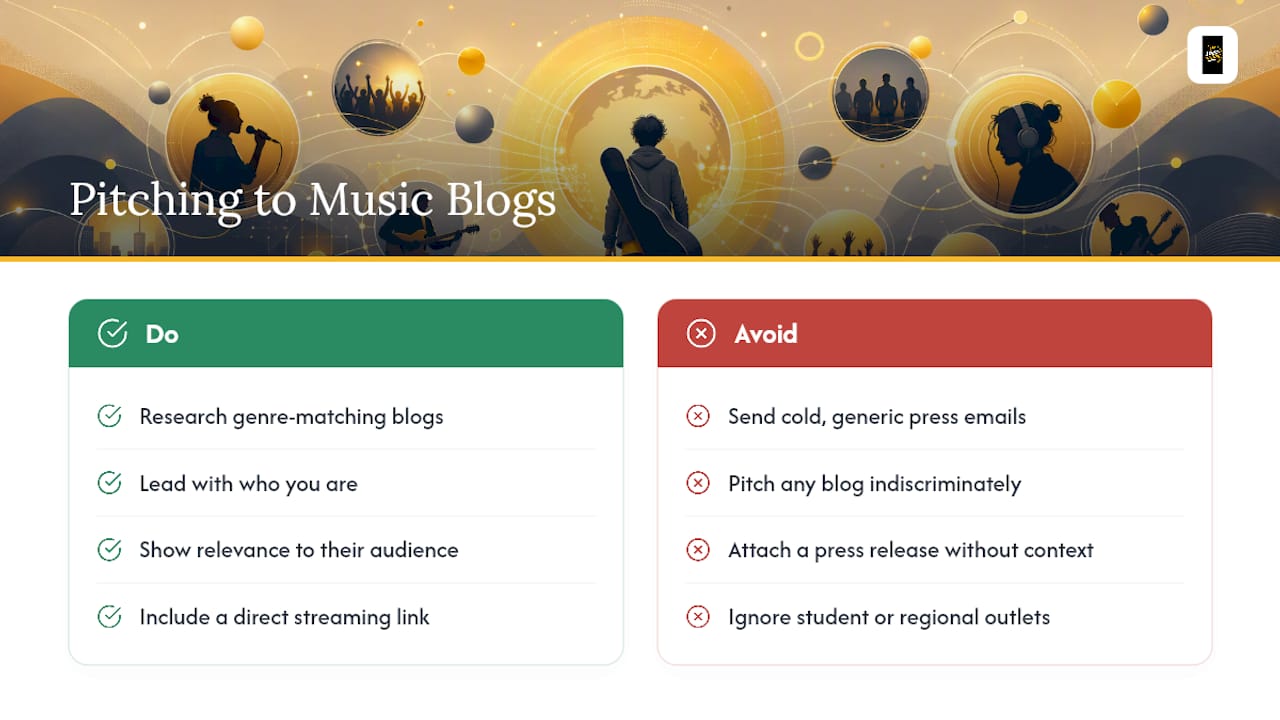
Music blogs and online magazines remain one of the most underused free channels, largely because most artists pitch them wrong. A cold email with a generic press release attached rarely gets opened, let alone covered. What works is research: find blogs that have actually covered artists in your genre and style recently, not just any music blog with a submission form.
Your pitch email needs three things in the first two sentences: who you are, what makes this release relevant to their specific audience, and a direct streaming link. Editors and bloggers reading dozens of pitches a day skim for relevance before anything else. A permanently hosted, search-indexed press release gives you something concrete to link in that pitch and doubles as evergreen content that surfaces later in searches for your name.
Many blogs also run recurring features built for exactly this: weekly new-music roundups, unsigned artist spotlights, or reader-submission columns. These have lower barriers than a full interview pitch and often accept direct submissions through a form rather than requiring a personal relationship with an editor.
Don't overlook student-run and regional publications either. A local paper's music section or a college radio station's blog often has far less competition for coverage than a major national outlet, and local coverage tends to translate into local show attendance more directly than national press does anyway.
How Do Fan Challenges and Interactive Content Build Reach?
Passive listening doesn't spread a song. Participation does. Challenges built around your track (a dance, a lyric-completion prompt, a cover version invitation) turn fans from an audience into distributors, since every version they post carries your sound into their own network.
The mechanics are simple: give fans something specific and easy to replicate. A 15-second dance moment, a caption prompt ("finish this lyric"), or a "duet this" invitation on TikTok all lower the barrier to participation compared to asking someone to just "check out my new song."
Polls and questions in Instagram Stories serve a quieter version of the same goal. Asking fans to vote on your next single, a cover art option, or a tour city keeps them invested in decisions about your career, which builds the kind of attachment that turns a casual listener into someone who shows up to a show or shares a release unprompted.
The artists who do this well treat it as a two-way conversation rather than a broadcast. Responding to duets, reposting fan covers with credit, and commenting on user-generated content signals that you're paying attention, which keeps people participating instead of feeling like they shouted into a void.
Why Should Independent Artists Cross-Promote Each Other?
Two artists with 2,000 followers each can reach 4,000 people through a single collaboration, and that math only improves as more artists join in. Cross-promotion works because it taps into an audience that's already proven receptive to independent music in your general genre space, which is a warmer audience than a cold algorithmic recommendation.
The simplest version is a feature or collaboration track, but you don't need to co-write a song to cross-promote effectively. Instagram Live sessions with another artist, a joint playlist you both share, or simply tagging each other in release posts all work. Local scene compilations, where a handful of artists in the same city release a combined EP or playlist, spread discovery costs across everyone involved while giving each artist access to the others' fanbases.
Look for artists at a similar career stage rather than reaching for someone with a much larger following expecting a favor. Reciprocity works best between peers, and an artist with 500 followers offering genuine collaboration to another artist with 500 followers tends to get a faster, more authentic response than a cold ask aimed upward.
Why Time and Community Beat Budget in the Early Years
Loca-nation's philosophy is simple: talent and genuine engagement should outrank money or industry connections, and that only works if artists treat free promotion as a discipline rather than a stopgap. The tactics in this guide compound. A playlist pitch here, a video there, a returning fan on your email list. None of it looks dramatic in isolation, but consistency over months is what separates artists who get discovered from artists who gave up after two weeks.
— Jason
Start Building Your Chart Journey on Loca-Nation
You've read the free tactics: dashboards, video, email, pitching, collaboration. Loca-Nation gives you a place to put all of that work to use, with a chart system built specifically for unsigned and independent artists rather than one dominated by whoever has the biggest ad budget.
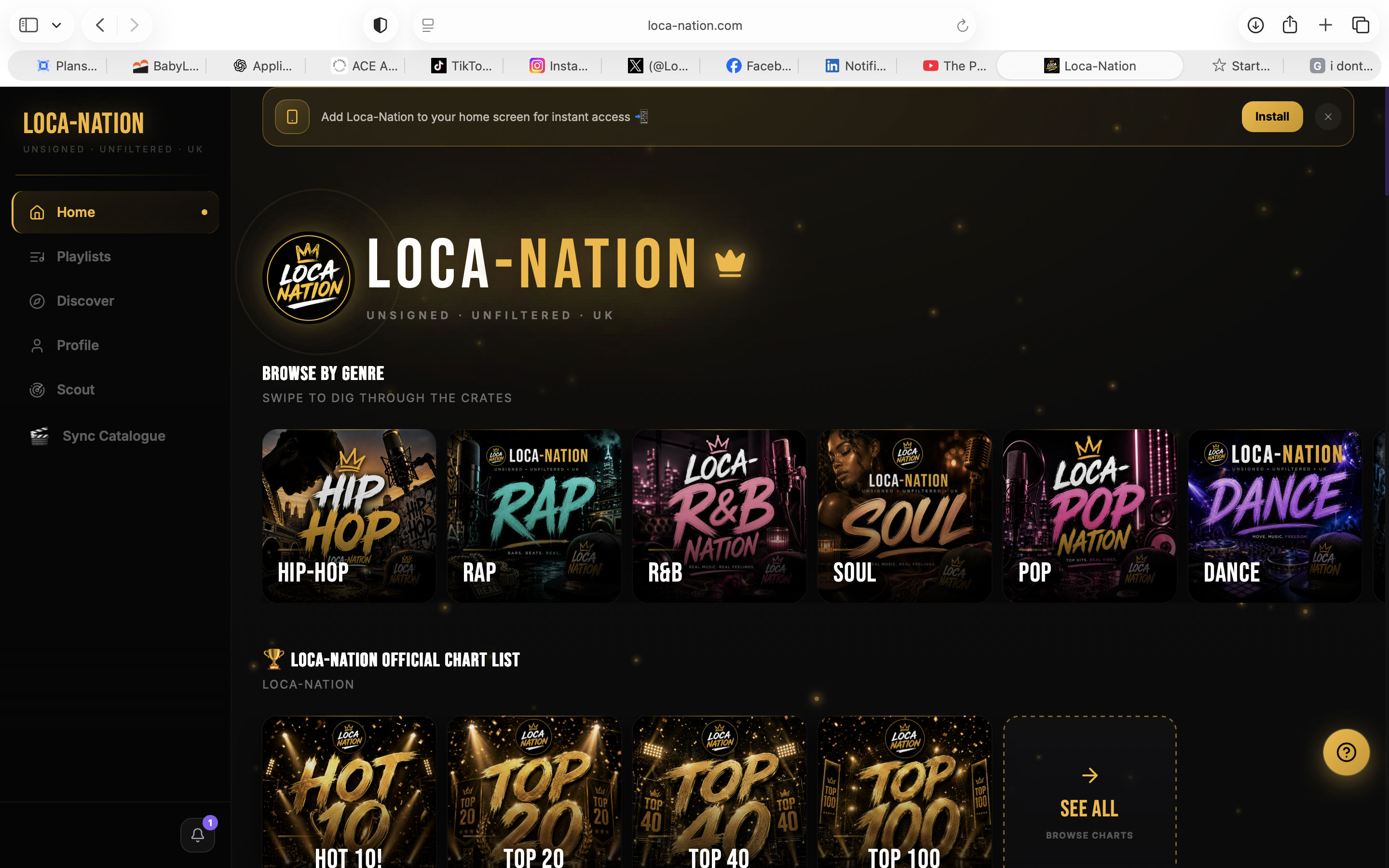
Upload your track, complete your artist profile, and let genuine listener votes carry you through your local, regional, and national chart path. There's no cost to list your music, no paid placement to buy your way up, and no subscription required for listeners, which means every stream and vote you earn reflects real interest rather than manufactured reach. Once you've built momentum, explore the platform's sync licensing opportunities for additional revenue paths beyond streaming.
Ready to put this week's checklist to work somewhere it counts? Head to Loca-Nation's genre onboarding and start your chart journey today.
Quick Resources to Act On Right Now
Start here: Loca-Nation for free chart exposure, Orphiq's free promotion guide for tool tactics, and Mix Analyzer's budget mixing guide for release-ready quality.