
The fastest way to reach a music supervisor is targeted research plus one hosted EPK link, sent as a short, specific email to 10 to 15 supervisors whose recent work already sounds like yours. Mass-blasting hundreds of contacts wastes time. Targeted outreach to a small, well-matched list outperforms volume every time.
Here's your next 30 to 60 minutes: pick five shows, films, or ad campaigns that already use music like yours. Find the supervisor's name attached to each one. Build one clean landing page (a single streaming link works fine) and treat that as your EPK. That's it. That's the setup.
Set your expectations now, before you send anything:
- Composers estimate supervisors open roughly 5% of cold emails, and reply to far fewer.
- A single reply is a genuine win, not a failure signal.
- Placements take weeks to months from first contact to confirmed use.
Key Takeaways
Contacting music supervisors successfully requires targeted research, clean metadata, one hosted EPK link, and a measured follow-up cadence rather than mass outreach.
| Point | Details |
|---|---|
| Target a small list | Research 10 to 15 supervisors whose recent work already matches your sound before writing a single email. |
| Lead with metadata | Include BPM, key, ISRC, PRO affiliation, and one-stop status so tracks don't get silently skipped. |
| Use one hosted link | Skip attachments entirely; a single private streaming link gets opened, files usually don't. |
| Time it to production | Pitch around renewal announcements and season premieres, not mid-season when budgets are spent. |
| Follow a set cadence | Bump at Day 7, add value at Day 21, and let EPK analytics decide whether a nudge is worth sending. |
Trusted Directories and Tools Worth Bookmarking
- IMDbPro for cross-referencing supervisor credits and filmographies.
- Tunefind for tracking real placements by show and episode.
- LinkedIn and the Guild of Music Supervisors for verifying active contacts.
- theSYNCreport if you want paid access to contact lists and TV calendars.
Table of Contents
- How to Contact Music Supervisors: Where to Look
- How to Write a Pitch Email Music Supervisors Actually Open
- When Should You Pitch a Music Supervisor?
- Sync vs. Master Rights: What You Need to Know Before You Pitch
- How Do You Follow Up Without Annoying a Supervisor?
- Your Pre-Send Pitch Package Checklist
- How Loca-Nation Helps You Get Discovered
- Contact Music Supervisors: A Practical Guide for Musicians
- Sources
How to Contact Music Supervisors: Where to Look
Contacting music supervisors starts with knowing where they actually leave a trail. Most don't publish an inbox and wait. You have to go find the name attached to the work.

End credits are still the most reliable free source. Watch the show or film you're targeting, note the music supervisor's credit, and search their name. IMDbPro lets you cross-reference that name against their full filmography, so you can see what else they've worked on and whether your sound actually fits their track record. Tunefind and similar placement trackers show you exactly which songs landed in which episodes, which tells you the supervisor's taste better than any bio ever could.
LinkedIn works for two things: confirming a supervisor is still active at a given company, and finding warm paths in through mutual connections. The Guild of Music Supervisors publishes a membership directory and hosts events where relationships start face to face, not through a cold inbox.
Paid directories like theSYNCreport aggregate supervisor contacts, production calendars, and buyer information in one searchable database. That's genuinely useful if you're pitching across dozens of active shows and don't have hours to piece credits together manually. It won't get your track placed. It just speeds up the research phase. Weigh the subscription cost against how much time you'd otherwise spend cross-referencing credits yourself.
Whatever source you use, verify before you send. A contact list that's a year old often has supervisors who've left their post or shows that were canceled. Cold blasts to large, unverified lists routinely fail because the addresses are stale or the list was scraped, not researched. Avoid any list you can't confirm was updated recently.
Pro Tip: Check a show's production calendar or renewal announcement before you pitch. A supervisor staffing up for a newly greenlit season is far more receptive than one mid-way through a season they've already scored.
How to Write a Pitch Email Music Supervisors Actually Open
Your subject line has one job: prove you did the research. "Track for [Show Name] Season 3" beats "New Music Submission" every time, because it signals you watched the thing before you emailed about it.
Keep the body to five lines:
- One line naming the specific show, episode type, or campaign you're pitching for.
- One line on why your track fits that specific scene or brief.
- Your hosted EPK link (one link, nothing else).
- Key metadata: BPM, key, ISRC, PRO affiliation, and one-stop status.
- A closing line naming who to contact for licensing.
That metadata line matters more than it looks. Supervisors sort tracks fast, and missing metadata functions as a silent rejection — no reply, no explanation, just skipped. Include BPM, key, and ISRC up front so nobody has to ask.
On links: use a single hosted, private streaming link (SoundCloud private link, Disco, or a similar platform), not an attachment. Supervisors generally won't open email attachments at all, and large file shares trigger spam filters before a human ever sees them.
Three templates cover most situations:
- Cold pitch: Lead with the scene-specific line, close with your EPK and licensing contact.
- Seven-day bump: A two-line nudge referencing your original email, only sent if analytics show the link was never opened.
- Warm intro: Open with the mutual contact's name in the first sentence, before anything else.
State your licensing status in one plain sentence: "This track is one-stop, cleared for sync." That single line removes the biggest friction point on a tight deadline.
Pro Tip: Match your pitch to a scene, not a genre. Saying "this fits the quiet devastation before the credits roll" beats "this is a moody indie folk track" because it proves you actually watched the show.
When Should You Pitch a Music Supervisor?
Timing beats volume almost every time. A supervisor staffed on a live production needs music now. One staffed on a show that wrapped its season six months ago doesn't need anything from you.
Different formats move at different speeds. Ad briefs can turn around in 48 hours. TV episodes typically run weeks of lead time before air. Feature films can take months between temp score and picture lock, with real opportunities opening up at several stages along the way.

Build a simple pitching calendar tied to real-world triggers: renewal announcements, new season premieres, and casting or production news for upcoming films. A show just picked up for a new season is actively staffing music decisions. A show three episodes from its finale usually isn't.
Pro Tip: Set an alert for renewal news and new-season announcements on shows in your genre lane. That single habit puts your pitch in front of supervisors exactly when they're building out a season's music budget, not after it's spent.
Sync vs. Master Rights: What You Need to Know Before You Pitch
A sync license covers the right to pair your composition with visual media. A master use license covers the right to use your specific recording of that composition. If you wrote the song and recorded it yourself, you control both, and that's what "one-stop" means: a supervisor can clear your track through a single agreement instead of chasing down separate publishing and label approvals.
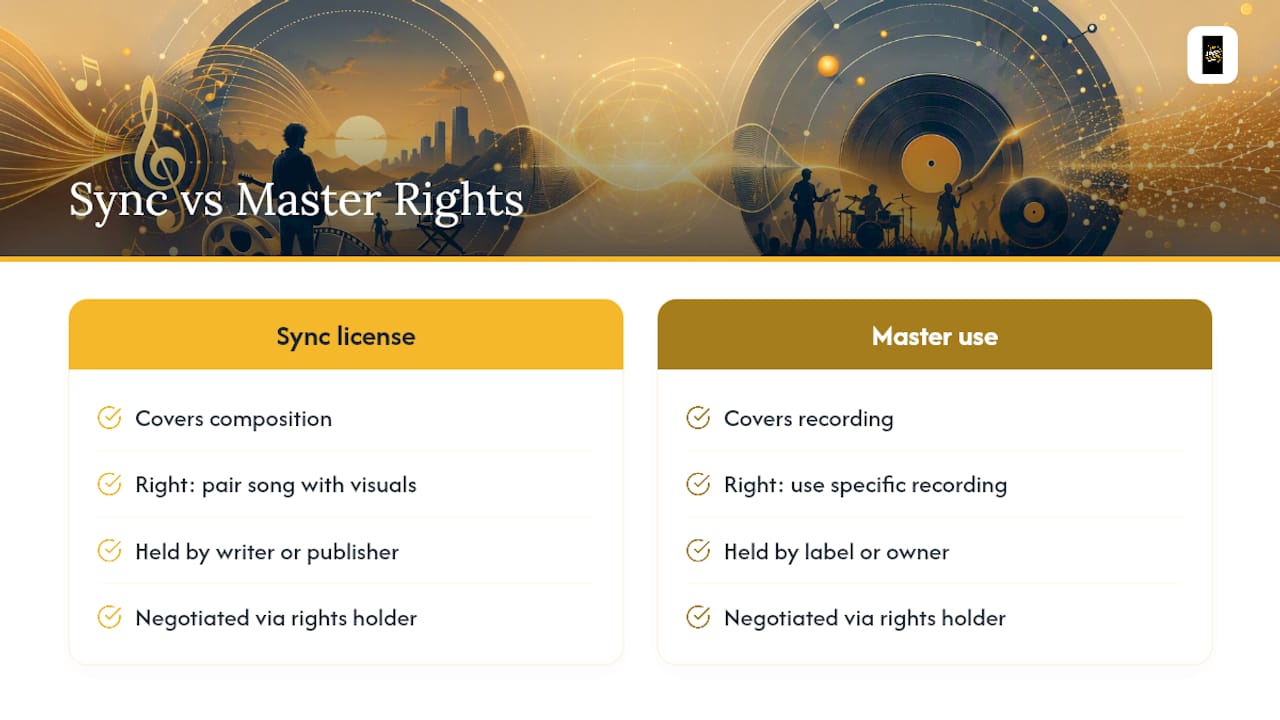
That one-stop status is often the deciding factor on fast-turnaround briefs, because nobody has time to track down a co-writer's publisher on a 48-hour ad deadline.
Before you pitch anything, have a split sheet ready. It should list every writer, their percentage share, and PRO affiliation. Supervisors look for title, artist, writer credits, splits, PRO, ISRC, BPM, and key before they'll move a track forward, and having this ready in advance saves days once someone says yes.
Fee negotiation typically runs through whoever holds the rights: you directly if you're one-stop, or your label, publisher, or agent if rights are split. Indie fees vary widely by format, with ads generally paying more than TV placements, and TV generally paying more than smaller independent films.
Watch for red flags. Anyone asking you to pay for "guaranteed placement" is running a pay-to-play scheme, not a real sync opportunity. A legitimate supervisor or agent never asks the artist to pay upfront for consideration.
Pro Tip: Build your split sheet before you ever pitch, not after someone says yes. Scrambling to track down a co-writer's signature after a supervisor approves your track is how placements fall through.
How Do You Follow Up Without Annoying a Supervisor?
A measured cadence works better than either silence or persistence. DropCue's recommended rhythm runs: Day 7 bump if unopened, Day 21 value-add (a new release or relevant credit), Day 60 relevance trigger (a new project that fits their lane), Day 120 annual touchpoint.
Let your EPK's analytics decide whether to bump at all. If a supervisor opened your link and listened but didn't reply, that's often a deliberate pause, not a missed message. Skip the Day 7 nudge in that case and wait for the Day 21 value-add instead.
Offline relationships still carry real weight. Guild of Music Supervisors events and sync showcases are where trust actually builds, and a referral from an attorney, manager, or fellow supervisor opens doors that a cold email never will. One genuine conversation at an event beats a dozen unanswered emails.
Avoid the mistakes that get you permanently filtered: mass blasts, email attachments, and repeated follow-ups after a clear non-response. Supervisors remember who respected their time.
Pro Tip: Ask for one small thing at events, like "who else works on shows in this genre," rather than pitching your track on the spot. Referrals convert far better than an impromptu elevator pitch.
Your Pre-Send Pitch Package Checklist
Run through this before a single email goes out:
- Hosted EPK link with your track set to play first, no login wall.
- WAV stems ready to send on request.
- Metadata embedded: ISRC, BPM, key, PRO affiliation.
- Split sheet listing every writer and percentage.
- A one-line rights statement, noting one-stop status if it applies.
- Direct licensing contact info.
Keep the hygiene simple: one streaming link, no attachments, no gated pages. Then test it yourself. Play the link on your phone. Check that the metadata displays correctly. Send the link to a friend and confirm it opens without a login.
How Loca-Nation Helps You Get Discovered
Direct pitching works, but it's not the only channel worth running. Loca-Nation's genre onboarding sorts your music into discovery channels built around your actual sound, so the right ears find you without a cold email involved.
The platform's sync catalogue gives industry professionals, supervisors included, a direct route to browse and license independent tracks. Your artist profile and analytics run alongside your chart performance, so a supervisor scanning the catalogue sees real engagement data, not just a submitted file.
Submitting through Loca-Nation doesn't replace the prep work above. You'll still need your metadata, split sheet, and rights status ready to go. Think of it as a parallel channel running while you self-pitch, not a shortcut around the fundamentals.
Independent artists rarely get discovered by accident. A platform built around genuine listener engagement gives supervisors a filtered, pre-vetted place to look, instead of an inbox full of unsolicited links.
Pro Tip: Keep your Loca-Nation profile and your EPK metadata identical. Supervisors who find you on one and check the other expect the same information both places.
Should I use an agent instead of pitching supervisors directly? An agent or sync library offers connections and industry access you may not have yet, but typically takes 25% to 50% commission. Direct pitching keeps full rights and revenue but requires more upfront relationship-building and research.
How many supervisors should I contact per pitch round? Ten to fifteen is a strong range. Fewer, better-matched supervisors consistently outperform mass outreach to hundreds of unverified contacts.
Contact Music Supervisors: A Practical Guide for Musicians
Most advice on this topic obsesses over finding the "perfect" contact list, as if the list itself were the bottleneck. It isn't. The bottleneck is almost always the pitch: vague subject lines, missing metadata, attachments nobody opens. A supervisor with a mediocre contact list and a sharp, scene-specific email will outperform someone with a premium directory and a generic message every time.
The conventional wisdom also undersells patience. Treat every reply as a genuine signal worth building on, not proof the previous ninety-five emails failed.
If you take one thing from this: fix your metadata and your one-stop status before you touch a contact list. That's where most independent pitches quietly die, long before anyone judges the song itself.
Sources
- How to Contact Music Supervisors (Without an Agent) | SyncPlacement
- How to Send Music to Music Supervisors | DropCue
- How to Pitch to a Music Supervisor | liminl.
- How to Pitch a Music Supervisor and What a Sync Brief Actually Is | Velveteen