
Own your name on a canonical website, publish a real page for every artwork you sell, and clean up your image files. Those three moves cover most of what artist profile SEO actually requires. Add corroborated facts across the web (press mentions, Wikidata, consistent bios) and you have a system that gets your name and work found, not just seen once and forgotten.
TL;DR:
- Claim your full name as the main heading and title tag on your homepage to establish a clear entity home, improving search engine trust.
- Create a dedicated, detailed webpage for each artwork with descriptive text and schema markup to make each piece discoverable in image and web searches.
- Use consistent name spelling across all platforms and add corroborating mentions from press, galleries, and databases to build a trustworthy profile.
- Focus on long-tail, buyer-intent keywords related to your artwork, medium, and location to attract potential buyers who are ready to purchase.
- Implement simple technical fixes like image compression, sitemap submission, and schema markup to ensure your site is easily crawled and indexed by search engines.
Table of Contents
- Artist Profile SEO: The Foundation Most Artists Skip
- Quick SEO Checklist: Immediate Wins You Can Do in a Weekend
- Keyword Research for Artists: Finding Phrases You Can Actually Win
- Optimize Your Artist Profile and About Page
- Artwork Pages and Image SEO: Make Every Piece Discoverable
- Technical Basics Artists Often Miss
- Build Authority and Trigger a Knowledge Panel
- Measure Results: The Minimal Analytics Plan for Artists
- Common Mistakes and the Final Pre-Publish Checklist
- Author Perspective: Jason on Discoverability and Career Impact
- Sources
Artist Profile SEO: The Foundation Most Artists Skip
Artist profile SEO means structuring your name, your website, and your artwork pages so search engines can identify you as a distinct entity, not just another gallery listing buried in a feed. Search engine optimization for creatives works differently than it does for e-commerce or blogs, because the product is you. Your own name is the highest-value keyword you can rank for, and most artists never claim it properly on their own site.
The gap is almost always structural. Artists post work to Instagram, list a few pieces on a marketplace, and call the SEO work done. None of that builds an entity home, which is the one canonical page search engines trust as the true source of facts about you. Fix that first and everything downstream, from image search to knowledge panels, gets easier.
Quick SEO Checklist: Immediate Wins You Can Do in a Weekend
You don't need a developer for this. Work through these in order over a weekend:
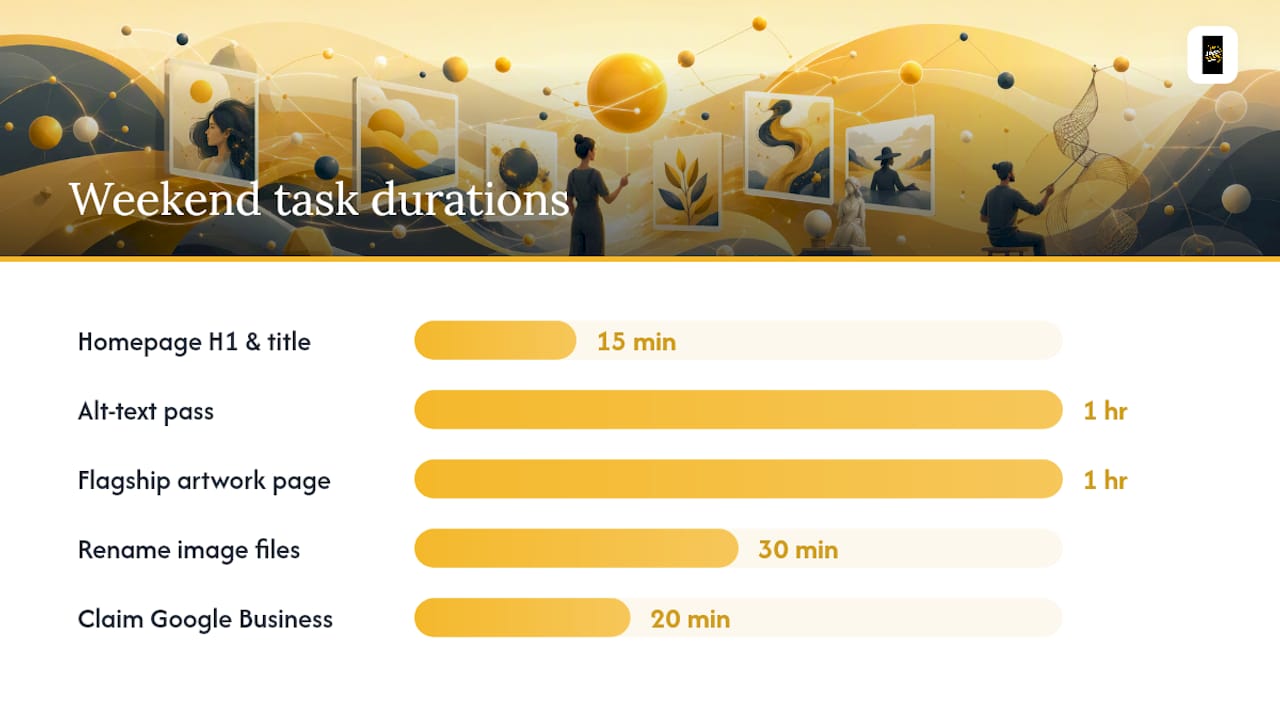
- Put your full name in your homepage H1 and title tag (15 minutes).
- Rewrite your meta description with name, medium, and location (10 minutes).
- Run an alt-text pass on every image using the artist name + medium + subject formula (1 hour).
- Build one full page for a single flagship artwork as a template (1 hour).
- Rename image files from "IMG_4521.jpg" to descriptive slugs (30 minutes).
- Generate and submit an image sitemap (20 minutes).
- Claim your Google Business Profile under the "Artist" category, since artists rarely claim this and it's a fast local win (20 minutes).
- Submit your sitemap in Google Search Console (10 minutes).
Expect Google to start crawling within days; image impressions usually move within 30 to 90 days.
Pro Tip: Batch the image work. Rename and write alt text for all your files in one sitting using a spreadsheet, then upload in a single pass. Switching between tasks is what makes this feel like it takes forever.
Keyword Research for Artists: Finding Phrases You Can Actually Win
Your name is the primary keyword. If it's common or shared with someone more famous, pair it with modifiers like medium, city, or subject matter (think "watercolor landscapes Portland" instead of competing for "landscape painter" alone).
Beyond your name, the real opportunity sits in long-tail, buyer-intent phrases most artists never target:
- Mine Google Search Console's "queries" report for phrases already bringing traffic, even at low volume.
- Check Google Images and Pinterest for the phrasing buyers use around similar work, like "original abstract painting for living room."
- Use a basic keyword tool to confirm search volume on medium plus subject combinations.
- Map each keyword type to a page: buyer-intent phrases go on artwork pages, discovery phrases (style, technique) go on your about or process pages, and local phrases go on a commissions page.
Prioritize buyer-intent phrases first. They convert. Discovery phrases build long-term topical depth but take longer to pay off.
Optimize Your Artist Profile and About Page
Your about page is your entity home, the one page search engines treat as the authoritative source of facts about you. Every other bio, listing, or mention should point back here.
Include on that page:
- Your full canonical name, stated exactly the same way everywhere online
- A short, scannable fact list (birth year or founding year of your practice, medium, location, education, notable exhibitions)
- One high-quality representative image
- Direct contact information and links to your artwork pages and press mentions
Behind the scenes, add Person schema (JSON-LD) with sameAs links to your verified social profiles and, once you have one, your Wikidata identifier. Entity clarity, meaning a consistent name and canonical domain, now matters more for brand search results than keyword density. Build a simple press or corroboration page listing exhibitions, features, and mentions, then ask those outlets or galleries to link back to your domain. That linking pattern is the same signal Google uses to validate facts for a knowledge panel.
If you need a starting template for the fact list and tone, these artist bio examples are a useful reference point.
Artwork Pages and Image SEO: Make Every Piece Discoverable
A gallery grid of thumbnails is invisible to search engines. Search engines cannot interpret a painting without descriptive text next to it, so every artwork that matters needs its own indexable page, not just a thumbnail in a scroll feed.
Each artwork page should include a title with the artwork name and medium, a description of at least 300 words covering the story, technique, and context, plus dimensions, medium, and a clear availability or inquiry path. That description is doing real work: it gives search engines the context an image alone can't provide, and it's the difference between a page that ranks and one that sits invisible next to a hundred identical grid entries.
| Element | What to include | Why it matters |
|---|---|---|
| Filename | descriptive slug (e.g., "blue-hour-oil-painting.jpg") | Search engines read filenames as ranking signals |
| Alt text | artist name + medium + subject + size | Feeds image search and accessibility |
| Image variants | full view, detail crop, scale/in-room shot | Matches different buyer search intents |
| Schema | VisualArtwork with mainEntityOfPage | Tells search engines this page is the artwork's canonical home |
| Compression | WebP or optimized JPEG under 200KB | Protects Core Web Vitals scores |
Image search drives more discovery than text search for many art buyers, which makes this the single highest-leverage section on your whole site.
Technical Basics Artists Often Miss
Most technical SEO problems on artist sites are simple to fix once you know to look:
- Test your site on a phone. If text overlaps images or buttons are hard to tap, fix the theme before anything else.
- Compress every image before upload and use lazy-loading for anything below the fold.
- Set caching headers through your hosting or website builder, most platforms have a one-click option.
- Submit both an XML sitemap and an image sitemap in Google Search Console.
- Check
robots.txtto confirm you haven't accidentally blocked your own artwork folder. - Use Search Console's URL Inspection tool to request indexing on new artwork pages instead of waiting.
Build Authority and Trigger a Knowledge Panel
A knowledge panel is not luck. Triggering one requires an entity home, corroborative sources, and a Wikidata item working together, and the steps are sequential.
- Set up a Wikidata item with your name, occupation, and website as the official reference.
- Get consistent facts about you, name, birth year, medium, listed the same way across press features, festival programs, and databases, all linking to your domain.
- Add Person schema site-wide and CreativeWork schema on project pages, linking every piece back to your entity home.
- Request links from any gallery, publication, or sync licensing platform that already mentions you, since consistent external citations reinforce the same facts.
This takes months, not weeks. Expect the panel process to unfold over roughly three to six months as corroboration accumulates.
Pro Tip: Before chasing new press, audit your existing mentions for spelling inconsistencies in your name. A knowledge panel forms from agreement across sources, and one mismatched name variant can stall the whole process.
Measure Results: The Minimal Analytics Plan for Artists
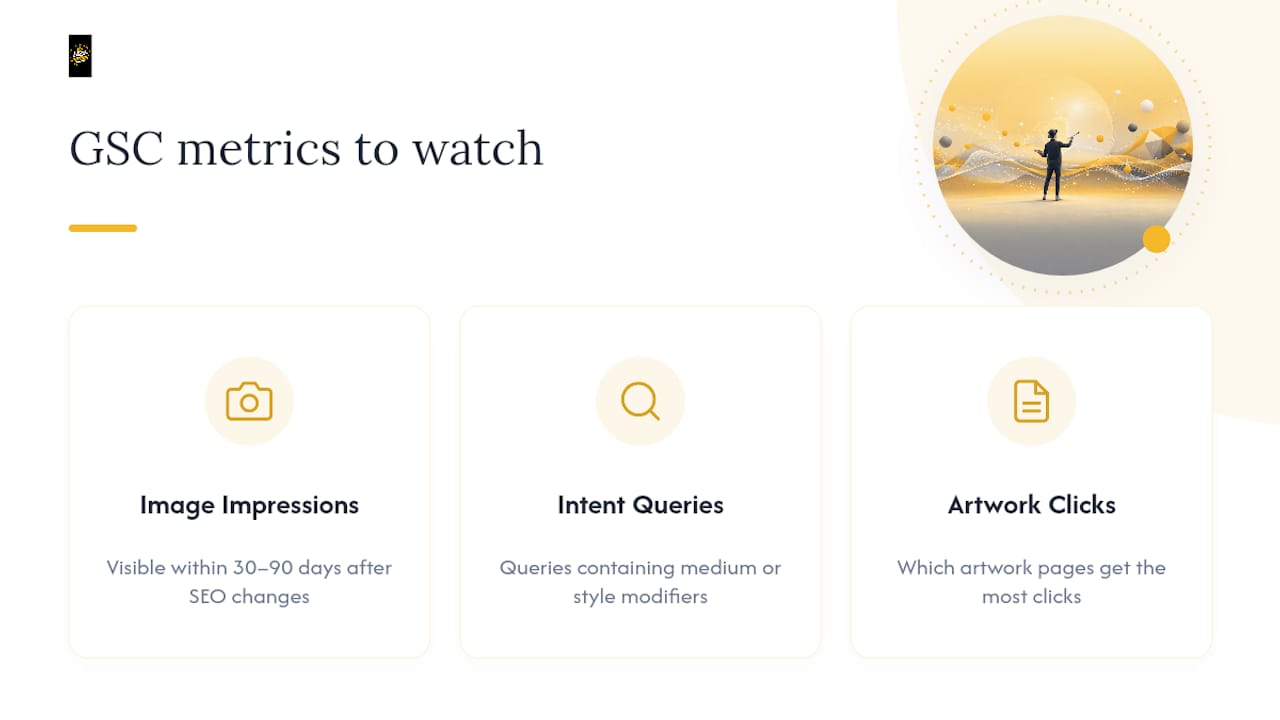
You don't need enterprise analytics. Watch three things in Google Search Console: image impressions, queries containing medium or style modifiers, and which artwork pages get the most clicks.
Add a simple "How did you find me?" field to your contact or inquiry form. That single field tells you which channel is actually producing leads, not just traffic. Image SEO improvements typically show up in impressions within 30 to 90 days, while attributing an actual sale or commission back to organic search usually takes four to six months, since buyers often browse for weeks before reaching out.
Track inquiry rate per artwork page, not just overall traffic. A page with fewer visits but a higher inquiry rate is doing its job better than a popular page nobody contacts you from.
Common Mistakes and the Final Pre-Publish Checklist
The recurring failures: single gallery pages with no text, empty alt attributes, a name spelled three different ways across platforms, and zero corroborating mentions anywhere else online. Before publishing any new artwork page, run through this:
- Full name matches exactly across the page and your entity home.
- Alt text follows the name plus medium plus subject formula.
- Description is at least 300 words.
- Filename is descriptive, not a camera default.
- VisualArtwork schema is present and valid.
- Page is not set to noindex.
- Images are compressed and lazy-loaded.
- Page is included in your sitemap.
- Internal links point to your about page and other relevant work.
- Contact or inquiry path is visible without scrolling.
Author Perspective: Jason on Discoverability and Career Impact
Here's what most guides won't tell you: SEO for musicians and SEO for visual artists solve the same problem, getting discovered by someone who has never heard your name, but visual artists treat it like an afterthought while musicians at least fight for playlist placement. That gap is the opportunity.
Artists who execute the entity-home and artwork-page work typically see galleries and press find them through search instead of chance introductions, and commission inquiries start citing specific pieces by name, a sign the artwork page itself did the selling. The same logic applies on platforms built for discovery. Loca-Nation's genre onboarding process works on this exact principle for musicians: a complete, well-tagged profile surfaces in searches an incomplete one never reaches.
Discoverability isn't a marketing extra. It's the mechanism that turns a good body of work into a career someone outside your existing network can actually find.
— Jason
Sources
- SEO for Artists in 2026 | Art World Marketing
- SEO for Artists: 2026 Guide to Getting Found on Google
- SEO for Artists' Websites - Ceri Hand
- Google Knowledge Panel for a Visual Artist: How to Get, Manage and Optimise?