

Here are four artist bio lengths you can copy right now: a one-liner, a short version around 50 to 100 words, and a longer version of around 250 to 400 words. Each one fits a different job. Paste the short version into your Spotify for Artists profile header, drop the long one into a press kit, and you're done rewriting from scratch every time someone asks for "a bio."
Bookers skim. Press writers scan for a hook. Playlist curators barely read at all before checking your streaming numbers. That's why one bio length never works everywhere, and why the templates below are built around what each gatekeeper actually looks for: a genre hook, one proof point, and a clear way to reach you.
- One-liner (Instagram/Twitter bio, artist header): "Bedroom-pop songwriter from Portland turning breakup texts into 200,000-stream choruses." Why it fits: it's scannable in two seconds and gives genre plus a number, which is all a social bio has room for.
- ~50 words (Bandcamp "about" section, social link-in-bio): "Maren Cole writes bedroom-pop confessionals out of a converted garage in Portland. Her 2026 single 'Static Line' passed 200,000 streams in six weeks and landed on three editorial playlists. Expect sparse guitar, blunt lyrics, and hooks that stick around longer than the relationships they're about." Why it fits: enough room for one real story beat without losing anyone.
- ~100 words (EPK short bio, ReverbNation profile, festival submission form): "Maren Cole is a Portland-based singer-songwriter whose bedroom-pop confessionals blend sparse acoustic guitar with unpolished, diary-style lyrics. Her breakout single 'Static Line' garnered notable streams shortly after release and earned placement on several independent playlists, alongside a feature on a regional radio session. Cole has played shows at The Fixin' To and Mississippi Studios and built a local following through relentless gigging and word of mouth. Her upcoming EP, due later this year, expands her sound with light percussion and harmony vocals while keeping the lyrical honesty that's defined her work so far. Booking: management@marencole.com." Why it fits: it gives press and bookers a full narrative arc plus contact info in under 30 seconds of reading.
- ~250 words (full EPK/press bio, website "About" page): Use this version when a journalist or booking agent needs the whole story, not just the highlights. It should walk through origin, sound, one or two concrete achievements, current release activity, live history, and a forward-looking closing line, ending with a direct contact line. Section 4 below gives you a full modular version of this length you can adapt line by line.
Key Takeaways
A bio only works when it pairs one clear genre hook with a verifiable proof point and current release information, formatted to the length each platform actually expects.
| Point | Details |
|---|---|
| Match length to platform | Use a one-liner for social bios, 100 words for EPK short bios, and 250+ for press. |
| Lead with proof, not adjectives | Replace vague praise with a stream count, sold show, or press mention. |
| Keep it in the present tense | Reference your most recent release or show, not an older milestone. |
| Update on a schedule | Refresh short bios per release and review the long bio every quarter. |
| Publish it on Loca-Nation | A current, well-formatted bio paired with genre tags helps your profile surface in chart discovery and sync searches. |
Table of Contents
- What Every Artist Bio Examples Approach Should Include
- Which Bio Length And Voice Fits Each Platform?
- Step-by-Step Templates And Eight Editable Examples
- Dos And Don'ts For A Bio That Sounds Professional
- Where To Paste Each Bio Across Platforms
- A Quick Editing Checklist Before You Publish
- Why These Templates Persuade Bookers, Press, And Fans
- How Often Should You Update Your Artist Bio?
- Should You Include Quotes Or Testimonials In Your Bio?
- First-Person Note From Loca-Nation
- How Loca-Nation Helps You Host And Promote Your Bio
- Sources
What Every Artist Bio Examples Approach Should Include
A bio that gets used has seven parts. Miss two or three and it reads like filler, which is exactly why so many unsigned artist bios get skimmed and forgotten. AMW's EPK guide lists photo, video, and press quote assets as core EPK essentials alongside the bio text itself, which tells you the bio never works in isolation. It's one piece of a small, tight package.
Here's what belongs in the text itself:
- Genre and sonic hook: name the genre and one sensory detail (instrumentation, mood, a comparison point) in the first sentence.
- Elevator sentence: one line that would work as a standalone caption or listing entry.
- Current release or activity: your most recent single, EP, or tour, stated in the present tense.
- Proof points: a stream count, a sold show, a playlist placement, a press mention, anything a booker can verify.
- Live credentials: venues played, festival slots, or a touring radius.
- Contact and booking info: an email or booking contact, never buried at the bottom of a paragraph.
- Media assets note: a line or footer pointing to photos, video, or press kit downloads.
A veteran publicist's advice, cited in That Eric Alper's booking guide, is blunt: concrete metrics and third-party credibility beat adjectives every time. "Passionate" and "unique" tell a booker nothing they can act on. "200,000 streams" and "sold out The Fixin' To twice" do.
Run your draft through this five-step check before you call it done:
- Does the first sentence name your genre and something specific about your sound?
- Is there at least one number or verifiable fact in the first three sentences?
- Is your most recent release or show mentioned by name and date?
- Is contact information visible without scrolling past a wall of text?
- Would a stranger who skims for five seconds still know what you sound like?
Which Bio Length And Voice Fits Each Platform?
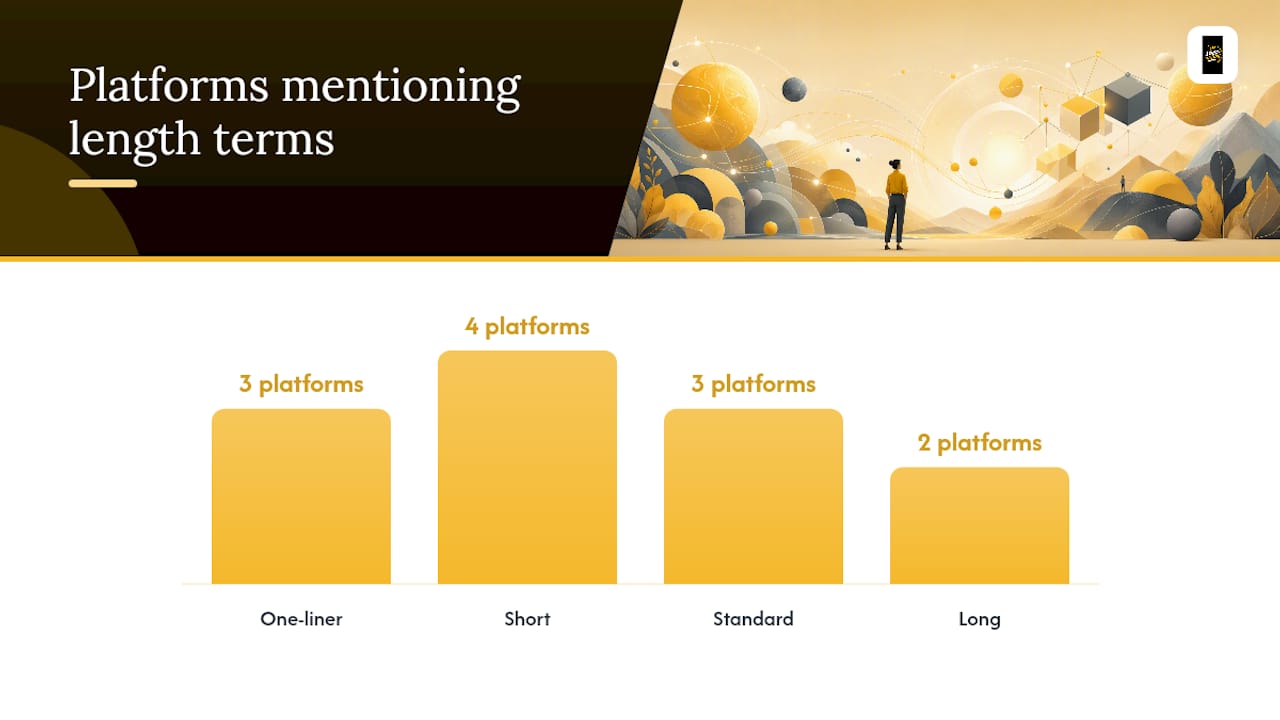
Four lengths cover almost every situation an independent artist runs into, and picking the wrong one is the fastest way to get skipped over. AMW recommends exactly two lengths for an EPK: a short version around 50 to 100 words and a long version around 250 to 400 words, which lines up closely with the four-tier system below.
| Length | Word count | Best use | Voice |
|---|---|---|---|
| One-liner | one-liner | Social bios, artist header, quick listings | Third person |
| Short | around 50 words | Bandcamp about section, ReverbNation profile | Third person |
| Standard | around 100 words | EPK short bio, festival submission forms | Third person |
| Long | 250 to 400 words | Full EPK, press release, website About page | Third or first person |
Third person is the default for press and booking contexts because it reads as something a publicist or manager wrote, which carries more weight with industry gatekeepers than self-description. First person works on personal social accounts, artist newsletters, or a website bio where you're speaking directly to fans rather than pitching a venue.
A few formatting habits separate a bio that gets read from one that gets skimmed and dropped:
- Italicize a pull quote if you're including a press line, so it visually breaks from your own narrative.
- Put booking contact info on its own line at the end, never folded into a sentence.
- Use parentheses sparingly, only for a date, city, or credit that would otherwise clutter the main sentence.
- Avoid bullet points inside the bio text itself; save bullets for the surrounding EPK or profile page, not the biography copy.
Step-by-Step Templates And Eight Editable Examples
Every long-form bio breaks into three blocks: a hook line, a credentials block, and a tonal finish. Build each block separately, then stitch them together, and you'll never stare at a blank page again.
- Write the hook line first. Name genre, location, and one emotional or sonic descriptor. ("[Genre] artist from [city] known for [specific sound trait].")
- Build the credentials block. List two to four proof points in order of impressiveness: streaming numbers, notable shows, press mentions, or sync placements.
- Add current activity. State your most recent release, tour, or project in the present tense.
- Close with a tonal finish. One sentence that hints at what's next, without overselling it.
- Append contact info. A booking email or management contact, formatted as its own line.
DIY Musician's guide for independent artists recommends naming two to four musical influences to give readers instant sonic context, and keeping the bio updated with your latest release rather than leaning on older milestones.
Here are eight short, editable examples across different project types. Swap in your own details:
- Solo singer-songwriter: "[Name] writes stripped-down folk-pop about small-town leaving, recorded mostly on a four-track in a spare bedroom in [city]."
- Indie band: "[Band name] is a four-piece from [city] blending jangly guitar and tight harmonies, drawing comparisons to early Alvvays and Camera Obscura."
- Electronic producer: "[Name] produces glitchy, bass-heavy electronic tracks that have racked up [X] streams across three self-released EPs since 2024."
- Alternative trio: "[Band name] fuses grunge-era guitar tone with modern pop structure, playing regularly across the Pacific Northwest club circuit."
- Emerging hip-hop act: "[Name] raps over lo-fi soul samples, building a following through weekly freestyle drops and a growing local mixtape series."
- Folk artist: "[Name] is a fingerstyle guitarist and vocalist whose songs draw on Appalachian tradition filtered through contemporary heartbreak."
- Experimental/electronic live act: "[Name] builds immersive, improvised electronic sets using modular synths and field recordings captured across [region]."
- Booking-focused festival-ready band: "[Band name] delivers high-energy live sets built for festival crowds, with [X] shows played across [region] in the last 12 months."
Pro Tip: Keep a running document of every stat you might use, streams, show counts, press mentions, dated the moment you learn it. Bios go stale fast, and a six-month-old number is worse than no number at all.
Sonicbids breaks down three real bios that landed press attention, and the common thread is present-tense relevance. Every example talks about what the artist is doing right now, not what they did three years ago.
A bio that only lists old achievements reads like an obituary. Keep the verbs in the present tense and the facts recent.
Before you publish anything, run a quick fact-check pass: confirm every number is current, every venue name is spelled correctly, and every credit you're claiming is one you can actually back up if someone asks.
Dos And Don'ts For A Bio That Sounds Professional
The fastest way to lose credibility with a booker is to reach for vague adjectives instead of specifics. "Passionate," "unique," and "genre-bending" show up in thousands of bios and mean nothing on their own.
- Don't open with "This artist is passionate about music." Do open with the genre, the place, and one sensory detail.
- Don't lead with a milestone from three years ago. Do lead with your most recent release or show.
- Don't inflate numbers ("millions of fans" when you mean a few thousand listeners). Do state the real figure, even if it's modest.
- Don't write a full chronological history from your first gig onward. Do pick the two or three moments that actually prove your trajectory.
- Don't bury contact info mid-paragraph. Do give it its own line at the end.
Show, don't gush. A specific detail always outperforms broad praise. Instead of "incredible live energy," write "closed out three sold-out shows at The Fixin' To this spring." That specificity is what industry readers respond to far more than adjectives ever will.
Pro Tip: Read your bio out loud. If a sentence sounds like something you'd say to impress a stranger at a party rather than something a booker would repeat in a listing, cut it.
One legal note worth keeping in mind: if you quote a journalist, blogger, or curator in your bio, make sure the quote is accurate and properly attributed, and get a quick okay from the source before using their name in promotional material, especially if you're pulling it from a private message rather than a published review.
Where To Paste Each Bio Across Platforms
Different platforms expect different lengths, and pasting your full EPK bio into a Spotify for Artists profile or an Instagram header just gets it cut off or ignored.
| Platform | Ideal length | Top formatting rule |
|---|---|---|
| EPK / press kit | Short (50 to 100) and long (250 to 400) | Include both lengths plus hi-res photos and a press quote |
| Spotify for Artists | One-liner to short | Present tense, no contact info needed |
| Bandcamp | Short to standard | Personal tone works; light first person is fine |
| SoundCloud | One-liner to short | Genre tags in the bio help discovery |
| ReverbNation | Standard | Include booking contact directly in the field |
| Instagram/Twitter | One-liner | Add a CTA or link, following standard social bio practice |
| Loca-Nation artist profile | Standard to long | Pair with genre tags and recent release for chart discovery |
For EPKs specifically, AMW's asset checklist calls for three high-resolution photos in mixed orientations, a video clip, and a music embed alongside the bio text. A professional photographer's portfolio approach is a useful reference for what "press-ready" photo quality actually looks like: sharp focus, varied orientation, and a minimum resolution around 2,000 pixels on the long edge.
A Quick Editing Checklist Before You Publish
Run through this before your bio goes anywhere public:
- Verify every date and number is current, not from an old draft.
- Test every link (streaming, contact, social) to confirm none are dead.
- Confirm photo files meet minimum resolution for press use.
- Read the first sentence alone. Does it work as a standalone hook?
- Check that contact info is visible and correctly formatted.
Once the text is clean, distribute it in order: EPK first, then your platform profiles (Spotify for Artists, Bandcamp, SoundCloud, ReverbNation, Loca-Nation), then social bios, then press outreach and venue submissions. Update the short version every time you release new music, and give the long version a full review every quarter.
- Give your bio the 30-second skimmability test: hand it to someone unfamiliar with your music and time how fast they can tell you your genre, one proof point, and how to book you.
- If they can't answer all three in half a minute, the bio needs another editing pass before it goes out.
Why These Templates Persuade Bookers, Press, And Fans
The mechanics are simple: a clear genre hook, one credible proof point, and current activity add up to usable pitch copy. Bookers want show-proof they can verify in seconds. Press wants a narrative angle plus evidence you're active right now, not two years ago. Playlist curators want almost nothing beyond a number that tells them you're worth the risk.
If a booker or journalist can't repeat your bio's opening line back to you after one read, it's not doing its job.
That single rule explains almost every mistake in this article. Vague language gets skipped because it can't be repeated or verified. Specific, current, provable details get lifted straight into listings, festival programs, and playlist pitches, which is the entire point of writing the bio in the first place.
How Often Should You Update Your Artist Bio?
Treat your bio like your setlist: it goes stale if you never touch it. A bio that still leads with a single from two years ago signals to a booker or press contact that you haven't released anything since, even if that's not true.
Update your short bio every time you drop a new single or EP. It only takes a few minutes to swap the "current release" line, and it keeps your Spotify for Artists profile and social bios accurate for anyone checking you out mid-release cycle.
Give your long-form bio a full review every three months. Recheck every number, confirm your live credentials still reflect your most impressive recent shows, and cut anything that's aged past relevance. DIY Musician's guidance on keeping bios current points to this same cycle: a narrative angle that made sense a year ago might now be buried under better, more recent proof points.
Should You Include Quotes Or Testimonials In Your Bio?
A single credible quote can do more work than three paragraphs of self-description. Sonicbids' breakdown of real press-winning bios shows that journalists respond well to a short pull quote from another outlet, a curator, or a respected voice in your genre scene, used once and italicized so it visually separates from your own narrative.
Keep it simple: pick your single strongest quote, attribute it correctly, and place it right after your hook line or inside your credentials block. Something like "one of the most promising DIY acts to come out of the Pacific Northwest this year" attributed to the actual outlet that said it works far better than three of your own adjectives strung together.
Don't fabricate or paraphrase a quote to make it sound stronger than it was. If a blog or reviewer used mild praise, use their actual words rather than inflating the sentiment, and always get a quick confirmation before using someone's name or publication in promotional material, particularly if the quote came from a direct message rather than a published piece.
First-Person Note From Loca-Nation
We built Loca-Nation because too much good, unsigned music never gets seen by the people who could actually do something with it. A polished bio isn't just copy, it's the first filter industry professionals use when they land on your profile, whether they're scouting for a sync placement or deciding who to feature in a chart spotlight.
When you publish a clear, current bio on your Loca-Nation profile, paired with genre tags and your latest release, you give our discovery system and human curators exactly what they need to place you in front of the right audience and the right industry contacts. Artists who keep their profiles updated tend to move through chart competitions with far more momentum than those who set it up once and forget it.
If you haven't touched your profile bio in a while, that's the first place to start.
How Loca-Nation Helps You Host And Promote Your Bio
Loca-Nation gives you a genuine alternative to shouting into the void on five different platforms with five different bio versions. Once your profile is live, your bio, your genre tags, and your latest release all work together inside a chart system built specifically to surface unsigned and independent acts, not bury them under major-label budgets.
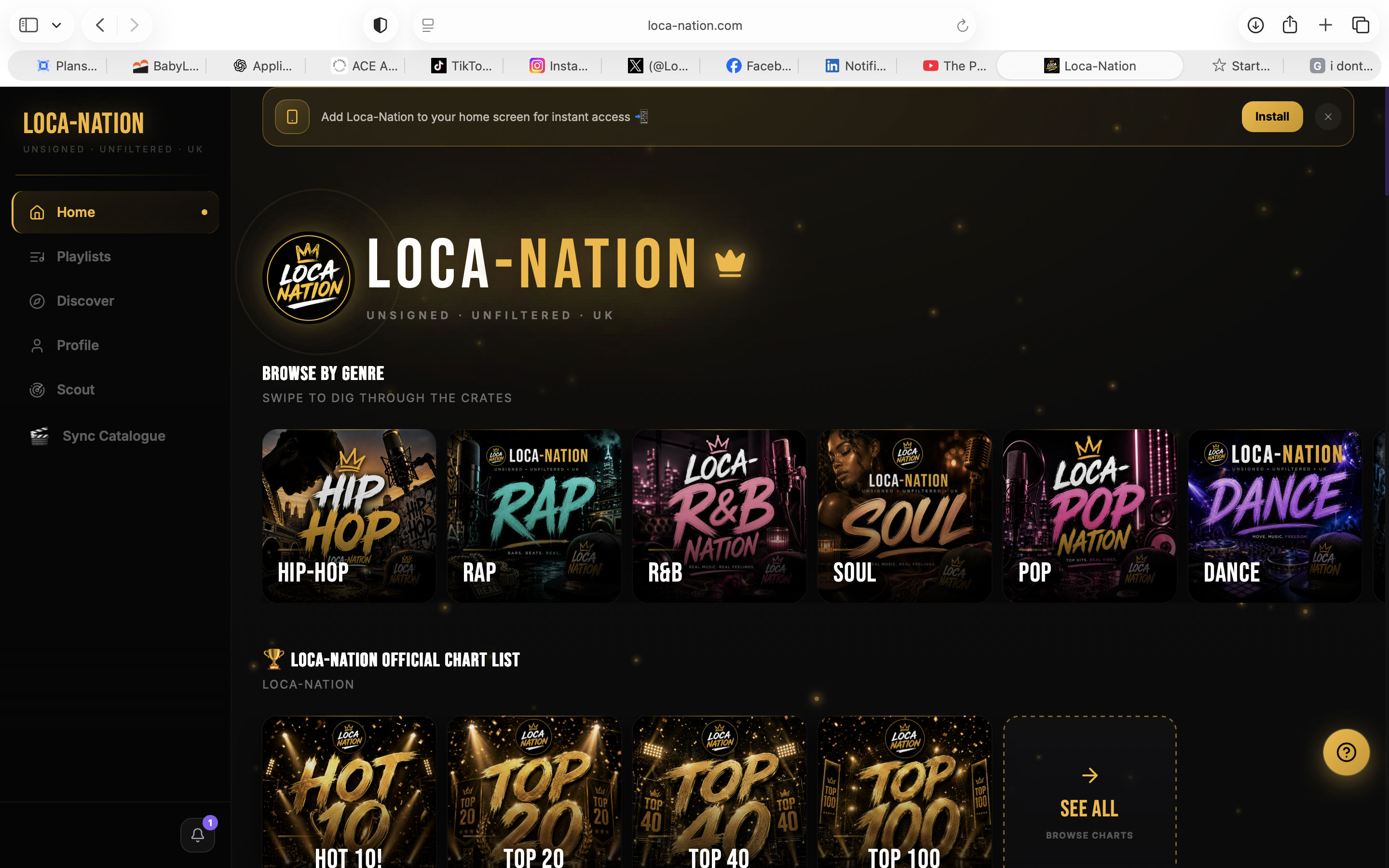
A few concrete ways it helps once your bio is in place: your profile competes in local, regional, and genre-specific charts based on real listener votes rather than ad spend; your analytics dashboard shows which proof points are actually driving engagement, so you know what to keep in your bio and what to cut; strong chart performance puts your profile in front of labels, scouts, and sync licensors browsing for talent; and the sync catalogue gives you a direct path to licensing opportunities if your bio highlights sync-friendly credits.
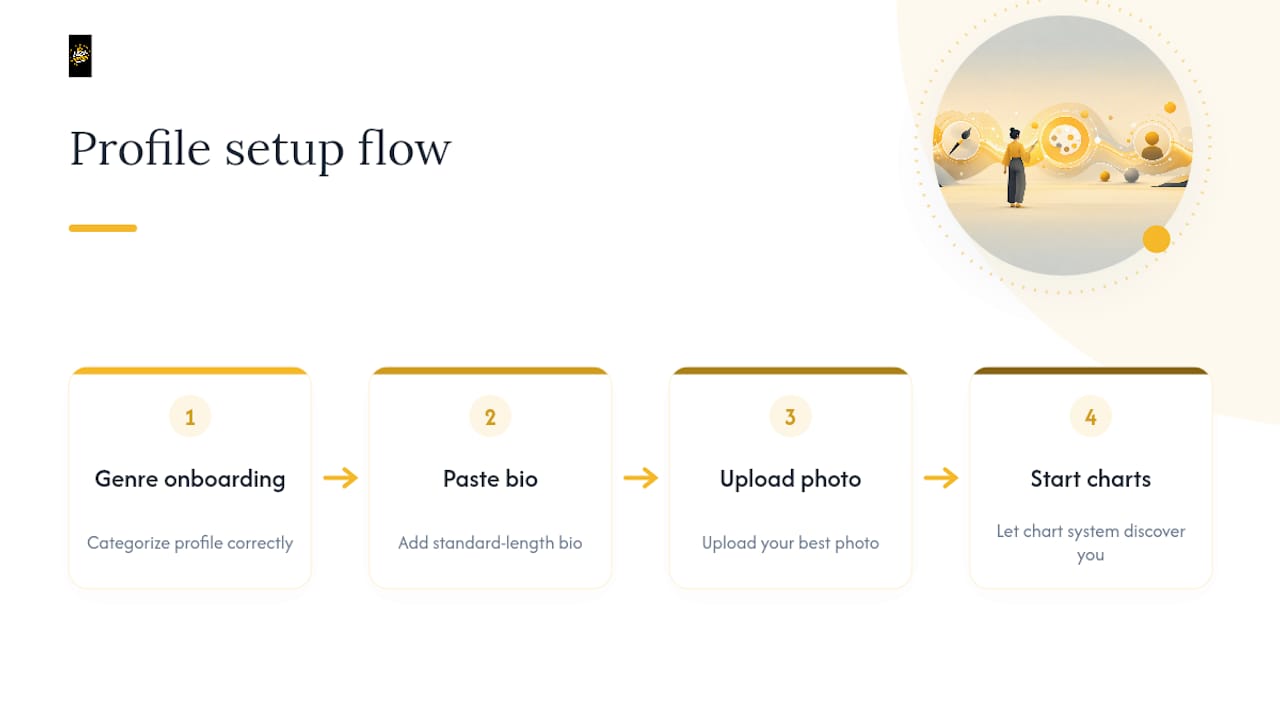
Start by heading to genre onboarding to get your profile categorized correctly, paste in your standard-length bio, upload your best photo, and let the chart system start doing the discovery work for you.
Sources
For deeper formatting guidance beyond this guide, AMW's EPK guide for musicians covers the full seven-essential asset list for press kits, and DIY Musician's artist bio walkthrough breaks down narrative structure and influence-naming in more detail. For booking-specific advice, That Eric Alper's guide is worth a full read, and Sonicbids' journalist perspective shows real bios that landed press coverage.
For platform-side resources, start with your Loca-Nation profile to host your bio and enter chart competitions, and check the press centre for additional profile and press tips. If your account has gone quiet, the reactivate feature helps you refresh a dormant profile and get back into active chart competition.
If you're still drafting your one-liner for social platforms, Presly's free bio generator is a quick way to test a few variations before settling on your final line.
- How to Write a Musician Bio That Gets You Booked - That Eric Alper
- How to write an artist bio (for independent musicians) | DIY Musician
- Ask a Music Journalist: What Makes a Compelling Band Bio? Here Are 3 Real Examples